The Weight of Righteousness: A Reflection on 2 Kings 10:9
“And it came to pass in the morning, that he went out, and stood, and said to all the people, Ye be righteous: behold, I conspired against my master, and slew him: but who slew all these?” — 2 Kings 10:9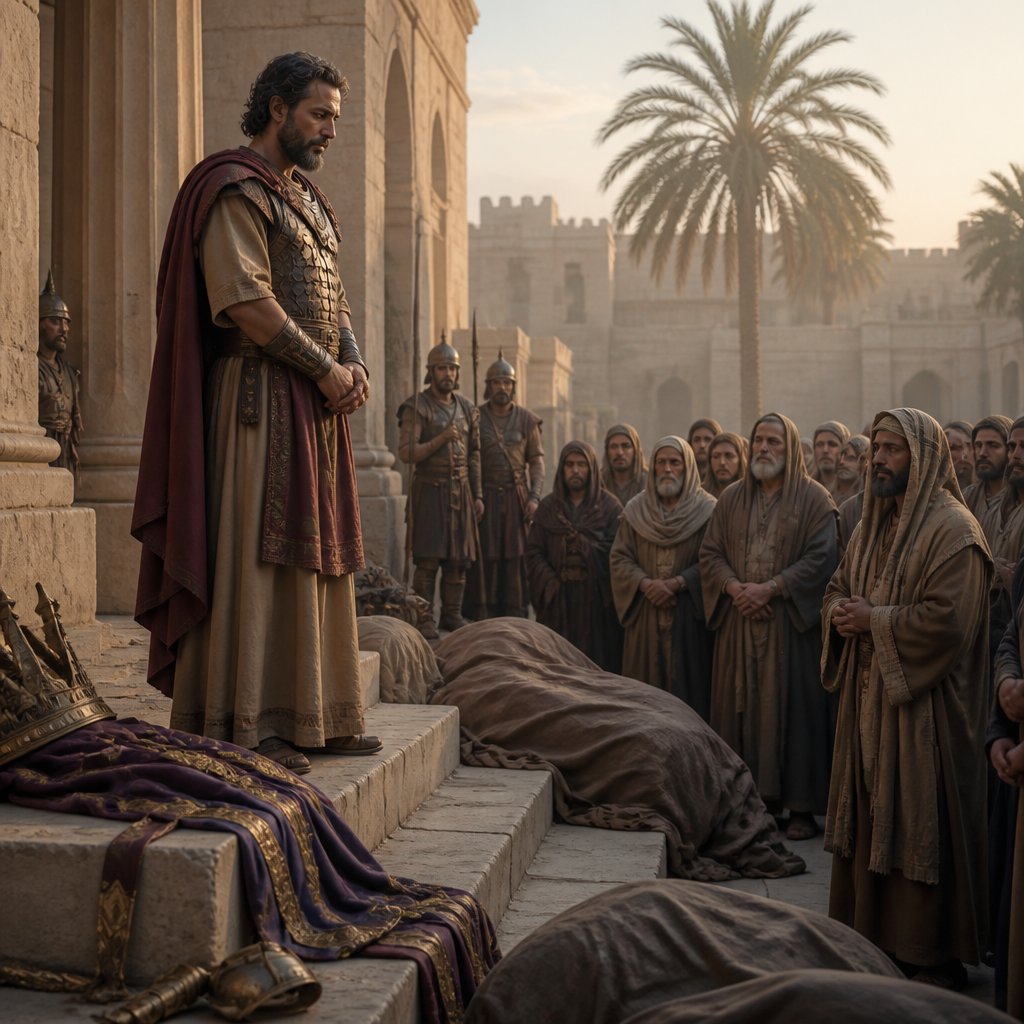
In 2 Kings 10:9, we encounter a moment that shocks the conscience. Jehu, having just enacted a bloody coup against King Joram, stands before the people and makes a stark proclamation: "Ye be righteous: behold, I conspired against my master, and slew him: but who slew all these?" (KJV). This proclamation serves not only as a confession of his actions but also as an indictment on the bloodshed surrounding the throne of Israel. The weight of righteousness encapsulated in these words invites us to examine our own hearts and motives under the light of divine scrutiny.
Jehu is a complex character in the narrative of Israel's monarchy. He was chosen by God to bring judgment upon the house of Ahab, an assignment filled with divine purpose but executed through violent means. His opening statement, "Ye be righteous," may initially sound like sarcasm. It reflects the twisted priorities of leaders who often cloak their actions in righteousness while committing acts that lead to death and destruction. In considering Jehu's declaration, we are forced to confront the relationship between righteousness, power, and accountability.
When Jehu claims cooperation with the people's sense of righteousness, he voices a significant question: "but who slew all these?" His accusation sheds light on the lingering consequences of his violence. He recognizes that his drastic actions have not been taken in isolation but have entangled the very fabric of the nation itself. This imagination of collective bloodguilt forces us to reconsider our roles within communities—where our decisions, although perhaps well-intentioned, may lead to collateral harm. In a world teeming with conflict and division, this serves as a sobering reminder of the perils of assuming righteousness without seeking justice or considering the ramifications of our actions.
This passage obliges us to reflect on our personal lives and the broader society. In what ways do we conspire against our spiritual authorities or leaders, even if they have led us astray? What might our actions say about our understanding of righteousness? As believers, it is easy to justify our anger and rebellion against those we perceive as corrupt, failing to recognize our call to gentle restoration and redemption. Jehu's rebellion might have seemed justified, yet, as the slaughter escalated, so did the destruction of innocent lives and the integrity of the nation.
As we meditate on this verse, we must ask ourselves: Are we truly pursuing righteousness, or are we merely cloaking our ambitions and grievances under the veil of righteous indignation? Are our actions aligned with God’s righteousness as outlined in the Scriptures? Jesus taught us that our righteousness must exceed that of the Pharisees; it must be rooted in love, humility, and truth (Matthew 5:20). Jehu’s rash actions remind us of the consequences when we elevate our desires above God’s will, as well as the profound importance of accountability in our spiritual walks.
Moreover, the crux of Jehu's dilemma signals a prophetic shadow pointing toward Christ, the ultimate Righteous King who confronts sin not through the sword but through sacrifice. Unlike Jehu, who incited fear and death, Jesus invites us into His fellowship through mercy and love. He lays down His life not just for the righteous but even for the unrighteous, as Paul notes: "For when we were yet without strength, in due time Christ died for the ungodly" (Romans 5:6, KJV).
May we, therefore, be guided by the humility of Christ as we seek to embody true righteousness in our lives. Let us shed the weight of performance and embrace the grace that leads to genuine repentance and a heartfelt desire for justice, mercy, and reconciliation with one another. Each day provides us with a choice: to act in ways that magnify Christ's love or to embrace a path paved with anger and division. Let us choose wisely, grounded in the truth that righteous living is birthed from the heart transformed by God.
Get our apps


Artwork for 2 Kings 10:9

2 Kings 10:9 - "And it came to pass in the morning, that he went out, and stood, and said to all the people, Ye be righteous: behold, I conspired against my master, and slew him: but who slew all these?"
"And it came to pass in the morning, that he went out, and stood, and said to all the people, Ye be righteous: behold, I conspired against my master, and slew him: but who slew all these?" - 2 Kings 10:9

2 Kings 9:10 - "And the dogs shall eat Jezebel in the portion of Jezreel, and there shall be none to bury her. And he opened the door, and fled."

2 kings 9:34-36

2 Kings 3:10 - "And the king of Israel said, Alas! that the LORD hath called these three kings together, to deliver them into the hand of Moab!"

1 Kings 10:9 - "Blessed be the LORD thy God, which delighted in thee, to set thee on the throne of Israel: because the LORD loved Israel for ever, therefore made he thee king, to do judgment and justice."

Titus 2:9-10

Titus 2:9-10

1 Kings 9:10 - "¶ And it came to pass at the end of twenty years, when Solomon had built the two houses, the house of the LORD, and the king's house,"

2 Kings 10:28 - "Thus Jehu destroyed Baal out of Israel."

Joshua 9:10 - "And all that he did to the two kings of the Amorites, that were beyond Jordan, to Sihon king of Heshbon, and to Og king of Bashan, which was at Ashtaroth."

"And the dogs shall eat Jezebel in the portion of Jezreel, and there shall be none to bury her. And he opened the door, and fled." - 2 Kings 9:10

2 Chronicles 9:22 - "And king Solomon passed all the kings of the earth in riches and wisdom."

2 Kings 21:10 - "¶ And the LORD spake by his servants the prophets, saying,"

2 Kings 10:4 - "But they were exceedingly afraid, and said, Behold, two kings stood not before him: how then shall we stand?"

2 Kings 9:9 - "And I will make the house of Ahab like the house of Jeroboam the son of Nebat, and like the house of Baasha the son of Ahijah:"

2 Kings 10:34 - "Now the rest of the acts of Jehu, and all that he did, and all his might, are they not written in the book of the chronicles of the kings of Israel?"

2 Kings 10:20 - "And Jehu said, Proclaim a solemn assembly for Baal. And they proclaimed it."
2 Corinthians 12:9-10

"Thus Jehu destroyed Baal out of Israel." - 2 Kings 10:28

1 Kings 2:10 - "So David slept with his fathers, and was buried in the city of David."

2 Kings 10:26 - "And they brought forth the images out of the house of Baal, and burned them."

2 Kings 10:12 - "¶ And he arose and departed, and came to Samaria. And as he was at the shearing house in the way,"

Psalms 2:10 - "Be wise now therefore, O ye kings: be instructed, ye judges of the earth."

2 Kings 10:36 - "And the time that Jehu reigned over Israel in Samaria was twenty and eight years."

2 Kings 24:10 - "¶ At that time the servants of Nebuchadnezzar king of Babylon came up against Jerusalem, and the city was besieged."

2 Kings 9:4 - "¶ So the young man, even the young man the prophet, went to Ramoth-gilead."

2 Kings 9:23 - "And Joram turned his hands, and fled, and said to Ahaziah, There is treachery, O Ahaziah."

2 Kings 9:29 - "And in the eleventh year of Joram the son of Ahab began Ahaziah to reign over Judah."

2 Corinthians 10:9 - "That I may not seem as if I would terrify you by letters."