The Fragility of False Security: A Devotional on 2 Kings 19:37
“And it came to pass, as he was worshipping in the house of Nisroch his god, that Adrammelech and Sharezer his sons smote him with the sword: and they escaped into the land of Armenia. And Esar-haddon his son reigned in his stead.” — 2 Kings 19:37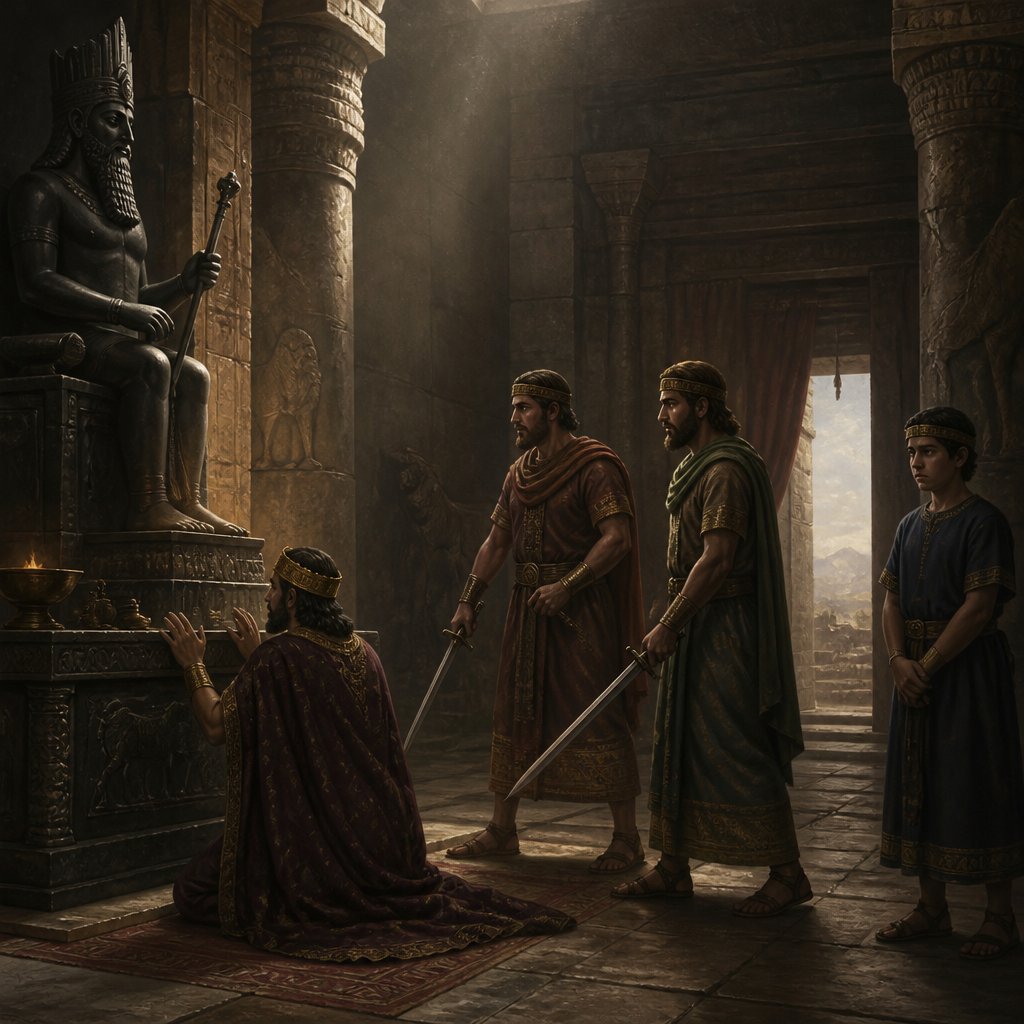
In the unfolding drama of human experience, few themes resonate as deeply as the search for security and safety. The narrative found in 2 Kings 19:37 provides a somber reminder of the transient nature of worldly power and the futility of placing confidence in false gods. The verse states, "And it came to pass, as he was worshipping in the house of Nisroch his god, that Adrammelech and Sharezer his sons smote him with the sword: and they escaped into the land of Armenia. And Esar-haddon his son reigned in his stead."
Here, we find ourselves at the end of King Sennacherib’s tumultuous reign. He is depicted worshipping in the temple of Nisroch, a deity of Assyrian culture, seeking solace and strength from an idol crafted by human hands. Yet, in this very act of false worship, Sennacherib’s vulnerability is laid bare. Instead of drawing near to the true God of Israel, he places his hope in a lifeless idol, revealing a deep spiritual and moral decay.
In our contemporary world, we often mirror Sennacherib’s actions, giving ourselves to various "gods" that symbolize security in our lives: success, wealth, relationships, or even self-esteem. We pour our energy into the pursuit of these idols, believing they will provide us with fulfillment and lasting safety. Yet, as the story unfolds, we witness the tragic consequences of such misplaced faith.
Sennacherib's worship in the temple of Nisroch sets the stage for his downfall, a stark reminder that while he sought refuge in a false god, the very sons he fathered turned against him in a moment of betrayal. There’s an uncomfortable reality in this betrayal—as he worshipped, violence was brewing at home. Those we love can turn against us, and our safety can dissipate in an instant. In contrast, the worship of the living God offers a steadfast foundation.
The physical realm appears secure while engaging in the worship of uncomfortable realities. However, true security cannot and does not come from what is physically present or the idols we've erected. It arises from a covenant relationship with the Almighty—the one true God who sovereignly reigns over all circumstances. In this verse, God’s sovereignty is evident, even as Sennacherib places his faith elsewhere.
As we reflect upon our own lives, we must ponder the gods we have constructed. Are we spending our worship on things that are but shadows? In times of trouble, such as when we face personal upheavals or societal crises, where do we turn? Is our foundation built on the sand, or do we anchor ourselves in Christ—our rock, and redeemer?
Moreover, the story ends with a transition of power, reinforcing that the machinations of man are ultimately at the mercy of God's divine plan. The rise of Esar-haddon, Sennacherib’s son, stands in stark contrast to the unpredictable volatility of trust in false gods. God’s will cannot be thwarted by human rebellion or the fleeting aspirations of worldly attempts at power. His plan prevails regardless of our human experience.
As we worship today, let's ask ourselves some hard questions: Are we fully relying on the Lord as our fortress? Are we entrusting our concerns and fears into His capable hands? True security is not found in the temporary or the tangible; it resides in the authentic relationship with Christ, who invites us to lean on Him in every circumstance.
Let us pray for discernment to identify the idols in our lives; may we courageously dismantle them, turning instead to worship the true God. Let us remember, as articulated in 2 Kings 19:37, that those who put their trust in false gods are left only vulnerable and exposed. May we choose to abide in the shadow of the Almighty, where our true refuge lies.
Get our apps


Artwork for 2 Kings 19:37

2 Kings 19:37 - "And it came to pass, as he was worshipping in the house of Nisroch his god, that Adrammelech and Sharezer his sons smote him with the sword: and they escaped into the land of Armenia. And Esar-haddon his son reigned in his stead."
"And it came to pass, as he was worshipping in the house of Nisroch his god, that Adrammelech and Sharezer his sons smote him with the sword: and they escaped into the land of Armenia. And Esar-haddon his son reigned in his stead." - 2 Kings 19:37

2 Kings 19:2

2 Kings 19:2

2 Kings 19:2

2 Kings 15:37 - "In those days the LORD began to send against Judah Rezin the king of Syria, and Pekah the son of Remaliah."

Daniel 2:37 - "Thou, O king, art a king of kings: for the God of heaven hath given thee a kingdom, power, and strength, and glory."

2 Kings 19:17 - "Of a truth, LORD, the kings of Assyria have destroyed the nations and their lands,"

2 Kings 23:37 - "And he did that which was evil in the sight of the LORD, according to all that his fathers had done."

2 Kings 9:37 - "And the carcase of Jezebel shall be as dung upon the face of the field in the portion of Jezreel; so that they shall not say, This is Jezebel."

2 Kings 4:37 - "Then she went in, and fell at his feet, and bowed herself to the ground, and took up her son, and went out."

2 Kings 12:19 - "¶ And the rest of the acts of Joash, and all that he did, are they not written in the book of the chronicles of the kings of Judah?"

2 Kings 3:16-19

2 Kings 16:19 - "¶ Now the rest of the acts of Ahaz which he did, are they not written in the book of the chronicles of the kings of Judah?"

2 Kings 19:5 - "So the servants of king Hezekiah came to Isaiah."

Genesis 19-37

2 Kings 17:37 - "And the statutes, and the ordinances, and the law, and the commandment, which he wrote for you, ye shall observe to do for evermore; and ye shall not fear other gods."

2 Kings 19:36 - "So Sennacherib king of Assyria departed, and went and returned, and dwelt at Nineveh."

2 Kings 19:13 - "Where is the king of Hamath, and the king of Arpad, and the king of the city of Sepharvaim, of Hena, and Ivah?"

2 Kings 18:37 - "Then came Eliakim the son of Hilkiah, which was over the household, and Shebna the scribe, and Joah the son of Asaph the recorder, to Hezekiah with their clothes rent, and told him the words of Rabshakeh."

Joshua 19:37 - "And Kedesh, and Edrei, and En-hazor,"

2 Kings 19:11 - "Behold, thou hast heard what the kings of Assyria have done to all lands, by destroying them utterly: and shalt thou be delivered?"

2 Kings 19:2 - "And he sent Eliakim, which was over the household, and Shebna the scribe, and the elders of the priests, covered with sackcloth, to Isaiah the prophet the son of Amoz."

2 Kings 19:34 - "For I will defend this city, to save it, for mine own sake, and for my servant David's sake."

"Of a truth, LORD, the kings of Assyria have destroyed the nations and their lands," - 2 Kings 19:17

2 Kings 24:19 - "And he did that which was evil in the sight of the LORD, according to all that Jehoiakim had done."

2 Kings 17:19 - "Also Judah kept not the commandments of the LORD their God, but walked in the statutes of Israel which they made."

Genesis 37:19 - "And they said one to another, Behold, this dreamer cometh."

1 Kings 2:37 - "For it shall be, that on the day thou goest out, and passest over the brook Kidron, thou shalt know for certain that thou shalt surely die: thy blood shall be upon thine own head."

2 Kings 19:33 - "By the way that he came, by the same shall he return, and shall not come into this city, saith the LORD."