The Weight of Surrender: Learning from Jehoiachin's Captivity
“And Jehoiachin the king of Judah went out to the king of Babylon, he, and his mother, and his servants, and his princes, and his officers: and the king of Babylon took him in the eighth year of his reign.” — 2 Kings 24:12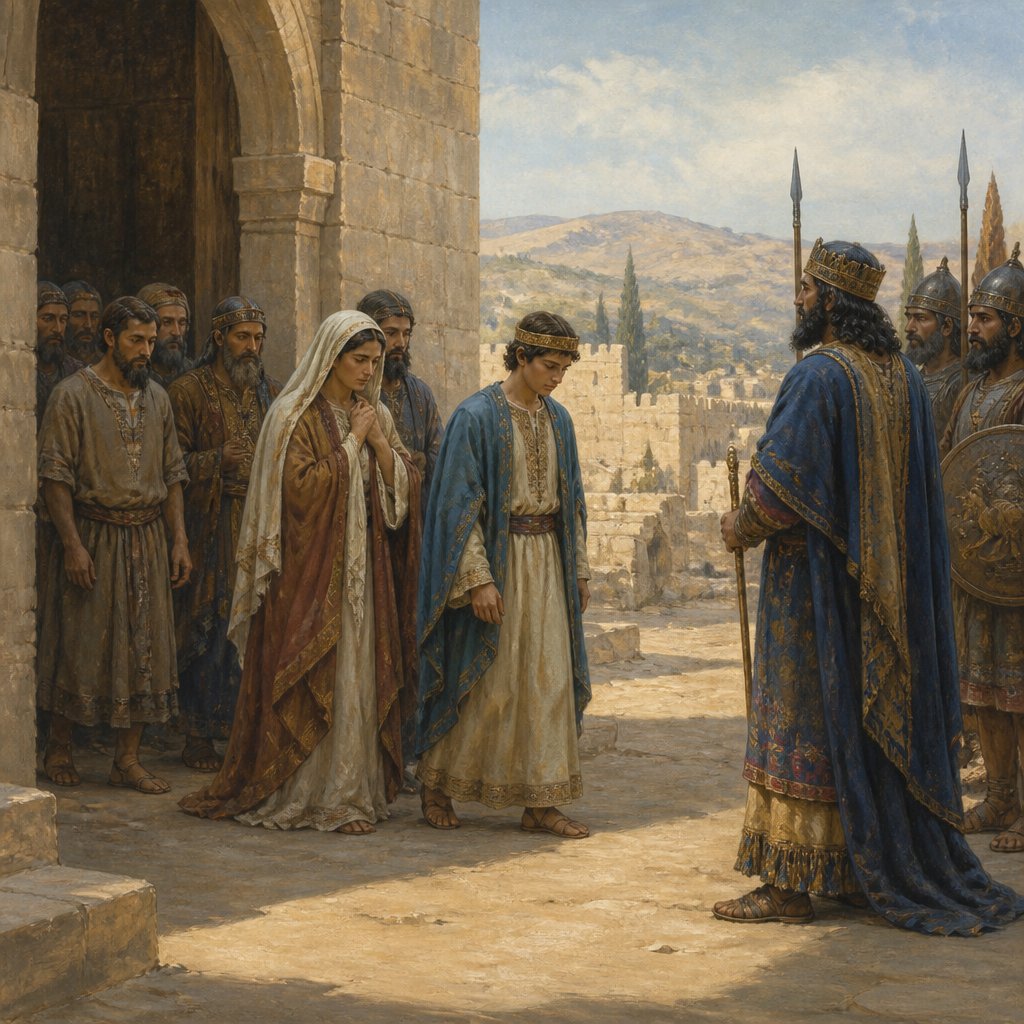
In 2 Kings 24:12, we read, "And Jehoiachin the king of Judah went out to the king of Babylon, he, and his mother, and his servants, and his princes, and his officers: and the king of Babylon took him in the eighth year of his reign." This verse marks a pivotal moment not just in the life of Jehoiachin, but in the history of Judah, leading to the eventual exile of God’s people.
To grasp the significance of this passage, we must understand the gravity of Jehoiachin’s situation. At just eighteen years old, he ascended to the throne following the reign of his father, King Jehoiakim. But his reign was tragically short, lasting only three months before facing the might of Babylonian power. When we reflect on his brief reign, we see a young leader thrust into turmoil—one who had inherited a divided kingdom fraught with sin and rebellion against God. His circumstances were not of his crafting; he was a product of a nation that repeatedly turned its back on the covenant made with the Lord.
As Jehoiachin prepared to surrender to Nebuchadnezzar in the eighth year of his reign, we can imagine the weight of that moment—the weight of disappointment, fear, and hopelessness. Imagine leaving your throne, your power, and your capital to bow to a foreign king. This moment encapsulates the human spirit's response to overwhelming circumstances. Jehoiachin’s act of surrender can serve as a mirror reflecting our own lives. How often do we face situations that seem beyond our control or understanding? How often do we wrestle with the need to let go and yield to something greater than ourselves?
Surrendering is not an act of weakness; it can often be the most courageous thing one does. Jehoiachin's decision to go out to Babylon is an illustration of acceptance—the acceptance that sometimes, despite our best efforts and our deepest desires, we find ourselves in circumstances we cannot change.
In our spiritual walk, moments of surrender are crucial. We must realize that surrendering to God might not mean the ceasing of our struggles, but rather the beginning of a new chapter in trusting His sovereign plan. Jehoiachin’s journey did not end with his surrender; it was, in many ways, the start of a different kind of reign. Captivity in Babylon forced him to rely on God in ways he never imagined, and while it may seem like a humiliating defeat, it provided him with an opportunity for spiritual transformation and reflection.
God, in His infinite wisdom, often allows us to face trials not as punishment but as preparation for a greater purpose. Jehoiachin later emerges from captivity, gaining favor with the king of Babylon, which indicates that God's hand is not cut off from our lives, even in our lowest moments.
As we reflect on this passage, it draws us to a deeper understanding of absolute trust in God’s plan. Jeremiah, the prophet, spoke of the coming exile, warning the people of Judah about the consequences of their actions, yet also instilled hope for restoration (Jeremiah 29:11). The discipline of the Lord often operates in tandem with His promise of redemption. Jehoiachin may have faced captivity in Babylon, but there remained a thread of hope—a belief that God has not abandoned His people and indeed has a future for them.
When we face our Babylon, whether it is a mental health crisis, a financial struggle, or a broken relationship, we can take heart in knowing that God is still present. He uses our seasons of surrender to mold us, to refine our faith, and to prepare us for His purpose. Like Jehoiachin, we may surrender our current circumstances, but we must also anticipate God's ability to restore and redeem. Let us learn from Jehoiachin—through every bowing of head in surrender, there is also an opportunity to gaze upward in faith.
In closing, reflect on what areas of your life God is asking you to surrender. What Babylonian captivity are you facing? Embrace the process of letting go, knowing that in every act of surrender, there lies the potential for newfound strength and unshakeable faith in the God who is still in control.
Get our apps


Artwork for 2 Kings 24:12

2 Kings 24:12 - "And Jehoiachin the king of Judah went out to the king of Babylon, he, and his mother, and his servants, and his princes, and his officers: and the king of Babylon took him in the eighth year of his reign."
"And Jehoiachin the king of Judah went out to the king of Babylon, he, and his mother, and his servants, and his princes, and his officers: and the king of Babylon took him in the eighth year of his reign." - 2 Kings 24:12

Joshua 12:24 - "The king of Tirzah, one: all the kings thirty and one."

James 1:2-4

2 kings 6:24

James 1: 2-4

Joel 1:2-4, 13-20

2 Kings 24:5 - "¶ Now the rest of the acts of Jehoiakim, and all that he did, are they not written in the book of the chronicles of the kings of Judah?"

"The king of Tirzah, one: all the kings thirty and one." - Joshua 12:24

2 Kings 24:10 - "¶ At that time the servants of Nebuchadnezzar king of Babylon came up against Jerusalem, and the city was besieged."

2 Kings 24:11 - "And Nebuchadnezzar king of Babylon came against the city, and his servants did besiege it."

2 Kings 12:19 - "¶ And the rest of the acts of Joash, and all that he did, are they not written in the book of the chronicles of the kings of Judah?"

2 Kings 24:6 - "So Jehoiakim slept with his fathers: and Jehoiachin his son reigned in his stead."

2 Kings 24:1 - "In his days Nebuchadnezzar king of Babylon came up, and Jehoiakim became his servant three years: then he turned and rebelled against him."

2 Kings 13:24 - "So Hazael king of Syria died; and Ben-hadad his son reigned in his stead."

2 Kings 24:9 - "And he did that which was evil in the sight of the LORD, according to all that his father had done."

2 Kings 24:19 - "And he did that which was evil in the sight of the LORD, according to all that Jehoiakim had done."

2 Kings 12:14 - "But they gave that to the workmen, and repaired therewith the house of the LORD."

Joshua 24:12 - "And I sent the hornet before you, which drave them out from before you, even the two kings of the Amorites; but not with thy sword, nor with thy bow."

2 Kings 24:17 - "¶ And the king of Babylon made Mattaniah his father's brother king in his stead, and changed his name to Zedekiah."

2 Kings 25:12 - "But the captain of the guard left of the poor of the land to be vinedressers and husbandmen."

Joshua 24:12 KJV (12) And I sent the hornet before you, which drave them out from before you, even the two kings of the Amorites; but not with thy sword, nor with thy bow.

2 Kings 6:24 - "¶ And it came to pass after this, that Ben-hadad king of Syria gathered all his host, and went up, and besieged Samaria."

2 Kings 12:16 - "The trespass money and sin money was not brought into the house of the LORD: it was the priests'."

Joshua 24:12 KJV (12) And I sent the hornet before you, which drave them out from before you, even the two kings of the Amorites; but not with thy sword, nor with thy bow.

2 Kings 12:12 - "And to masons, and hewers of stone, and to buy timber and hewed stone to repair the breaches of the house of the LORD, and for all that was laid out for the house to repair it."

2 Kings 24:4 - "And also for the innocent blood that he shed: for he filled Jerusalem with innocent blood; which the LORD would not pardon."

2 Kings 12:2 - "And Jehoash did that which was right in the sight of the LORD all his days wherein Jehoiada the priest instructed him."

2 Kings 10:12 - "¶ And he arose and departed, and came to Samaria. And as he was at the shearing house in the way,"

2 Kings 13:12 - "And the rest of the acts of Joash, and all that he did, and his might wherewith he fought against Amaziah king of Judah, are they not written in the book of the chronicles of the kings of Israel?"