The Overflow of Faith: Empty Vessels and Abundant Blessings
“Then he said, Go, borrow thee vessels abroad of all thy neighbours, even empty vessels; borrow not a few.” — 2 Kings 4:3
In 2 Kings 4:3, we encounter the compelling instruction of the prophet Elisha: "Then he said, Go, borrow thee vessels abroad of all thy neighbours, even empty vessels; borrow not a few." This verse serves as a powerful metaphor for faith, providence, and God’s abundant supply in our lives.
To fully appreciate this directive, we must first understand the context in which it is given. The widow of a prophet finds herself in desperate need; she has lost her husband, and her creditors are coming to reclaim her sons as payment for the debt left behind. In her moment of despair, she turns to Elisha for help, and he responds not with immediate relief, but with an unusual task. He instructs her to gather empty vessels from her neighbors.
Why empty vessels? Empty vessels symbolize potential and readiness to receive. The absence of contents in these vessels signifies a state of expectation. The act of gathering these vessels is akin to preparing one's heart for God’s blessings. It invites us to consider: What empty vessels do we have in our own lives? Are we positioned to receive what God wants to pour into us?
The specificity of Elisha’s command—"borrow not a few"—is equally significant. The widow’s faith is being tested, and she is encouraged to believe God for something far beyond her current circumstances. In the same way, God often calls us to step out of our comfort zones and to stretch our faith. He prompts us to broaden our expectations. When was the last time we asked God for more than we thought possible? This kind of faith requires a willingness to be vulnerable and to believe that we serve a God of abundance.
As the widow goes about gathering her vessels, it acts as a reminder of the communal nature of our blessings. She is instructed to involve her neighbors, which implies that God’s provision often involves the participation of others. In a culture that increasingly celebrates independence and self-sufficiency, this biblical narrative illustrates the importance of community, and how our blessings can extend beyond our own needs to bless those around us.
Then, Elisha tells her to take the gathered vessels inside her home, shutting the door behind her. This act of solitude emphasizes a private relationship with God. As she begins pouring out the little oil she has into the vessels, the miracle commences. Her obedience in pouring, without knowing how long it will last, demonstrates faith in action. Each empty vessel she fills symbolizes not only physical nourishment, but also how God can fill our spiritual emptiness. When we give God our perceived limitations, He can transform, multiply, and use them for His glory.
Eventually, the widow finds that her supply of oil continues until there are no more vessels to fill. In that moment, God’s provision exceeds her expectations. This narrative highlights an essential principle: God’s resources are not limited by our needs but are proportional to our willingness to believe and to act. In the face of struggles, we can remain hopeful that God has the power to provide for our every need abundantly.
In contemplating 2 Kings 4:3, let us ask ourselves moving questions: What areas of our lives feel empty? What vessels can we present to God today? Do we truly believe that He can fill us beyond measure? God encourages us to come boldly with our emptiness, and He promises that when we do, He will respond with overwhelming grace and abundance.
May we, like the widow, have the courage to gather our empty vessels and place them before Him, trusting in His faithfulness to fill, overflow, and bless not only us but those around us. Let us be reminded that in our emptiness, God is at work, awaiting our willingness to surrender so that He may alight us with His glorious supply.
Get our apps


Artwork for 2 Kings 4:3

2 Kings 4:3 - "Then he said, Go, borrow thee vessels abroad of all thy neighbours, even empty vessels; borrow not a few."

"Then he said, Go, borrow thee vessels abroad of all thy neighbours, even empty vessels; borrow not a few." - 2 Kings 4:3

2 Kings 3:4 - "¶ And Mesha king of Moab was a sheepmaster, and rendered unto the king of Israel an hundred thousand lambs, and an hundred thousand rams, with the wool."

1 Kings 4:3 - "Elihoreph and Ahiah, the sons of Shisha, scribes; Jehoshaphat the son of Ahilud, the recorder."

2 Kings 4:4-5

2 Kings 3:15

2 Kings 3:15

"Elihoreph and Ahiah, the sons of Shisha, scribes; Jehoshaphat the son of Ahilud, the recorder." - 1 Kings 4:3

2 Kings 3:15

2 Kings 3:16-19

2 Kings 3:10 - "And the king of Israel said, Alas! that the LORD hath called these three kings together, to deliver them into the hand of Moab!"

2 Kings 3:23 - "And they said, This is blood: the kings are surely slain, and they have smitten one another: now therefore, Moab, to the spoil."

2 Kings 10:4 - "But they were exceedingly afraid, and said, Behold, two kings stood not before him: how then shall we stand?"
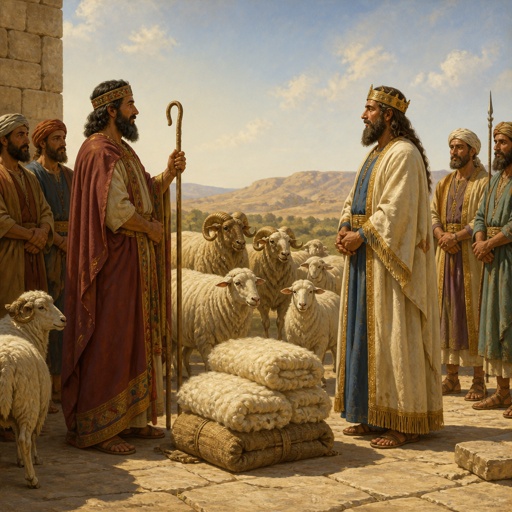
"¶ And Mesha king of Moab was a sheepmaster, and rendered unto the king of Israel an hundred thousand lambs, and an hundred thousand rams, with the wool." - 2 Kings 3:4

1 Kings 3:4 - "And the king went to Gibeon to sacrifice there; for that was the great high place: a thousand burnt offerings did Solomon offer upon that altar."

Matthew 2:3-4

Matthew 2:3-4

Matthew 2:3-4

Matthew 2:3-4

2 Kings 3:3 - "Nevertheless he cleaved unto the sins of Jeroboam the son of Nebat, which made Israel to sin; he departed not therefrom."

2 Kings 3:6 - "¶ And king Jehoram went out of Samaria the same time, and numbered all Israel."

2 Kings 3:5 - "But it came to pass, when Ahab was dead, that the king of Moab rebelled against the king of Israel."

2 Kings 4:11 - "And it fell on a day, that he came thither, and he turned into the chamber, and lay there."

2 Kings 3:16 - "And he said, Thus saith the LORD, Make this valley full of ditches."

1 Kings 4:2 - "And these were the princes which he had; Azariah the son of Zadok the priest,"

2 Kings 9:4 - "¶ So the young man, even the young man the prophet, went to Ramoth-gilead."

2 Kings 6:4 - "So he went with them. And when they came to Jordan, they cut down wood."

2 Corinthians 1:3-4

2 Kings 3:18 - "And this is but a light thing in the sight of the LORD: he will deliver the Moabites also into your hand."

2 Kings 25:3 - "And on the ninth day of the fourth month the famine prevailed in the city, and there was no bread for the people of the land."