Abundance in the Little: Trusting God's Provision
“And Elisha said unto her, What shall I do for thee? tell me, what hast thou in the house? And she said, Thine handmaid hath not any thing in the house, save a pot of oil.” — 2 Kings 4:2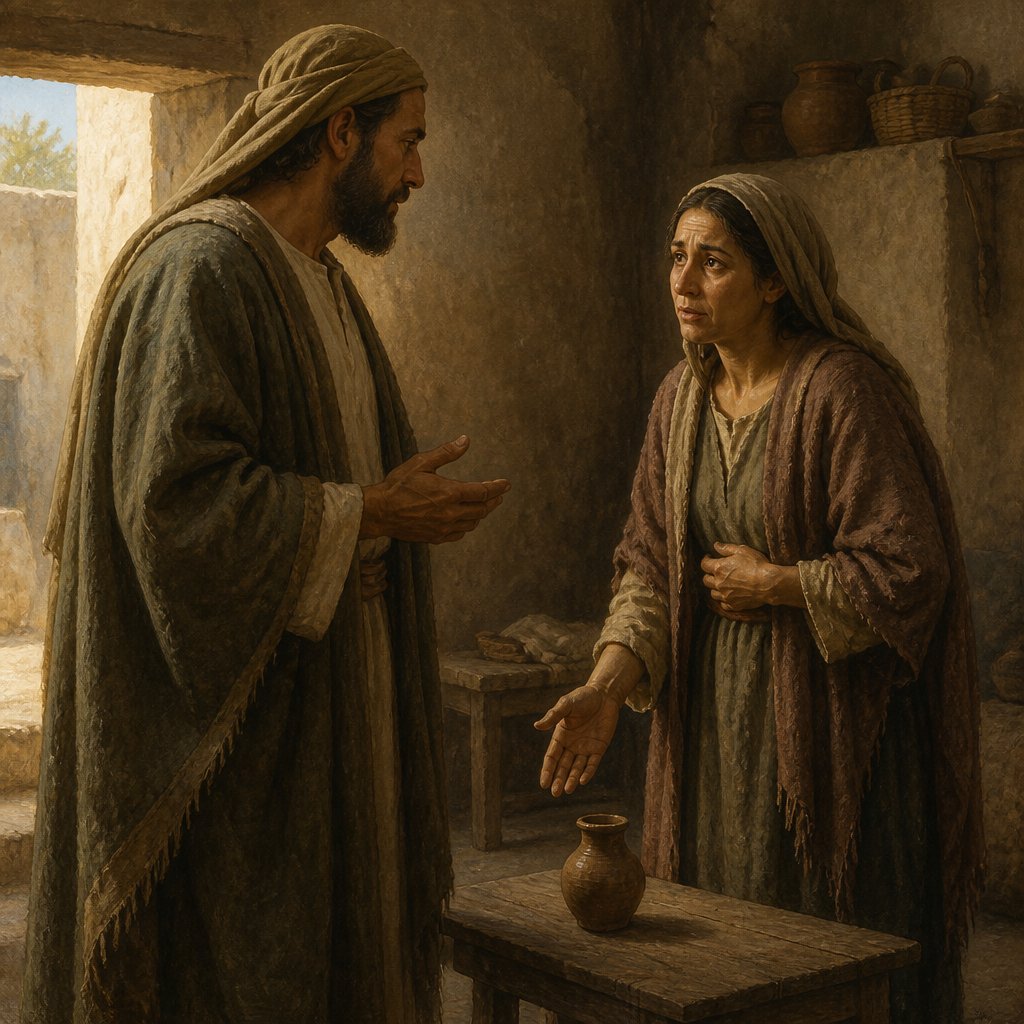
The story encapsulated in 2 Kings 4:2 reveals profound truths about God's provision and the posture of our hearts in times of need. The verse states, "And Elisha said unto her, What shall I do for thee? tell me, what hast thou in the house? And she said, Thine handmaid hath not any thing in the house, save a pot of oil." This seemingly simple exchange between Elisha and the widow reveals the intricate dance of faith, need, and divine provision.
Upon first reading, we encounter a widow who is in utter despair. She is in a position of dire need; her husband has died, leaving her with debts that threaten her very livelihood as creditors are coming to take her children as surety. In her moment of desperation, she turns to Elisha, a prophet of God, in search of help. Her answer to Elisha's probing question about what she has in her house is striking: "Thine handmaid hath not any thing in the house, save a pot of oil."
It's important to focus on the widow's response. What resonates deeply is the word "save"—she acknowledges that she possesses oil, yet in her eyes, it is insignificant. This reaction is not uncommon among us; we often underestimate the small resources we have, especially when faced with overwhelming obstacles. We see our limitations and deficits instead of recognizing that within those very limitations lies an opportunity for God’s miraculous intervention.
In essence, this widow, representing many of us, believes that her needs far outweigh her assets. However, Elisha gently redirects her attention away from her poverty and towards what she does possess, however meager it might seem. It is both a challenge and an invitation to examine our lives: What do we have? What has God placed in our hands, however small or insignificant it may seem?
This passage teaches us that God often works through what we deem as insufficient. The “pot of oil” symbolizes hope; it is the raw material that God will use to turn around the widow's circumstances. The story continues as God instructs her to gather vessels from her neighbors. In faith, she obeys, pouring out her meager oil into every vessel she collected until every one was filled. The miracle manifested not in the abundance of resources present, but in the act of faith—the willingness to use the little she had for the glory of God.
Elisha's question, "What shall I do for thee?" also encourages us to articulate our needs before God. Too often, we remain silent, either out of shame or the belief that we must prove our self-sufficiency. But God desires dialogue, and He invites us to bring our requests before Him, as we are reminded in Philippians 4:6, "Be careful for nothing; but in every thing by prayer and supplication with thanksgiving let your requests be made known unto God."
The widow's encounter with Elisha showcases the principle that God is a provider who seeks to bless us through our obedience and faithfulness. When we surrender our little—our talents, our time, our resources—everything is subject to God’s unlimited capacity to multiply and expand it for His purpose.
Consider the various “pots of oil” in your own life. Is it a talent, a network, a small piece of furniture you can share, or even a simple act of kindness? The world often trains us to look for big, flashy solutions, but God thrives in the quiet spaces and the small miracles that often go unnoticed.
Ultimately, what we learn from the widow’s story is that in our moments of utmost need, we are called to recognize God’s presence and provision through faith. When we dare to ask God what He can do in our lives, we position ourselves for His abundant blessing. Let us carry with us the truth that even in our "nothingness," God can create miracles from the little we offer Him. May we also have the faith to say, "I have a pot of oil," believing that it is more than enough for God to provide just what we need.
Get our apps


Artwork for 2 Kings 4:2

2 Kings 4:2 - "And Elisha said unto her, What shall I do for thee? tell me, what hast thou in the house? And she said, Thine handmaid hath not any thing in the house, save a pot of oil."
"And Elisha said unto her, What shall I do for thee? tell me, what hast thou in the house? And she said, Thine handmaid hath not any thing in the house, save a pot of oil." - 2 Kings 4:2

2 Kings 4:4-5

2 Kings 10:4 - "But they were exceedingly afraid, and said, Behold, two kings stood not before him: how then shall we stand?"

2 Kings 4:11 - "And it fell on a day, that he came thither, and he turned into the chamber, and lay there."

1 Kings 4:2 - "And these were the princes which he had; Azariah the son of Zadok the priest,"

2 Kings 6:4 - "So he went with them. And when they came to Jordan, they cut down wood."

2 Kings 9:4 - "¶ So the young man, even the young man the prophet, went to Ramoth-gilead."

2 Kings 16:4 - "And he sacrificed and burnt incense in the high places, and on the hills, and under every green tree."

2 Kings 4:33 - "He went in therefore, and shut the door upon them twain, and prayed unto the LORD."

2 Kings 4:32 - "And when Elisha was come into the house, behold, the child was dead, and laid upon his bed."

2 Kings 4:18 - "¶ And when the child was grown, it fell on a day, that he went out to his father to the reapers."

2 Kings 4:44 - "So he set it before them, and they did eat, and left thereof, according to the word of the LORD."

2 Kings 5:4 - "And one went in, and told his lord, saying, Thus and thus said the maid that is of the land of Israel."

2 Kings 15:4 - "Save that the high places were not removed: the people sacrificed and burnt incense still on the high places."

2 Kings 4:15 - "And he said, Call her. And when he had called her, she stood in the door."

2 Kings 21:4 - "And he built altars in the house of the LORD, of which the LORD said, In Jerusalem will I put my name."

2 Kings 4:17 - "And the woman conceived, and bare a son at that season that Elisha had said unto her, according to the time of life."

2 Kings 3:4 - "¶ And Mesha king of Moab was a sheepmaster, and rendered unto the king of Israel an hundred thousand lambs, and an hundred thousand rams, with the wool."

2 Kings 20:4 - "And it came to pass, afore Isaiah was gone out into the middle court, that the word of the LORD came to him, saying,"

2 Kings 4:14 - "And he said, What then is to be done for her? And Gehazi answered, Verily she hath no child, and her husband is old."

2 Kings 4:21 - "And she went up, and laid him on the bed of the man of God, and shut the door upon him, and went out."

2 Kings 4:28 - "Then she said, Did I desire a son of my lord? did I not say, Do not deceive me?"

2 Kings 14:4 - "Howbeit the high places were not taken away: as yet the people did sacrifice and burnt incense on the high places."

2 Kings 4:37 - "Then she went in, and fell at his feet, and bowed herself to the ground, and took up her son, and went out."

2 Kings 24:4 - "And also for the innocent blood that he shed: for he filled Jerusalem with innocent blood; which the LORD would not pardon."

2 Kings 13:4 - "And Jehoahaz besought the LORD, and the LORD hearkened unto him: for he saw the oppression of Israel, because the king of Syria oppressed them."

2 Kings 4:30 - "And the mother of the child said, As the LORD liveth, and as thy soul liveth, I will not leave thee. And he arose, and followed her."

2 Kings 4:3 - "Then he said, Go, borrow thee vessels abroad of all thy neighbours, even empty vessels; borrow not a few."

2 Kings 4:19 - "And he said unto his father, My head, my head. And he said to a lad, Carry him to his mother."