What does 2 Kings 4:2 mean?
“And Elisha said unto her, What shall I do for thee? tell me, what hast thou in the house? And she said, Thine handmaid hath not any thing in the house, save a pot of oil.” — 2 Kings 4:2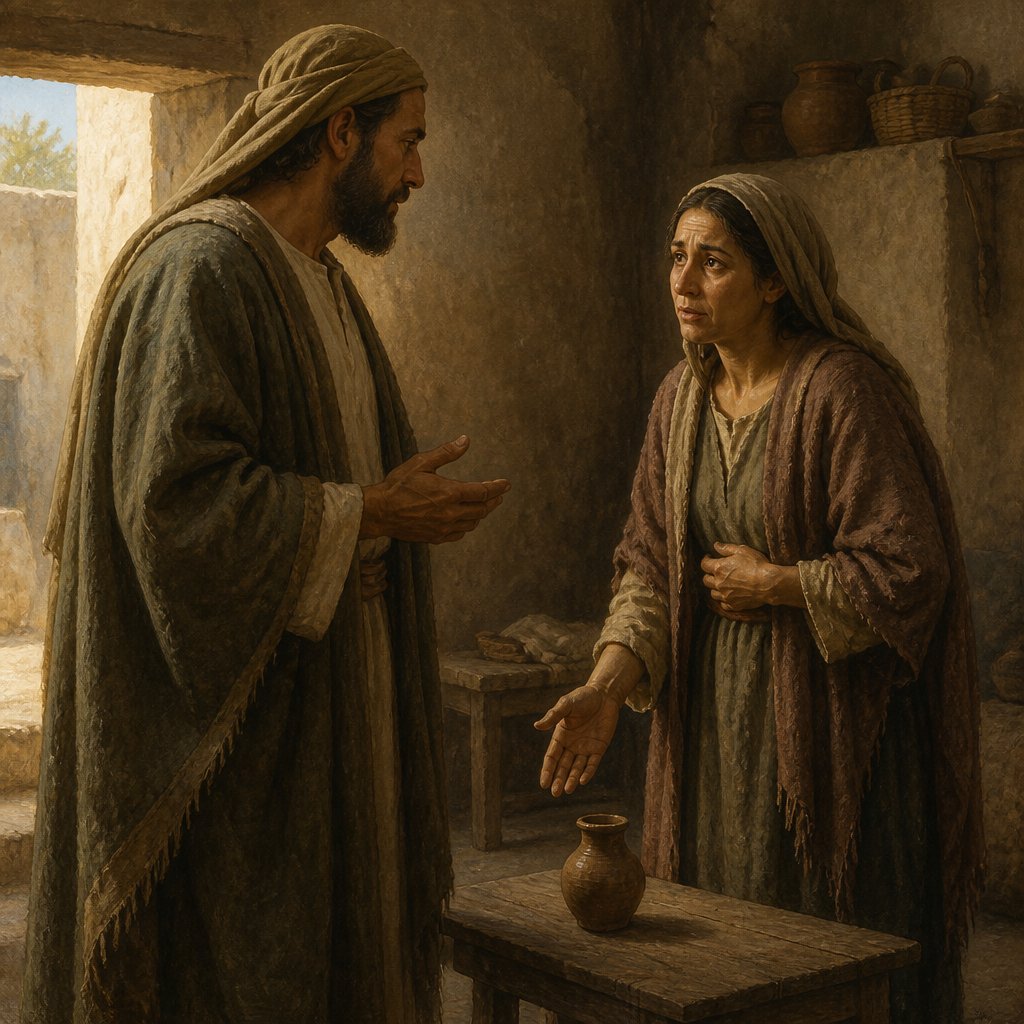
The Bible verse 2 Kings 4:2 from the King James Version reads, "And Elisha said unto her, What shall I do for thee? tell me, what hast thou in the house? And she said, Thine handmaid hath not any thing in the house, save a pot of oil."
This verse is part of a larger story found in 2 Kings 4:1-7. In this passage, a widow of one of the prophets came to Elisha, the prophet, seeking help because her husband had died and she was left with a considerable amount of debt. The creditor was threatening to take her two sons as slaves unless the debt was paid. Elisha asked her what she had in her house, to which she replied that she only had a small amount of oil.
This story holds several important themes and lessons that are relevant for believers today. One of the central themes of this passage is the faithfulness of God in providing for His people. Despite the difficult circumstances the widow found herself in, she turned to Elisha, a representative of God, for help. She did not lose hope, but sought assistance from someone who could help her. This reflects the importance of seeking God's guidance and provision in times of need.
Another significant theme in this passage is the concept of God's provision through what may seem like insignificant resources. The widow initially believed that she had nothing of value to offer, except for a small amount of oil. However, through the power of God, that small amount of oil became the means by which she was able to pay off her debt and provide for herself and her sons. This speaks to the idea that God can take what seems insignificant or insufficient in our eyes and use it in remarkable ways to bring about His purposes. It reminds us that God is able to do immeasurably more than we can ask or imagine (Ephesians 3:20).
Furthermore, this passage also addresses the concept of faith and obedience. When Elisha instructed the widow to gather empty vessels and pour out the oil from her jar into them, she obeyed without questioning or doubting. This act of obedience and faith led to a miraculous multiplication of the oil, resulting in enough oil to fill all the vessels she had gathered. This demonstrates the importance of faith and obedience in experiencing God's provision and blessings. It also serves as a reminder that God often requires us to take a step of faith and obedience before He reveals His plan and provides for our needs.
In a broader context, this story also serves as a reminder of God's care and compassion for the vulnerable and the marginalized in society. The widow in this passage was in a desperate situation, facing the loss of her sons to slavery due to her inability to pay off her debt. However, God used Elisha to intervene and provide a solution to her problem, ultimately delivering her from that difficult circumstance. This reflects God's heart for the poor and oppressed, and His desire to bring about justice and restoration in their lives.
Symbolically, the oil in this passage can be interpreted as a representation of God's anointing, blessing, and presence. Oil is often used throughout the Bible as a symbol of the Holy Spirit, and it signifies God's empowerment, consecration, and healing. The miraculous multiplication of the oil in this story can be seen as a metaphor for God's abundant provision and blessing in our lives, as well as His ability to transform and multiply the resources we have when placed in His hands.
Overall, the story of the widow and Elisha in 2 Kings 4:1-7 conveys timeless and universal truths about God's faithfulness, provision, and care for His people. It serves as a powerful reminder to trust in God's ability to provide for our needs, even when our resources may seem limited or insignificant. It also encourages us to exercise faith and obedience in seeking God's guidance and relying on His provision in our lives. Ultimately, this passage offers hope and encouragement for believers, reminding us of God's unending grace and compassion towards His people.
Get our apps


Artwork for 2 Kings 4:2

2 Kings 4:2 - "And Elisha said unto her, What shall I do for thee? tell me, what hast thou in the house? And she said, Thine handmaid hath not any thing in the house, save a pot of oil."
"And Elisha said unto her, What shall I do for thee? tell me, what hast thou in the house? And she said, Thine handmaid hath not any thing in the house, save a pot of oil." - 2 Kings 4:2

2 Kings 4:4-5

2 Kings 10:4 - "But they were exceedingly afraid, and said, Behold, two kings stood not before him: how then shall we stand?"

2 Kings 4:11 - "And it fell on a day, that he came thither, and he turned into the chamber, and lay there."

1 Kings 4:2 - "And these were the princes which he had; Azariah the son of Zadok the priest,"

2 Kings 6:4 - "So he went with them. And when they came to Jordan, they cut down wood."

2 Kings 9:4 - "¶ So the young man, even the young man the prophet, went to Ramoth-gilead."

2 Kings 16:4 - "And he sacrificed and burnt incense in the high places, and on the hills, and under every green tree."

2 Kings 4:33 - "He went in therefore, and shut the door upon them twain, and prayed unto the LORD."

2 Kings 4:32 - "And when Elisha was come into the house, behold, the child was dead, and laid upon his bed."

2 Kings 4:18 - "¶ And when the child was grown, it fell on a day, that he went out to his father to the reapers."

2 Kings 4:44 - "So he set it before them, and they did eat, and left thereof, according to the word of the LORD."

2 Kings 5:4 - "And one went in, and told his lord, saying, Thus and thus said the maid that is of the land of Israel."

2 Kings 15:4 - "Save that the high places were not removed: the people sacrificed and burnt incense still on the high places."

2 Kings 4:15 - "And he said, Call her. And when he had called her, she stood in the door."

2 Kings 21:4 - "And he built altars in the house of the LORD, of which the LORD said, In Jerusalem will I put my name."

2 Kings 4:17 - "And the woman conceived, and bare a son at that season that Elisha had said unto her, according to the time of life."

2 Kings 3:4 - "¶ And Mesha king of Moab was a sheepmaster, and rendered unto the king of Israel an hundred thousand lambs, and an hundred thousand rams, with the wool."

2 Kings 20:4 - "And it came to pass, afore Isaiah was gone out into the middle court, that the word of the LORD came to him, saying,"

2 Kings 4:14 - "And he said, What then is to be done for her? And Gehazi answered, Verily she hath no child, and her husband is old."

2 Kings 4:21 - "And she went up, and laid him on the bed of the man of God, and shut the door upon him, and went out."

2 Kings 4:28 - "Then she said, Did I desire a son of my lord? did I not say, Do not deceive me?"

2 Kings 14:4 - "Howbeit the high places were not taken away: as yet the people did sacrifice and burnt incense on the high places."

2 Kings 4:37 - "Then she went in, and fell at his feet, and bowed herself to the ground, and took up her son, and went out."

2 Kings 24:4 - "And also for the innocent blood that he shed: for he filled Jerusalem with innocent blood; which the LORD would not pardon."

2 Kings 13:4 - "And Jehoahaz besought the LORD, and the LORD hearkened unto him: for he saw the oppression of Israel, because the king of Syria oppressed them."

2 Kings 4:30 - "And the mother of the child said, As the LORD liveth, and as thy soul liveth, I will not leave thee. And he arose, and followed her."

2 Kings 4:3 - "Then he said, Go, borrow thee vessels abroad of all thy neighbours, even empty vessels; borrow not a few."

2 Kings 4:19 - "And he said unto his father, My head, my head. And he said to a lad, Carry him to his mother."