The Heart of Generosity: Reflections on 2 Kings 5:16
“But he said, As the LORD liveth, before whom I stand, I will receive none. And he urged him to take it; but he refused.” — 2 Kings 5:16
In the narrative of 2 Kings 5, we find the story of Naaman, a Syrian commander who was afflicted with leprosy. His quest for healing took him to the prophet Elisha, who, through divine intervention, restored Naaman’s health. This miracle marks a significant turning point in Naaman's life, revealing not just the act of healing, but also a deep lesson in humility, gratitude, and the essence of true generosity. The climax of this profound story occurs in 2 Kings 5:16, where Elisha firmly declares, "But he said, As the LORD liveth, before whom I stand, I will receive none. And he urged him to take it; but he refused."
Here, we encounter a moment that encapsulates the heart of Elisha's character—a refusal to accept any gifts or rewards from Naaman, despite the immense gratitude Naaman held for his miraculous healing. This response raises significant questions about the motivations of our hearts when it comes to generosity and gratitude. Elisha's actions speak volumes about his integrity and devotion to God, setting an example for us in our own lives.
Elisha’s statement, “As the LORD liveth, before whom I stand,” reflects his unwavering faith in God’s provision and his commitment to serving God above all else. By refusing the gifts, Elisha is not merely rejecting material compensation; he is illustrating that God's grace cannot be bought or bartered. This points us to an important lesson: God’s blessings are freely given and should not be sullied by means of our human transactions.
In our modern context, we often find ourselves navigating a world that regularly associates blessings with transactions. Influential forces may suggest that the more we give, the more we receive—a principle often twisted into prosperity theology. Yet Elisha's denial of the gifts shows us that blessings emanate from a relationship with God, not as a result of a quid pro quo system. His act of refusal epitomizes a life lived in absolute surrender to God's will and purpose, free from the chains of human expectation.
If we consider ourselves as beneficiaries of God’s grace, how often do we attempt to repay Him for His gifts? Much like Naaman, we may feel compelled to express gratitude through means we understand—whether it be through giving money to a church or performing acts of service. However, seldom are we called to repay God with gifts; rather, our duty is to live in gratitude, allowing our lives to reflect His love and truth to those around us. This is the truest form of worship.
Elisha’s refusal also serves as a reminder of the danger of pride and how easily we can let it creep into our hearts. Naaman, upon being healed, sought to express his gratitude in a way that would restore his honor amongst his people. Yet Elisha’s actions teach us to shun arrogance and to center our lives around God’s glory rather than our own. The act of humility is often the bedrock of our spiritual posture, and it’s here that we find our greatest strength. When we humble ourselves, we allow God to work in and through us without obstacles, showcasing His splendor rather than our own.
The narrative compels us to examine our own hearts. Are we like Naaman, seeking to leverage our blessings for personal gain, or are we like Elisha, who understands the true nature of God’s grace? God calls us to be conduits of His generosity, sharing blessings—not hoarding them. When we live in gratitude, we shift our perspective, focusing on the source of our blessings rather than the material values we can offer in return.
As you meditate on this powerful reminder from 2 Kings 5:16, ask yourself: in what areas of my life do I seek to give back to God in ways that are meaningful and truly reflect His love? How can I demonstrate the grace I have received through acts of humility and service to others? May we all learn from Elisha’s example, embracing true generosity that glorifies God alone.
Get our apps


Artwork for 2 Kings 5:16

2 Kings 5:16 - "But he said, As the LORD liveth, before whom I stand, I will receive none. And he urged him to take it; but he refused."

"But he said, As the LORD liveth, before whom I stand, I will receive none. And he urged him to take it; but he refused." - 2 Kings 5:16

2 Kings 16:5 - "¶ Then Rezin king of Syria and Pekah son of Remaliah king of Israel came up to Jerusalem to war: and they besieged Ahaz, but could not overcome him."

1 Kings 16:5 - "Now the rest of the acts of Baasha, and what he did, and his might, are they not written in the book of the chronicles of the kings of Israel?"

2 Kings 16:16 - "Thus did Urijah the priest, according to all that king Ahaz commanded."

1 Kings 5:16 - "Beside the chief of Solomon's officers which were over the work, three thousand and three hundred, which ruled over the people that wrought in the work."

2 Kings 3:16-19

2 Kings 16:19 - "¶ Now the rest of the acts of Ahaz which he did, are they not written in the book of the chronicles of the kings of Judah?"

1 Kings 5:2 - "And Solomon sent to Hiram, saying,"

2 Samuel 5:16 - "And Elishama, and Eliada, and Eliphalet."

2 Kings 14:16 - "And Jehoash slept with his fathers, and was buried in Samaria with the kings of Israel; and Jeroboam his son reigned in his stead."

2 Kings 4:4-5

2 Kings 19:5 - "So the servants of king Hezekiah came to Isaiah."

2 Kings 6:16 - "And he answered, Fear not: for they that be with us are more than they that be with them."

2 Kings 20:16 - "And Isaiah said unto Hezekiah, Hear the word of the LORD."

2 Kings 24:5 - "¶ Now the rest of the acts of Jehoiakim, and all that he did, are they not written in the book of the chronicles of the kings of Judah?"

2 Kings 12:16 - "The trespass money and sin money was not brought into the house of the LORD: it was the priests'."

2 Chronicles 28:16 - "¶ At that time did king Ahaz send unto the kings of Assyria to help him."

"¶ Then Rezin king of Syria and Pekah son of Remaliah king of Israel came up to Jerusalem to war: and they besieged Ahaz, but could not overcome him." - 2 Kings 16:5

2 Kings 3:16 - "And he said, Thus saith the LORD, Make this valley full of ditches."

2 Kings 16:1 - "In the seventeenth year of Pekah the son of Remaliah Ahaz the son of Jotham king of Judah began to reign."

2 Kings 16:8 - "And Ahaz took the silver and gold that was found in the house of the LORD, and in the treasures of the king's house, and sent it for a present to the king of Assyria."

"Thus did Urijah the priest, according to all that king Ahaz commanded." - 2 Kings 16:16

2 Kings 16:12 - "And when the king was come from Damascus, the king saw the altar: and the king approached to the altar, and offered thereon."
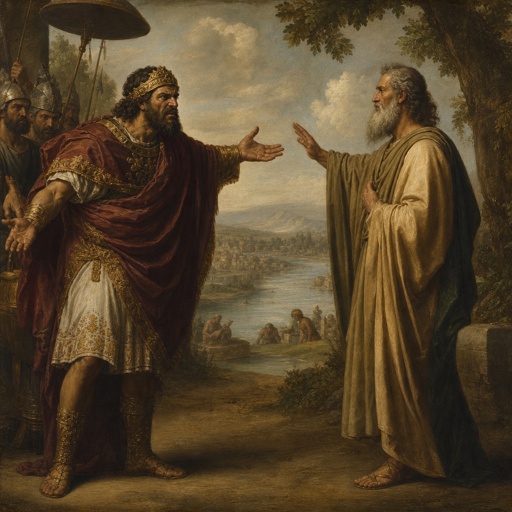
2 kings 5:11 Create Naaman being upset and frustrated at ELisha

2 Kings 16:4 - "And he sacrificed and burnt incense in the high places, and on the hills, and under every green tree."

2 Kings 5:19 - "And he said unto him, Go in peace. So he departed from him a little way."

2 Kings 16:18 - "And the covert for the sabbath that they had built in the house, and the king's entry without, turned he from the house of the LORD for the king of Assyria."

2 Chronicles 16:11 - "¶ And, behold, the acts of Asa, first and last, lo, they are written in the book of the kings of Judah and Israel."

2 Kings 11:16 - "And they laid hands on her; and she went by the way by the which the horses came into the king's house: and there was she slain."