A Divine Transition: Understanding the Reigns of Ahaziah and Joram
“In the twelfth year of Joram the son of Ahab king of Israel did Ahaziah the son of Jehoram king of Judah begin to reign.” — 2 Kings 8:25
The transition of power between rulers is often a pivotal moment in the course of a nation’s history, and 2 Kings 8:25 marks such a moment: "In the twelfth year of Joram the son of Ahab king of Israel did Ahaziah the son of Jehoram king of Judah begin to reign." While this passage might seem like a mere historical note, it carries profound implications for our understanding of leadership, legacy, and divine sovereignty.
Ahaziah's ascent to the throne is not just a matter of chronology; it reveals the continuity of choices made by previous generations and sets the stage for the unfolding of God’s plan. In scripture, kingship signifies more than political authority; it is a reflection of divine ordinance. In this case, we see the continuation of a dynasty—the lineage of Ahab and Jehoram—whose reigns are marked by unfaithfulness and idolatry.
The man of God, Elijah, had already foretold the demise of Ahab’s house due to their turning away from the Lord. Ahaziah's reign, beginning in the shadow of Joram's questionable alliances and actions, is indicative of the spiritual turbulence within both the northern kingdom (Israel) and the southern kingdom (Judah). As we reflect on this passage, we can draw lessons on the significance of our own reign over our lives and the choices we make.
When Ahaziah began his reign, he stepped into a legacy tarnished by idolatry, conflict, and a wayward spirit. His lineage bore the weight of ungodliness, a reality that serves as a stark reminder of the implications of leadership. It prompts us to consider: What legacy do we inherit, and what legacy will we leave behind? Leadership, whether in the home, the workplace, or within our communities, carries the potential to influence hearts and minds either towards God or away from Him.
This brings to mind the importance of our own decisions in shaping the landscape of our lives. Ahaziah’s inclination towards his grandfather Ahab’s legacy of Baal worship signals a failure to recognize the call to spiritual purity and fidelity to the Lord. As Christians, we are given the gift of Christ—the ultimate king whose reign is characterized by righteousness and grace. In contrast to Ahaziah’s choices, we are invited to live under the lordship of Christ, allowing His teachings and example to guide our decisions.
Moreover, reflecting on this verse leads us to consider the timeline of God’s plan. Although Ahaziah was crowned in the twelfth year of Joram’s rule, the events surrounding his kingship were not accidental; they played a role in God’s grand narrative. Similarly, our lives are not a series of random events; every season of waiting, every trial faced, every victory won contributes toward the tapestry of our purpose. Perhaps you are in a waiting period of your own, uncertain of where God is leading you. Remember that just as God was sovereign over the kings of Israel and Judah, He is sovereign over your life and circumstances.
In moments of doubt, let us lean into the truth that God is orchestrating events in our favor. With every decision we make, may we seek wisdom from above and strive to reflect the character of Christ. Let Ahaziah's story be a canvas upon which we paint our understanding of true kingship—a submission to God’s rule in our hearts that transcends any earthly title or authority.
As we study the lives of these kings, may we be encouraged to steer clear of the pitfalls of complacency and compromise. Let us earnestly seek to reign in our spheres of influence with integrity, knowing that ultimately, we serve a King who reigns forevermore—an example of purity, justice, and grace. The question remains: How will you choose to reign today?
Get our apps


Artwork for 2 Kings 8:25

2 Kings 8:25 - "¶ In the twelfth year of Joram the son of Ahab king of Israel did Ahaziah the son of Jehoram king of Judah begin to reign."

"¶ In the twelfth year of Joram the son of Ahab king of Israel did Ahaziah the son of Jehoram king of Judah begin to reign." - 2 Kings 8:25

2 Kings 25:8 - "¶ And in the fifth month, on the seventh day of the month, which is the nineteenth year of king Nebuchadnezzar king of Babylon, came Nebuzar-adan, captain of the guard, a servant of the king of Babylon, unto Jerusalem:"

2 Kings 25:2 - "And the city was besieged unto the eleventh year of king Zedekiah."

2 Kings 21:25 - "Now the rest of the acts of Amon which he did, are they not written in the book of the chronicles of the kings of Judah?"

2 Kings 25:28 - "And he spake kindly to him, and set his throne above the throne of the kings that were with him in Babylon;"

2 Kings 2:25 - "And he went from thence to mount Carmel, and from thence he returned to Samaria."

2 Kings 25:12 - "But the captain of the guard left of the poor of the land to be vinedressers and husbandmen."

2 KINGS 8:29

Proverbs 25:2 - "It is the glory of God to conceal a thing: but the honour of kings is to search out a matter."

2 Kings 25:20 - "And Nebuzar-adan captain of the guard took these, and brought them to the king of Babylon to Riblah:"
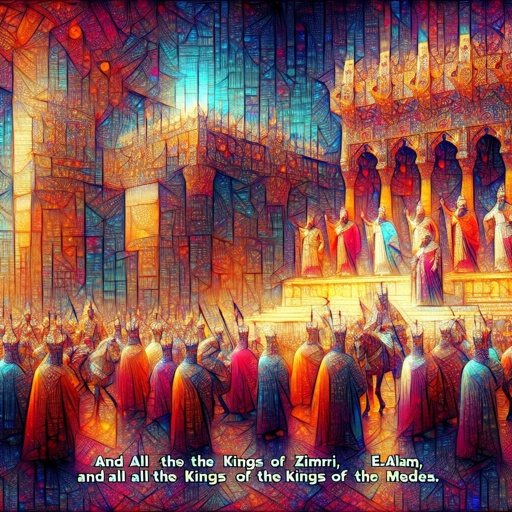
Jeremiah 25:25 - "And all the kings of Zimri, and all the kings of Elam, and all the kings of the Medes,"

"And the city was besieged unto the eleventh year of king Zedekiah." - 2 Kings 25:2

2 Kings 25:3 - "And on the ninth day of the fourth month the famine prevailed in the city, and there was no bread for the people of the land."

2 Kings 8:23 - "And the rest of the acts of Joram, and all that he did, are they not written in the book of the chronicles of the kings of Judah?"

2 Kings 25:6 - "So they took the king, and brought him up to the king of Babylon to Riblah; and they gave judgment upon him."

2 Kings 25:14 - "And the pots, and the shovels, and the snuffers, and the spoons, and all the vessels of brass wherewith they ministered, took they away."

2 Kings 25:1 show King Nebuchadnezzar in war zone

2 Kings 25:1 show King Nebuchadnezzar and the army and the Temple

1 Kings 2:25 - "And king Solomon sent by the hand of Benaiah the son of Jehoiada; and he fell upon him that he died."

2 Kings 25:10 - "And all the army of the Chaldees, that were with the captain of the guard, brake down the walls of Jerusalem round about."

2 Kings 25:18 - "¶ And the captain of the guard took Seraiah the chief priest, and Zephaniah the second priest, and the three keepers of the door:"

2 Chronicles 25:26 - "Now the rest of the acts of Amaziah, first and last, behold, are they not written in the book of the kings of Judah and Israel?"

2 Kings 25:15 - "And the firepans, and the bowls, and such things as were of gold, in gold, and of silver, in silver, the captain of the guard took away."

Jehoiachin is released from Babylonian jail 2 kings 25: 27

2 Kings 25:26 - "And all the people, both small and great, and the captains of the armies, arose, and came to Egypt: for they were afraid of the Chaldees."

2 Kings 13:8 - "¶ Now the rest of the acts of Jehoahaz, and all that he did, and his might, are they not written in the book of the chronicles of the kings of Israel?"

2 Kings 25:30 - "And his allowance was a continual allowance given him of the king, a daily rate for every day, all the days of his life."

2 Kings 25:25 - "But it came to pass in the seventh month, that Ishmael the son of Nethaniah, the son of Elishama, of the seed royal, came, and ten men with him, and smote Gedaliah, that he died, and the Jews and the Chaldees that were with him at Mizpah."

2 Kings 25:21 - "And the king of Babylon smote them, and slew them at Riblah in the land of Hamath. So Judah was carried away out of their land."