The Perils of Idleness: Lessons from David's Lapse
“And it came to pass, after the year was expired, at the time when kings go forth to battle, that David sent Joab, and his servants with him, and all Israel; and they destroyed the children of Ammon, and besieged Rabbah. But David tarried still at Jerusalem.” — 2 Samuel 11:1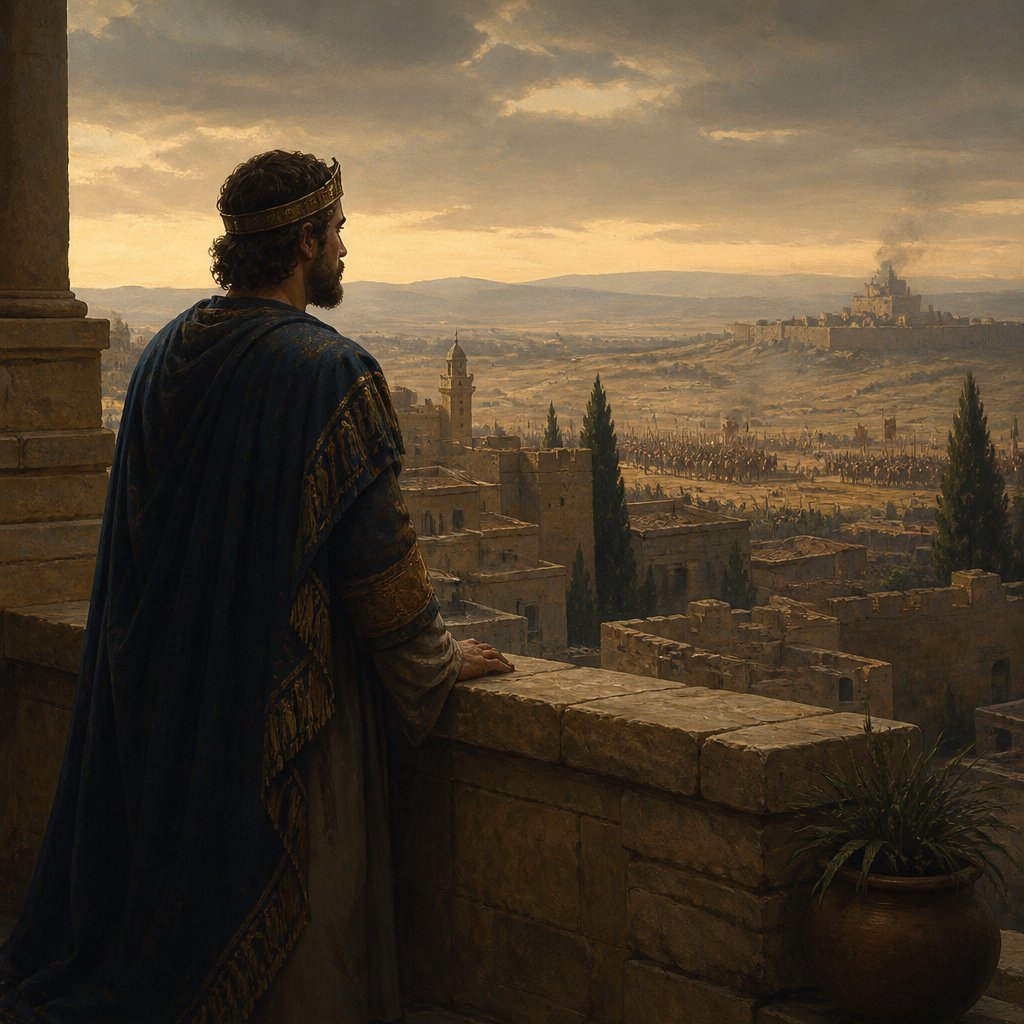
In the annals of biblical history, few figures are as illustrious and as human as King David. His triumphs are well-documented, from defeating Goliath to uniting the tribes of Israel under a single banner. Yet, it is in moments of vulnerability—like the one described in 2 Samuel 11:1—that we find profound lessons about our own spiritual journey and the nature of temptation.
The KJV states: "And it came to pass, after the year was expired, at the time when kings go forth to battle, that David sent Joab, and his servants with him, and all Israel; and they destroyed the children of Ammon, and besieged Rabbah. But David tarried still at Jerusalem." Here, we encounter a moment that starkly contrasts with the expectations of a king, particularly a warrior king such as David.
As spring arrived, a time when kings embarked on military campaigns, David chose not to go. Instead, he stayed behind, leaving his men to do the fighting. This decision set the stage for the downfall into sin that would come to define David's later years. What can we glean from David's choice to remain in Jerusalem instead of joining his army?
**The Dangers of Inactivity**
Idleness can be a breeding ground for trouble. When David chose not to fulfill his calling as a king and join his men in battle, he inadvertently opened the door to temptation. Many of us find ourselves in periods of inactivity, often leading to spiritual stagnation. 1 Peter 5:8 warns us to be sober and vigilant, for our adversary, the devil, walks about like a roaring lion, seeking whom he may devour. Like David, when we allow ourselves to linger in idle moments, we become prey to the enemy's schemes.
**Keeping Our Armor On**
Another vital lesson is the importance of being proactive in our faith. Ephesians 6:11 instructs us to "put on the whole armor of God, that ye may be able to stand against the wiles of the devil." David’s military absence did not just signify a physical retreat but a spiritual one as well. Our spiritual armor is meant to be worn daily, but when we choose to take a step back from our duties—whether they be prayer, worship, service, or fellowship—we risk exposing ourselves to danger.
**The Consequences of Choices**
David’s decision to remain in Jerusalem ultimately led to dire consequences: temptation, sin, and heartbreak marked by his relationship with Bathsheba and the subsequent fallout. James 1:14-15 reminds us that every man is tempted when he is drawn away of his own lust and enticed; and when lust hath conceived, it bringeth forth sin: and sin, when it is finished, bringeth forth death. David’s inactivity permitted his desires to fester, leading him down a destructive path.
**The Call to Action**
As Christians, we must ask ourselves: Are we remaining spiritually vigilant, or are we in a season of spiritual lethargy? Is God calling us to engage actively in His kingdom, or are we idling, potentially paving the way for temptation? Let us remember that we do not have the luxury of spiritual downtime. The world is in need of believers on the front lines—interceding, supporting, and proclaiming truth.
**Conclusion**
In conclusion, the lesson from 2 Samuel 11:1 offers a sobering reminder of the dangers inherent in idleness. David, a man after God’s own heart, faced the consequences of a momentary lapse in action. As we reflect on this passage, let us recommit ourselves to pursuing God wholeheartedly, recognizing that it is often in our most mundane choices that the battles for our hearts are fought and won. May we strive to advance in faith, recognizing the call that our King has placed on our lives and responding with courage and diligence. Amen.
Get our apps


Artwork for 2 Samuel 11:1

2 Samuel 11:1 - "And it came to pass, after the year was expired, at the time when kings go forth to battle, that David sent Joab, and his servants with him, and all Israel; and they destroyed the children of Ammon, and besieged Rabbah. But David tarried still at Jerusalem."
"And it came to pass, after the year was expired, at the time when kings go forth to battle, that David sent Joab, and his servants with him, and all Israel; and they destroyed the children of Ammon, and besieged Rabbah. But David tarried still at Jerusalem." - 2 Samuel 11:1

2 Samuel 11:1-15 - "In the spring, at the time when kings go off to war, David sent Joab out with the king’s men and the whole Israelite army. They destroyed the Ammonites and besieged Rabbah. But David remained in Jerusalem. One evening David got up from his bed and walked around on the roof of the palace. From the roof he saw a woman bathing. The woman was very beautiful, and David sent someone to find out about her. The man said, “She is Bathsheba, the daughter of Eliam and the wife of Uriah the Hittite.” Then David sent messengers to get her. She came to him, and he slept with her. (Now she was purifying herself from her monthly uncleanness.) Then she went back home. The woman conceived and sent word to David, saying, “I am pregnant.” So David sent this word to Joab: “Send me Uriah the Hittite.” And Joab sent him to David. When Uriah came to him, David asked him how Joab was, how the soldiers were and how the war was going. Then David said to Uriah, “Go down to your house and wash your feet.” So Uriah left the palace, and a gift from the king was sent after him. But Uriah slept at the entrance to the palace with all his master’s servants and did not go down to his house. David was told, “Uriah did not go home.” So he asked Uriah, “Haven’t you just come from a military campaign? Why didn’t you go home?” Uriah said to David, “The ark and Israel and Judah are staying in tents, and my commander Joab and my lord’s men are camped in the open country. How could I go to my house to eat and drink and make love to my wife? As surely as you live, I will not do such a thing!” Then David said to him, “Stay here one more day, and tomorrow I will send you back.” So Uriah remained in Jerusalem that day and the next. At David’s invitation, he ate and drank with him, and David made him drunk. But in the evening Uriah went out to sleep on his mat among his master’s servants; he did not go home. In the morning David wrote a letter to Joab and sent it with Uriah. In it he wrote, “Put Uriah out in front where the fighting is fiercest. Then withdraw from him so he will be struck down and die.”"
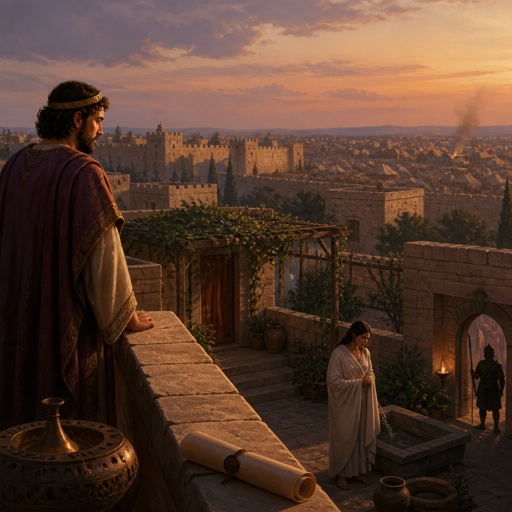
"In the spring, at the time when kings go off to war, David sent Joab out with the king’s men and the whole Israelite army. They destroyed the Ammonites and besieged Rabbah. But David remained in Jerusalem. One evening David got up from his bed and walked around on the roof of the palace. From the roof he saw a woman bathing. The woman was very beautiful, and David sent someone to find out about her. The man said, “She is Bathsheba, the daughter of Eliam and the wife of Uriah the Hittite.” Then David sent messengers to get her. She came to him, and he slept with her. (Now she was purifying herself from her monthly uncleanness.) Then she went back home. The woman conceived and sent word to David, saying, “I am pregnant.” So David sent this word to Joab: “Send me Uriah the Hittite.” And Joab sent him to David. When Uriah came to him, David asked him how Joab was, how the soldiers were and how the war was going. Then David said to Uriah, “Go down to your house and wash your feet.” So Uriah left the palace, and a gift from the king was sent after him. But Uriah slept at the entrance to the palace with all his master’s servants and did not go down to his house. David was told, “Uriah did not go home.” So he asked Uriah, “Haven’t you just come from a military campaign? Why didn’t you go home?” Uriah said to David, “The ark and Israel and Judah are staying in tents, and my commander Joab and my lord’s men are camped in the open country. How could I go to my house to eat and drink and make love to my wife? As surely as you live, I will not do such a thing!” Then David said to him, “Stay here one more day, and tomorrow I will send you back.” So Uriah remained in Jerusalem that day and the next. At David’s invitation, he ate and drank with him, and David made him drunk. But in the evening Uriah went out to sleep on his mat among his master’s servants; he did not go home. In the morning David wrote a letter to Joab and sent it with Uriah. In it he wrote, “Put Uriah out in front where the fighting is fiercest. Then withdraw from him so he will be struck down and die.”" - 2 Samuel 11:1-15

2 Samuel 11:9

2 Samuel 11

2 samuel 11

2 Samuel 1:11 - "Then David took hold on his clothes, and rent them; and likewise all the men that were with him:"

2 Samuel 11:11

1 Samuel 2:11 - "And Elkanah went to Ramah to his house. And the child did minister unto the LORD before Eli the priest."
1 Samuel 13:11

1 Samuel 11:14 - "Then said Samuel to the people, Come, and let us go to Gilgal, and renew the kingdom there."

1 Samuel 11:2 - "And Nahash the Ammonite answered them, On this condition will I make a covenant with you, that I may thrust out all your right eyes, and lay it for a reproach upon all Israel."

2 Samuel 2:11 - "And the time that David was king in Hebron over the house of Judah was seven years and six months."

1 Samuel 22:11-13

2 Samuel 11:18 - "¶ Then Joab sent and told David all the things concerning the war;"

1 Samuel 28:11 - "Then said the woman, Whom shall I bring up unto thee? And he said, Bring me up Samuel."

2 Samuel 21:11 - "And it was told David what Rizpah the daughter of Aiah, the concubine of Saul, had done."

2 Samuel 11:5 - "And the woman conceived, and sent and told David, and said, I am with child."

1 Samuel 3:11 - "¶ And the LORD said to Samuel, Behold, I will do a thing in Israel, at which both the ears of every one that heareth it shall tingle."

2 Samuel 11:22 - "¶ So the messenger went, and came and shewed David all that Joab had sent him for."

1 Samuel 12:11 - "And the LORD sent Jerubbaal, and Bedan, and Jephthah, and Samuel, and delivered you out of the hand of your enemies on every side, and ye dwelled safe."

2 Samuel 3:11 - "And he could not answer Abner a word again, because he feared him."

2 Samuel 11:14 - "¶ And it came to pass in the morning, that David wrote a letter to Joab, and sent it by the hand of Uriah."

1 Samuel 11:12 - "¶ And the people said unto Samuel, Who is he that said, Shall Saul reign over us? bring the men, that we may put them to death."

1 Samuel 31:11 - "¶ And when the inhabitants of Jabesh-gilead heard of that which the Philistines had done to Saul;"

1 Samuel 2:26 - "And the child Samuel grew on, and was in favour both with the LORD, and also with men."

2 Samuel 22:11 - "And he rode upon a cherub, and did fly: and he was seen upon the wings of the wind."
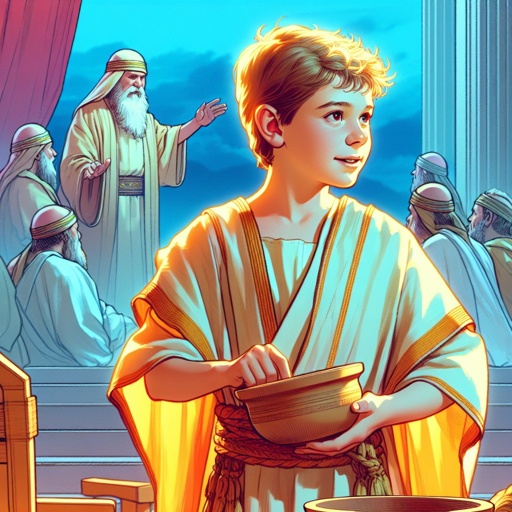
1 Samuel 2:18 - "¶ But Samuel ministered before the LORD, being a child, girded with a linen ephod."

"Then David took hold on his clothes, and rent them; and likewise all the men that were with him:" - 2 Samuel 1:11