A King's Question: The Weight of Honor and Deceit
“And when Uriah was come unto him, David demanded of him how Joab did, and how the people did, and how the war prospered.” — 2 Samuel 11:7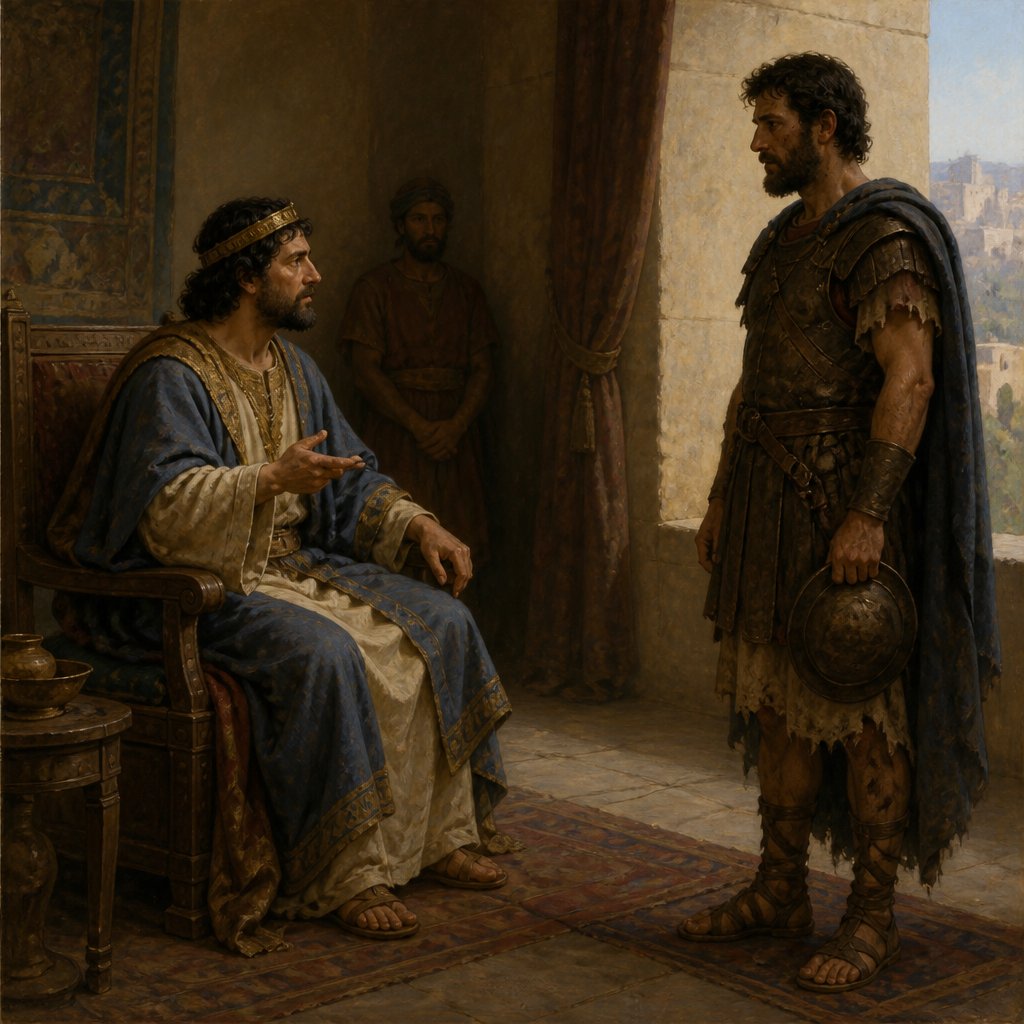
In 2 Samuel 11:7, we find a significant moment in the life of King David. The verse reads: "And when Uriah was come unto him, David demanded of him how Joab did, and how the people did, and how the war prospered." At first glance, this might seem to be a simple inquiry about the state of the battlefield. However, a closer examination reveals a deep and tragic layer of human behavior, responsibility, and the consequences of our actions.
At this point in the narrative, King David is embroiled in a web of his own making. He stands as a king, a leader appointed by God, yet he is also a man severely compromised by his sin. Just prior to this event, David had succumbed to lust and had sent Uriah’s wife, Bathsheba, to him, only to later engineer Uriah’s death on the battlefield. Uriah, an honorable man, was completely unaware of the duplicity of his king.
David's question to Uriah can be evaluated from a few angles: First, it reflects a measure of normalcy for a king concerned about the state of his army. David, preoccupied with his own choices, engages Uriah to establish a representation of normal leadership. He appears to be the caring king, focused on his people's well-being. But this is a mask; underneath it lies the tragic reality of betrayal and moral failure.
The question arises—why does David feign interest in the war when his heart is already heavy with guilt for his actions against Uriah? This is the nature of sin; it often leads us to a place where we must maintain a facade. David's question serves as a poignant reminder that the external pressures of leadership do not obliterate internal conflict. As leaders, as Christians, we oftentimes carry burdens that are invisible to others.
Secondly, this passage invites reflection on the profound honor and integrity that Uriah represented. Uriah, knowing that many soldiers remained in battle, had displayed unwavering loyalty to King and country. He was a Hittite, not an Israelite, yet he displayed faithfulness and commitment that, in many ways, exceeded that of his king. The irony and tragedy of this moment become increasingly palpable, as Uriah is the embodiment of honor standing before a king who has fallen from grace.
Moreover, Uriah’s obedience to King David in this moment is a testimony to his character. When asked how Joab and the soldiers fared, Uriah gives David the information he seeks without any hint of the betrayal that has occurred back at home. He is a soldier first, showing unwavering respect for his king, unaware of the hidden dagger within David’s heart. This serves as a vivid lesson on the nature of trust and the importance of integrity, even in the face of betrayal.
As we meditate on this scripture and the complexities it presents, it leads us to the larger narrative about the consequences of sins hidden in darkness. The chapter serves as a springboard into understanding how unchecked desires can spiral into tragic outcomes. Like Uriah, we are often surrounded by circumstances that call our integrity into question. We must remember that our actions, even in secrecy, bear consequences not just for ourselves but for others as well.
Consequently, we must reflect on our motivations and the burdens of our leadership, asking ourselves difficult questions about the integrity of our actions. Are we demanding the truth from ourselves and from God? Are we living authentically, with transparency before the Lord?
In closing, as we ponder David’s question to Uriah, let it lead us toward a deeper understanding of accountability, integrity, and the tragic price of sin. May we learn to seek reconciliation and healing rather than hiding behind deceit. Lord, may we be as steadfast as Uriah and recognize the depth of your grace as we navigate our failings. Amen.
Get our apps


Artwork for 2 Samuel 11:7

2 Samuel 11:7 - "And when Uriah was come unto him, David demanded of him how Joab did, and how the people did, and how the war prospered."
"And when Uriah was come unto him, David demanded of him how Joab did, and how the people did, and how the war prospered." - 2 Samuel 11:7

2 Samuel 11:9

2 Samuel 11

2 samuel 11

2 Samuel 11:11

2 Samuel 7:11 - "And as since the time that I commanded judges to be over my people Israel, and have caused thee to rest from all thine enemies. Also the LORD telleth thee that he will make thee an house."

2 samuel 9:7 fhdhdhdhhd

2 Samuel 7:1–29

2 Samuel 2:11 - "And the time that David was king in Hebron over the house of Judah was seven years and six months."

2 Samuel 11:18 - "¶ Then Joab sent and told David all the things concerning the war;"

1 Samuel 7:11 - "And the men of Israel went out of Mizpeh, and pursued the Philistines, and smote them, until they came under Beth-car."

2 Samuel 21:11 - "And it was told David what Rizpah the daughter of Aiah, the concubine of Saul, had done."

2 Samuel 5:7 - "Nevertheless David took the strong hold of Zion: the same is the city of David."

2 Samuel 11:5 - "And the woman conceived, and sent and told David, and said, I am with child."

2 Chronicles 11:7 - "And Beth-zur, and Shoco, and Adullam,"

2 Samuel 11:22 - "¶ So the messenger went, and came and shewed David all that Joab had sent him for."

2 Samuel 3:11 - "And he could not answer Abner a word again, because he feared him."

2 Samuel 11:14 - "¶ And it came to pass in the morning, that David wrote a letter to Joab, and sent it by the hand of Uriah."

2 Samuel 7:4 - "¶ And it came to pass that night, that the word of the LORD came unto Nathan, saying,"

2 Samuel 22:11 - "And he rode upon a cherub, and did fly: and he was seen upon the wings of the wind."

2 Samuel 10:7 - "And when David heard of it, he sent Joab, and all the host of the mighty men."

1 Samuel 2:7 - "The LORD maketh poor, and maketh rich: he bringeth low, and lifteth up."

2 Samuel 8:7 - "And David took the shields of gold that were on the servants of Hadadezer, and brought them to Jerusalem."

2 Samuel 17:7 - "And Hushai said unto Absalom, The counsel that Ahithophel hath given is not good at this time."

2 Samuel 7:3 - "And Nathan said to the king, Go, do all that is in thine heart; for the LORD is with thee."

2 Samuel 7:2 - "That the king said unto Nathan the prophet, See now, I dwell in an house of cedar, but the ark of God dwelleth within curtains."

2 Samuel 11:6 - "¶ And David sent to Joab, saying, Send me Uriah the Hittite. And Joab sent Uriah to David."

2 Samuel 11:26 - "¶ And when the wife of Uriah heard that Uriah her husband was dead, she mourned for her husband."

2 Samuel 1:11 - "Then David took hold on his clothes, and rent them; and likewise all the men that were with him:"