Legacy of Faith: The Names of Promise
“And these be the names of those that were born unto him in Jerusalem; Shammua, and Shobab, and Nathan, and Solomon,” — 2 Samuel 5:14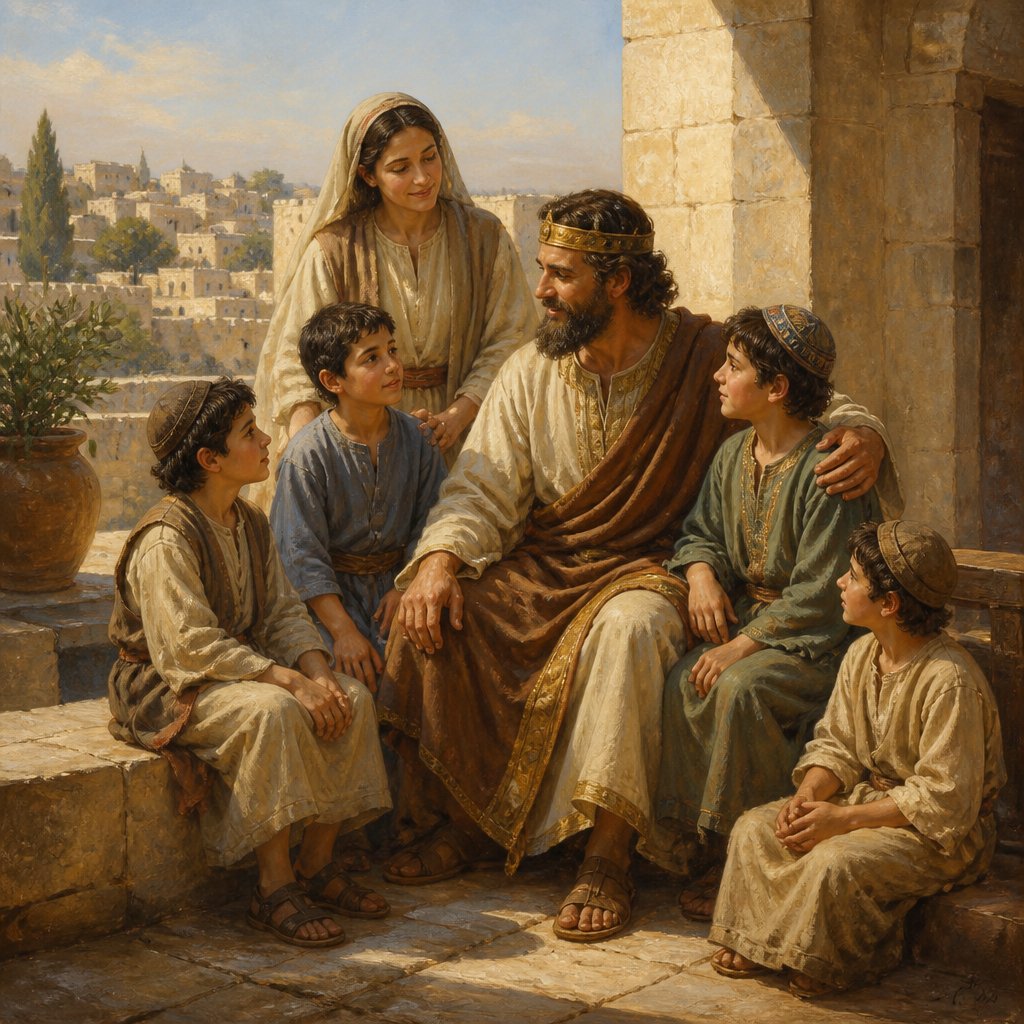
In the quiet accounts of scripture, we often find deep insights woven through the simple declaration of names and lineage. One such verse, 2 Samuel 5:14, simply states, "And these be the names of those that were born unto him in Jerusalem; Shammua, and Shobab, and Nathan, and Solomon." At first glance, this might seem like a mere genealogical record, a list of royal offspring. Yet, as we delve deeper, we uncover profound principles about legacy, identity, and the unfolding of God’s promises in our lives.
The context of this verse is significant. David has just been anointed king of all Israel, uniting a fractured nation. His reign in Jerusalem marks a new beginning, not only for him but also for the people of Israel. This moment is pivotal; it symbolizes a rich heritage and a responsibility to lead with wisdom and righteousness. Naming each son becomes a public acknowledgment of family legacy and future promise. The names mentioned—Shammua, Shobab, Nathan, and Solomon—carry meanings that resonate deeply both historically and spiritually.
Each name has its own significance, reflecting attributes and characteristics that can inspire us today. For instance, Nathan means "He gave," which not only highlights God’s generous nature but also reminds us of our calling to give of ourselves to others in service and love. Solomon, perhaps the most famous of David's sons, signifies peace—a fitting name for one who would eventually reign during an era of unprecedented peace and prosperity.
As believers, we often grapple with our identity and the legacy we are building. The act of naming is powerful; it encapsulates hopes, dreams, and destinies. In the same way David named his sons—with intention and foresight—so too can we consider the names we carry or the identities we choose to embrace in our lives. What legacy are we creating with our lives, our words, our actions?
Moreover, Matthew Henry points out that these names can be seen differently. They represent not only David's immediate family but the future he is building for the nation. With this in mind, we must ask ourselves: are we cultivating a legacy of faith? When others look at us, do they see lives led in pursuit of divine purpose? How we live our lives will echo in the generations that follow, just as David’s lineage would powerfully impact the history of Israel.
As we think about the names of David’s sons, let’s also draw strength from the understanding that each name represents a chapter in God’s unfolding story. In our own lives, we may feel overwhelmed by the challenges surrounding us, yet these are opportunities for God to work through us, shaping our identity as we lean into His promises. Our destinies are not left to chance but are purposefully intertwined with divine plans.
Thus, 2 Samuel 5:14 invites us to reflect not only on the significance of familial legacy but also on the importance of being intentional about the names we give to our actions, our relationships, and even our trials. Are we nurturing peace like Solomon, or are we embodying the characteristics of those who represent God’s giving nature like Nathan? Each day offers a canvas on which we can paint the legacy we wish to leave.
In conclusion, let us remember that every name tells a story; every story serves a purpose in God’s kingdom. As we walk through our day, may we be intentional in how we live, aligning our actions with His will, creating a legacy that points to His glory. May we too be remembered not just by our names but by the lives we lived, a testimony of faith for generations to come. Amen.
Get our apps


Artwork for 2 Samuel 5:14

2 Samuel 5:14 - "And these be the names of those that were born unto him in Jerusalem; Shammua, and Shobab, and Nathan, and Solomon,"
"And these be the names of those that were born unto him in Jerusalem; Shammua, and Shobab, and Nathan, and Solomon," - 2 Samuel 5:14

2 Samuel 14:5 - "And the king said unto her, What aileth thee? And she answered, I am indeed a widow woman, and mine husband is dead."

2 Samuel 5:12

2 Samuel 6:14

2 Samuel 5:15 - "Ibhar also, and Elishua, and Nepheg, and Japhia,"

2 Samuel 5:16 - "And Elishama, and Eliada, and Eliphalet."

2 Samuel 6:14–22

"And Elishama, and Eliada, and Eliphalet." - 2 Samuel 5:16

1 Samuel 14:5 - "The forefront of the one was situate northward over against Michmash, and the other southward over against Gibeah."

2 Samuel 23:14 - "And David was then in an hold, and the garrison of the Philistines was then in Beth-lehem."

2 Samuel 14:23 - "So Joab arose and went to Geshur, and brought Absalom to Jerusalem."

2 Samuel 5:18 - "The Philistines also came and spread themselves in the valley of Rephaim."

2 Samuel 5:7 - "Nevertheless David took the strong hold of Zion: the same is the city of David."

2 Samuel 5:22 - "¶ And the Philistines came up yet again, and spread themselves in the valley of Rephaim."

2 Samuel 5:21 - "And there they left their images, and David and his men burned them."

2 Samuel 22:14 - "The LORD thundered from heaven, and the most High uttered his voice."

2 Samuel 16:14 - "And the king, and all the people that were with him, came weary, and refreshed themselves there."

2 Samuel 14:1 - "Now Joab the son of Zeruiah perceived that the king's heart was toward Absalom."

2 Samuel 14:28 - "¶ So Absalom dwelt two full years in Jerusalem, and saw not the king's face."

2 Samuel 11:14 - "¶ And it came to pass in the morning, that David wrote a letter to Joab, and sent it by the hand of Uriah."

"Ibhar also, and Elishua, and Nepheg, and Japhia," - 2 Samuel 5:15

2 Samuel 5:10 - "And David went on, and grew great, and the LORD God of hosts was with him."

2 Samuel 2:14 - "And Abner said to Joab, Let the young men now arise, and play before us. And Joab said, Let them arise."

2 Samuel 5:4 - "¶ David was thirty years old when he began to reign, and he reigned forty years."

2 Samuel 11:5 - "And the woman conceived, and sent and told David, and said, I am with child."

2 Samuel 6:14 - "And David danced before the LORD with all his might; and David was girded with a linen ephod."

2 Samuel 3:5 - "And the sixth, Ithream, by Eglah David's wife. These were born to David in Hebron."

1 Samuel 5:2 - "When the Philistines took the ark of God, they brought it into the house of Dagon, and set it by Dagon."

2 Samuel 14:3 - "And come to the king, and speak on this manner unto him. So Joab put the words in her mouth."