Claiming Our Identity: The Power of Being a Citizen of Two Realms
“Then the chief captain came, and said unto him, Tell me, art thou a Roman? He said, Yea.” — Acts 22:27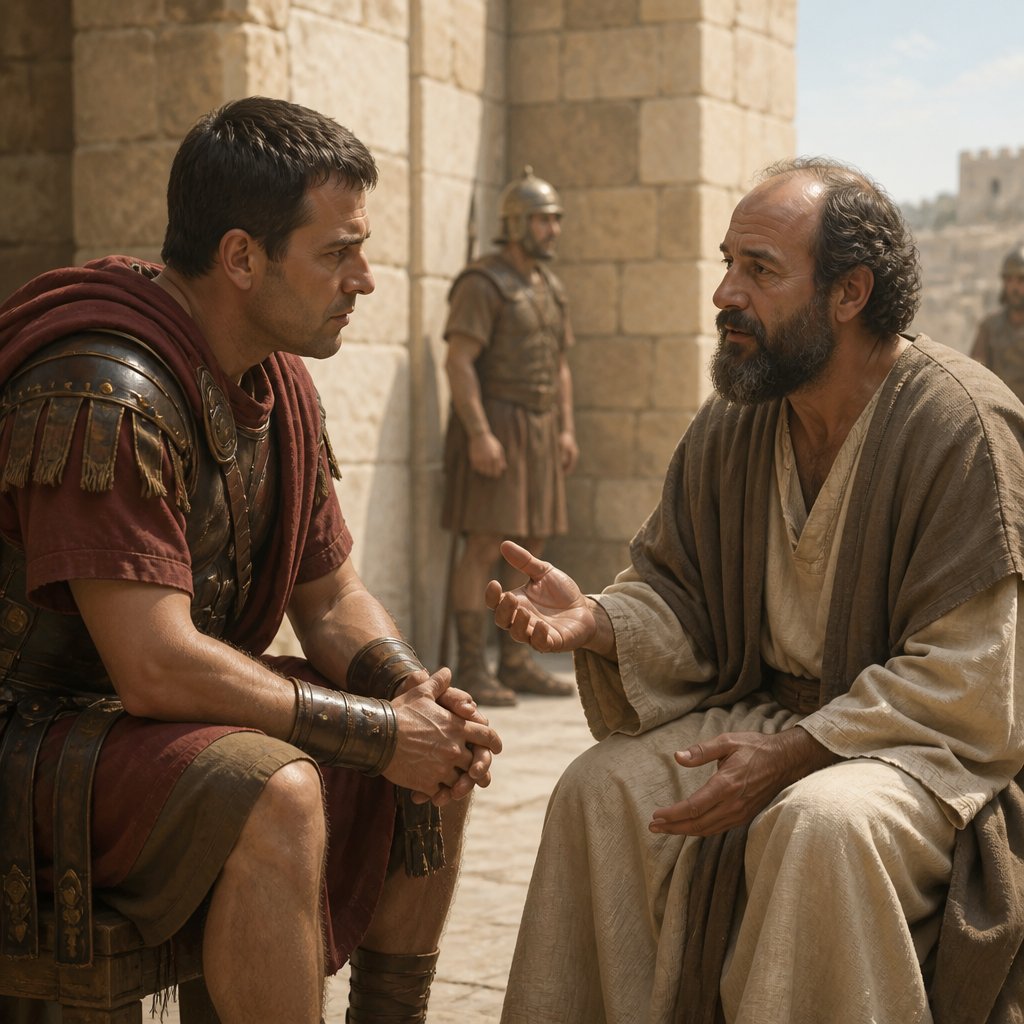
As we delve into Acts 22:27, where the chief captain approaches Paul with the question, "Tell me, art thou a Roman? He said, Yea," we find ourselves at the crossroads of identity, authority, and the believer's position in Christ. This moment, seemingly straightforward, holds profound implications not just for Paul’s circumstance, but for every believer seeking to understand their identity in God and in the world.
To give context, Paul was arrested in Jerusalem amid rising tensions, and the chief captain, a Roman official, was trying to discern Paul's status to handle the situation appropriately. The conversation revolves around Paul revealing his Roman citizenship. In the Roman Empire, this was no trivial matter. Citizenship endowed one with numerous rights, protection from unjust punishment, and a voice against tyranny. In asserting his identity as a Roman, Paul wasn’t merely stating a fact; he was invoking the privileges that came with that status, a smart move that would not only protect him but further the purpose of God in his life.
In our walk of faith, we too possess a dual citizenship – one in our earthly realm and the other in Heaven. Philippians 3:20 eloquently reminds us, "For our conversation is in heaven; from whence also we look for the Saviour, the Lord Jesus Christ." This means that while we live in this world with all its trials and tribulations, our true identity and ultimate allegiance rest in Christ. We must recognize the weight of our heavenly citizenship; it carries the authority, privileges, and responsibilities bestowed upon us by the King of Kings.
When Paul answers affirmatively, it showcases his understanding of the authority he holds. In conflicts or challenging times, the acknowledgment of who we are in Christ provides us with confidence and strength. Just like Paul, who relied on his Roman citizenship for protection from unjust treatment, we must lean on the promises of God that declare us as heirs to His Kingdom. Romans 8:17 states, "And if children, then heirs; heirs of God, and joint-heirs with Christ." This identity not only grants us access to God’s presence but also empowers us to navigate our earthly challenges.
Moreover, this passage invites us to reflect on how we identify ourselves daily. Are we merely citizens of our respective nations, or are we first and foremost citizens of Heaven? Our lives should reflect the values, attitudes, and behaviors befitting our royal lineage. When trials come our way, we must not let fear or chaos dictate our response. Instead, we can echo Paul’s attitude, remembering our identity as God’s chosen people, a royal priesthood (1 Peter 2:9).
It is also essential to recognize that our identity in Christ is not exclusive; it draws us into a larger family of believers. As Paul utilized his Roman identity for a greater purpose — to spread the Gospel and build up the church — so too must we utilize our identities to foster unity and encourage those around us. In each interaction, we have the opportunity to apply our dual citizenship to lead others towards the hope found in Christ.
Today, let us reflect on our own lives. How does our identity in Christ shape our decisions, our desires, and our demeanor? Like Paul, do we boldly claim our heavenly citizenship, or do we allow earthly challenges to overshadow our true identity?
Let us pray:
Lord, help us to boldly affirm our identity as citizens of Heaven. May we walk in the authority and grace that comes from You, knowing that we are loved and chosen. Equip us to face the challenges of this world with confidence, drawing upon the strength of your promises. In Jesus’ name, Amen.
Get our apps


Artwork for Acts 22:27

Acts 22:27 - "Then the chief captain came, and said unto him, Tell me, art thou a Roman? He said, Yea."
"Then the chief captain came, and said unto him, Tell me, art thou a Roman? He said, Yea." - Acts 22:27

Acts 27:22 - "And now I exhort you to be of good cheer: for there shall be no loss of any man's life among you, but of the ship."

"And now I exhort you to be of good cheer: for there shall be no loss of any man's life among you, but of the ship." - Acts 27:22

Acts 17:27

Acts 27:26 - "Howbeit we must be cast upon a certain island."

Acts 27:27 - "But when the fourteenth night was come, as we were driven up and down in Adria, about midnight the shipmen deemed that they drew near to some country;"

Acts 1:21-22

Deut 14:22-27

Acts 11:27 - "¶ And in these days came prophets from Jerusalem unto Antioch."

Acts 1:21-22

Acts 27:36 - "Then were they all of good cheer, and they also took some meat."

Acts 27:14 - "But not long after there arose against it a tempestuous wind, called Euroclydon."

Acts 27:32 - "Then the soldiers cut off the ropes of the boat, and let her fall off."

Matthew 22:27 - "And last of all the woman died also."

Acts 27:18 - "And we being exceedingly tossed with a tempest, the next day they lightened the ship;"

Acts 27:37 - "And we were in all in the ship two hundred threescore and sixteen souls."

Acts 20:27 - "For I have not shunned to declare unto you all the counsel of God."

Acts 26:27 - "King Agrippa, believest thou the prophets? I know that thou believest."

Acts 27:38 - "And when they had eaten enough, they lightened the ship, and cast out the wheat into the sea."

Acts 27:19 - "And the third day we cast out with our own hands the tackling of the ship."
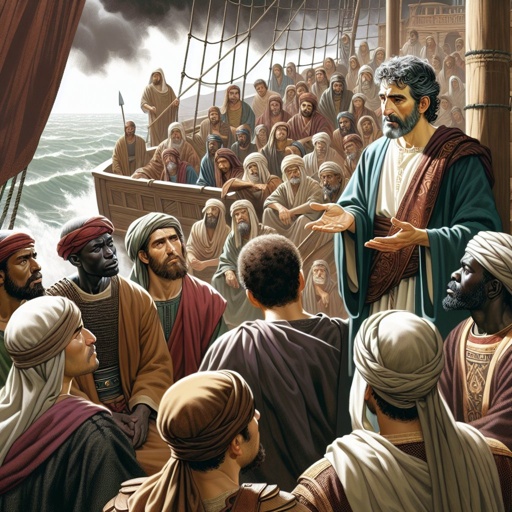
Acts 27:31 - "Paul said to the centurion and to the soldiers, Except these abide in the ship, ye cannot be saved."

Acts 10:27 - "And as he talked with him, he went in, and found many that were come together."

Acts 27:6 - "And there the centurion found a ship of Alexandria sailing into Italy; and he put us therein."

Acts 27:23 - "For there stood by me this night the angel of God, whose I am, and whom I serve,"

Acts 27:42 - "And the soldiers' counsel was to kill the prisoners, lest any of them should swim out, and escape."

Acts 25:27 - "For it seemeth to me unreasonable to send a prisoner, and not withal to signify the crimes laid against him."

Jeremiah 22:27 - "But to the land whereunto they desire to return, thither shall they not return."

Acts 22:22 - "And they gave him audience unto this word, and then lifted up their voices, and said, Away with such a fellow from the earth: for it is not fit that he should live."

Acts 12:22 - "And the people gave a shout, saying, It is the voice of a god, and not of a man."