What does Acts 22:27 mean?
“Then the chief captain came, and said unto him, Tell me, art thou a Roman? He said, Yea.” — Acts 22:27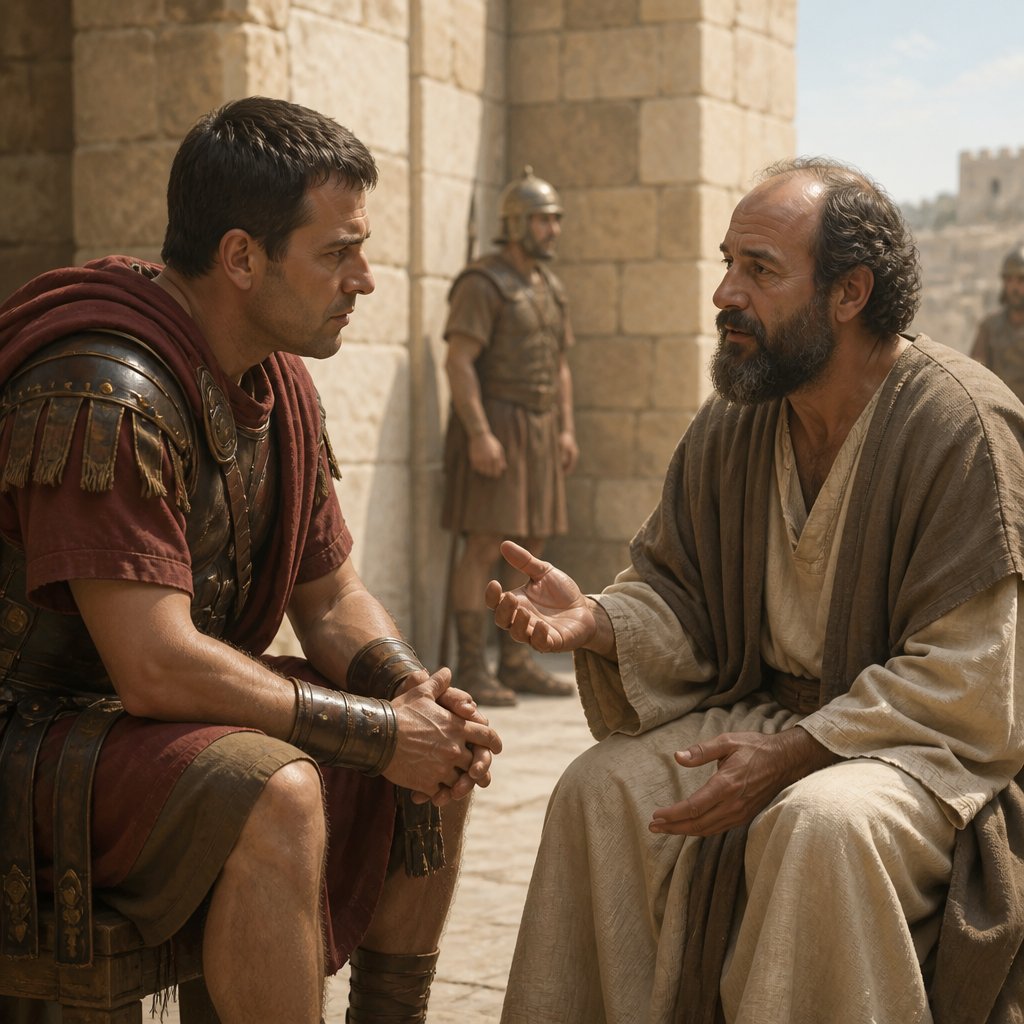
The verse Acts 22:27 in the King James Version of the Bible reads: "Then the chief captain came, and said unto him, Tell me, art thou a Roman? He said, Yea."
This verse is part of a larger passage in the book of Acts that recounts the story of how the apostle Paul, a devout Jew who had converted to Christianity, was arrested in Jerusalem. The chief captain mentioned in the verse was a Roman military officer in charge of keeping the peace in the city. When the captain heard that there was a disturbance in the temple, he quickly came to the scene and took Paul into custody.
In this particular moment, the captain asks Paul a crucial question: "art thou a Roman?" This question is significant because Roman citizenship was a privilege that carried certain legal and social advantages in the ancient world. It was not something that was easily obtained, and it conferred a special status on the person who held it. Paul's response, "Yea," confirmed that he was indeed a Roman citizen.
The context of this verse is important in understanding its significance. Paul's Roman citizenship becomes a central theme in the subsequent verses as it protects him from the harsh treatment that would have been meted out to him by the Jewish authorities. This episode illustrates the providence of God and serves as a testament to the fulfillment of God's plan for Paul's life.
The symbolism in this verse is profound. On a literal level, it represents the intersection of Paul's Jewish and Roman identities. As a Jew, Paul was deeply connected to his religious and cultural heritage. Yet, as a Roman citizen, he held a position of privilege and authority that set him apart from other members of the Jewish community. This duality in his identity mirrors the dichotomy of the early Christian community, which sought to reconcile its Jewish roots with its mission to spread the gospel to the wider Roman world.
On a deeper level, Paul's affirmation of his Roman citizenship can be seen as a symbol of his divine calling and the unique role he was to play in the spread of Christianity. This moment marks a turning point in his journey, as it sets the stage for the events that will unfold in the rest of the book of Acts. By declaring his Roman citizenship, Paul asserts his rights and claims the protection that comes with it. This not only allows him to avoid immediate punishment but also leads to his eventual appeals to Roman authorities and his eventual journey to Rome, where he will have the opportunity to spread the message of Christ to the heart of the Roman Empire.
The theme of divine providence is also evident in this verse. It is no coincidence that Paul happened to be a Roman citizen at this crucial moment in his life. This fact served as a strategic advantage in the unfolding of God's plan for him. It demonstrates the element of divine intervention at play in the course of human events and serves as a reminder that God is in control, even in the midst of chaos and uncertainty.
In conclusion, Acts 22:27 is a verse that holds great significance in the larger narrative of the book of Acts and in the story of the early Christian church. Paul's affirmation of his Roman citizenship marks a pivotal moment in his journey and serves as a symbol of his dual identity and God's providential care. It is a testament to the intersection of human agency and divine intervention, and it sets the stage for the events that will unfold as Paul's mission continues to unfold.
Get our apps


Artwork for Acts 22:27

Acts 22:27 - "Then the chief captain came, and said unto him, Tell me, art thou a Roman? He said, Yea."
"Then the chief captain came, and said unto him, Tell me, art thou a Roman? He said, Yea." - Acts 22:27

Acts 27:22 - "And now I exhort you to be of good cheer: for there shall be no loss of any man's life among you, but of the ship."

"And now I exhort you to be of good cheer: for there shall be no loss of any man's life among you, but of the ship." - Acts 27:22

Acts 17:27

Acts 27:26 - "Howbeit we must be cast upon a certain island."

Acts 27:27 - "But when the fourteenth night was come, as we were driven up and down in Adria, about midnight the shipmen deemed that they drew near to some country;"

Acts 1:21-22

Deut 14:22-27

Acts 11:27 - "¶ And in these days came prophets from Jerusalem unto Antioch."

Acts 1:21-22

Acts 27:36 - "Then were they all of good cheer, and they also took some meat."

Acts 27:14 - "But not long after there arose against it a tempestuous wind, called Euroclydon."

Acts 27:32 - "Then the soldiers cut off the ropes of the boat, and let her fall off."

Matthew 22:27 - "And last of all the woman died also."

Acts 27:18 - "And we being exceedingly tossed with a tempest, the next day they lightened the ship;"

Acts 27:37 - "And we were in all in the ship two hundred threescore and sixteen souls."

Acts 20:27 - "For I have not shunned to declare unto you all the counsel of God."

Acts 26:27 - "King Agrippa, believest thou the prophets? I know that thou believest."

Acts 27:38 - "And when they had eaten enough, they lightened the ship, and cast out the wheat into the sea."

Acts 27:19 - "And the third day we cast out with our own hands the tackling of the ship."
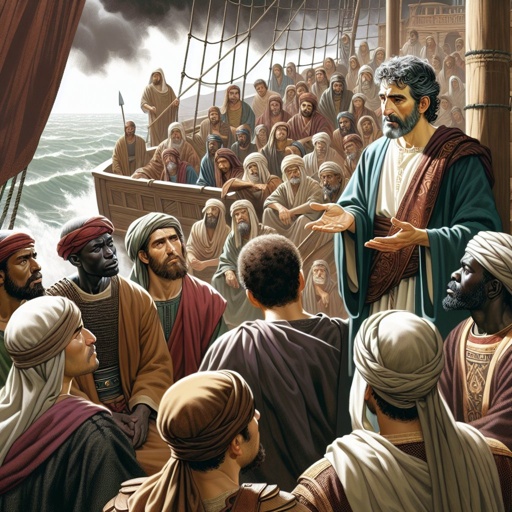
Acts 27:31 - "Paul said to the centurion and to the soldiers, Except these abide in the ship, ye cannot be saved."

Acts 10:27 - "And as he talked with him, he went in, and found many that were come together."

Acts 27:6 - "And there the centurion found a ship of Alexandria sailing into Italy; and he put us therein."

Acts 27:23 - "For there stood by me this night the angel of God, whose I am, and whom I serve,"

Acts 27:42 - "And the soldiers' counsel was to kill the prisoners, lest any of them should swim out, and escape."

Acts 25:27 - "For it seemeth to me unreasonable to send a prisoner, and not withal to signify the crimes laid against him."

Jeremiah 22:27 - "But to the land whereunto they desire to return, thither shall they not return."

Acts 22:22 - "And they gave him audience unto this word, and then lifted up their voices, and said, Away with such a fellow from the earth: for it is not fit that he should live."

Acts 12:22 - "And the people gave a shout, saying, It is the voice of a god, and not of a man."