The Journey to Jerusalem: Trials and Triumphs of Faith
“But Festus, willing to do the Jews a pleasure, answered Paul, and said, Wilt thou go up to Jerusalem, and there be judged of these things before me?” — Acts 25:9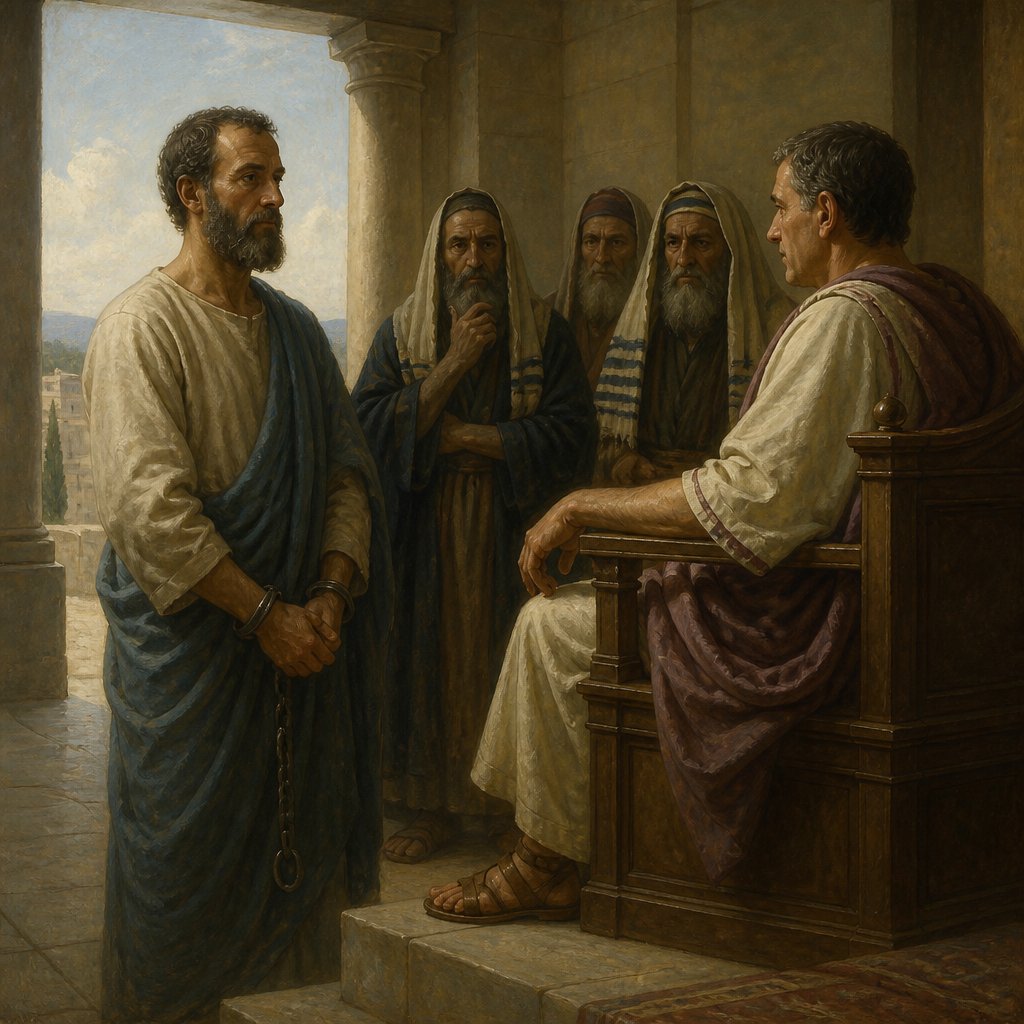
In the arena of faith, the story in Acts 25:9 presents a captivating intersection of politics, justice, and the unwavering truth of God’s Word. The verse reads, "But Festus, willing to do the Jews a pleasure, answered Paul, and said, Wilt thou go up to Jerusalem, and there be judged of these things before me?" This interaction between Paul and Festus serves as a profound lesson, reminding us of the complexities of human motivations and the steadfastness one must harness in the face of trials.
Paul, having been imprisoned unjustly, found himself in the hands of Festus, a new governor appointed by Rome. His very existence faced the whims of political maneuvering—Festus, sensing the pressure from the Jewish leaders, sought to pander to their desires. Here, we’re met with a reality that echoes throughout history: often rulers and leaders act to please the loudest voices, reflecting a fundamental human inclination towards popularity rather than justice.
But the heart of Paul does not waver even in such a precarious situation. Instead of conforming to the pressures that seek to define his fate, Paul, grounded in the truth of the Gospel, remained steadfast. His profound trust in God’s plan for his life illuminates a path for us in moments of trial. Just as Paul was not deterred, we too must embrace our situations looking beyond mere political outcomes and societal pressures.
In those moments of feeling outnumbered or misjudged, we are invited to reflect on the ultimate purpose of our trials. Are we merely seeking to escape discomfort, or are we leveraging these experiences to grow closer to God? It is vital to remember that our journeys may lead us through stormy seas or into the well-lit rooms of judgment; however, God’s sovereignty governs all. Paul’s response rebuffed the suggestion of going to Jerusalem—a politically charged move that could lead to his death. Instead, he invoked his rights as a Roman citizen, appealing to Caesar’s court (Acts 25:11). Here, Paul models for us the importance of recognizing the tools God has given us to navigate life.
When facing our own judgments—whether they are biased or based on misunderstandings—a sense of peace can come when we rely not on our strength but on the advocacy of Jesus Christ. He is our intercessor before the Father and understands every trial we face. Paul's story urges us to courageously stand for our beliefs, turning away from the fleeting pleasures of conformity, instead choosing the tough path of integrity, punctuated with faith in God’s ultimate justice.
Moreover, Paul’s commitment to his followership of Christ juxtaposed against the political intrigue of Festus illuminates a critical truth: the kingdom of God often functions in an upside-down manner compared to worldly reasoning. Festus envisioned safety and applause through accommodation, while Paul found his strength through defiance against injustice. We often face choices in our spiritual walk—when do we cower, and when do we confront the circumstances with boldness? Let us lean into the wisdom gleaned from Paul’s experience to educate our responses in the face of life’s trials.
In closing, Acts 25:9 reflects a broader narrative: faithfulness is rooted in a deep understanding of who God is. As Christians, each day presents us with choices echoing Paul’s – will we align with the status quo of convenience, or will we courageously stand for the values we are called to uphold, trusting in God amidst circumstances where our trials are pronounced? May we, like Paul, find our voice in the places of judgment and allow God to direct our paths to fulfill His purposes.
Get our apps


Artwork for Acts 25:9

Acts 25:9 - "But Festus, willing to do the Jews a pleasure, answered Paul, and said, Wilt thou go up to Jerusalem, and there be judged of these things before me?"

"But Festus, willing to do the Jews a pleasure, answered Paul, and said, Wilt thou go up to Jerusalem, and there be judged of these things before me?" - Acts 25:9

Acts 9:25 - "Then the disciples took him by night, and let him down by the wall in a basket."

"Then the disciples took him by night, and let him down by the wall in a basket." - Acts 9:25

Acts 23:25 - "And he wrote a letter after this manner:"

Acts 11:25 - "Then departed Barnabas to Tarsus, for to seek Saul:"

Acts 14:25 - "And when they had preached the word in Perga, they went down into Attalia:"

Acts 25:25 - "But when I found that he had committed nothing worthy of death, and that he himself hath appealed to Augustus, I have determined to send him."

1 Corinthians 9:25-27

1 Corinthians 9:25-27

1 Corinthians 9:25-27

1 Corinthians 9:25-27

Genesis 25-9

Acts 25:2 - "Then the high priest and the chief of the Jews informed him against Paul, and besought him,"

Acts 9:9 - "And he was three days without sight, and neither did eat nor drink."

Acts 16:25 - "¶ And at midnight Paul and Silas prayed, and sang praises unto God: and the prisoners heard them."

Acts 25:27 - "For it seemeth to me unreasonable to send a prisoner, and not withal to signify the crimes laid against him."

Acts 10:25 - "And as Peter was coming in, Cornelius met him, and fell down at his feet, and worshipped him."

Acts 25:13 - "And after certain days king Agrippa and Bernice came unto Caesarea to salute Festus."

Acts 27:25 - "Wherefore, sirs, be of good cheer: for I believe God, that it shall be even as it was told me."

Acts 9:1-20

Acts 9:1-20

Genesis 9:24-25

Acts 25:4 - "But Festus answered, that Paul should be kept at Caesarea, and that he himself would depart shortly thither."

"And he wrote a letter after this manner:" - Acts 23:25

"Then departed Barnabas to Tarsus, for to seek Saul:" - Acts 11:25

Acts 25:18 - "Against whom when the accusers stood up, they brought none accusation of such things as I supposed:"

Acts 25:1 - "Now when Festus was come into the province, after three days he ascended from Caesarea to Jerusalem."

Acts 8:25 - "And they, when they had testified and preached the word of the Lord, returned to Jerusalem, and preached the gospel in many villages of the Samaritans."

2 Chronicles 25:26 - "Now the rest of the acts of Amaziah, first and last, behold, are they not written in the book of the kings of Judah and Israel?"