The Power and the Fall: A Reflection on Daniel 7:20
“And of the ten horns that were in his head, and of the other which came up, and before whom three fell; even of that horn that had eyes, and a mouth that spake very great things, whose look was more stout than his fellows.” — Daniel 7:20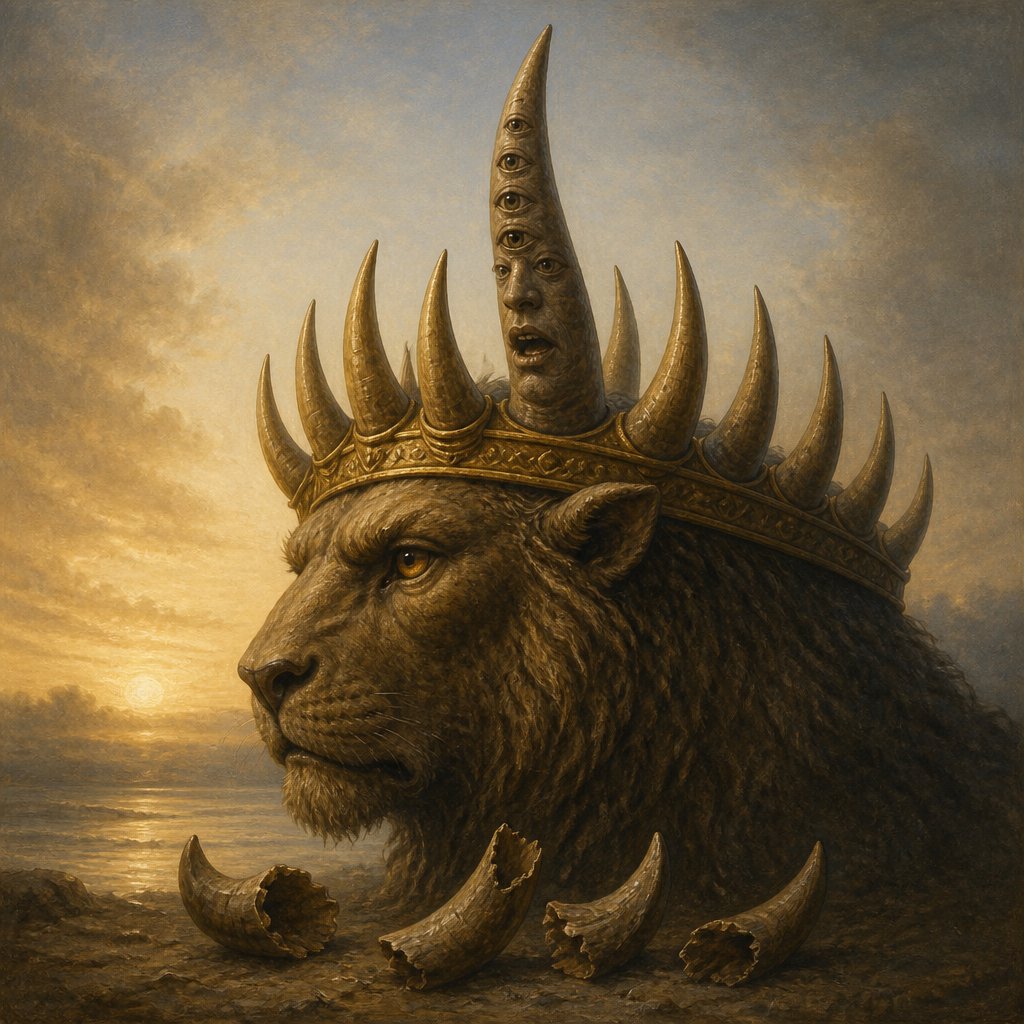
The book of Daniel is a profound piece of biblical literature that intertwines prophecy, history, and the sovereignty of God over the kingdoms of the world. Within its pages, we encounter images of power, strength, and spiritual warfare. Daniel 7:20 provides a striking depiction of a horn—representing a powerful ruler or kingdom—arising amidst ten horns, illustrating the dynamics of authority and its relation to divine providence. The verse states: "And of the ten horns that were in his head, and of the other which came up, and before whom three fell; even of that horn that had eyes, and a mouth that spake very great things, whose look was more stout than his fellows."
As we delve into the layers of meaning within this verse, let us first consider the horns as symbols of power, authority, and dominion. In ancient times, horns represented strength and a call to battle. The ten horns emerge as a group that signifies a coalition of power—perhaps referencing ten kingdoms or rulers that thrive together but also experience the threat of being uprooted by a more formidable force. This imagery resonates in our world today, where powers often rise and fall, and where governmental structures can change drastically in a short period.
The verse also introduces an 'other' horn that comes up after the ten. This horn is not merely another contender in the game of thrones but an overpowering entity that causes three of the original horns to fall before it. This detail emphasizes that new powers can emerge, often at the expense of existing ones. It evokes a sense of turmoil, transitions, and upheaval that reveals a truth familiar to our experience: change is often difficult and comes with loss.
Furthermore, this prominent horn has features that set it apart—eyes and a mouth that speaks "very great things." The horn's ability to see provides it with insight and perception, while its mouth symbolizes communication, often linked with authority, influence, and even blasphemy. The intensity of its gaze and the grandiose speech it produces serve as a reminder of the deceptive nature of power. While it may seem attractive and formidable, it is crucial for us as believers to discern the signs and be cautious about the influences we allow into our lives.
The phrase "whose look was more stout than his fellows" denotes a boastful demeanor, indicative of egotism and arrogance. When authority figures believe themselves to be invincible, they are at their most perilous. This characteristic of the horn mirrors scenarios we encounter within our society, from political figures to corporate leaders, where pride often precedes a fall.
As believers, we are encouraged to examine our hearts and minds when faced with the powers and malice of influential figures in our lives, whether seen in politics, society, or even in personal relationships. We must not lose sight of God's sovereignty amidst human attempts to assert dominance and control. Daniel 7 reminds us that no matter how powerful or boastful they may appear, their authority is temporary in view of God's eternal kingdom.
Reflecting on this passage brings us to a place of humility. In a world that often celebrates strength and defiance, we are called to be the opposite—gentle, kind, and followers of the true King, whose reign is characterized by love and righteousness. The narrative of Daniel offers assurance that even when it seems that the foundations of the world are shaking, God remains sovereign and in control.
In the days ahead, let us carry this awareness into our daily lives. While we navigate power dynamics around us, may we seek the Lord's wisdom in discerning truth from deception, pushing against pride with humility, and living out our faith as representatives of His kingdom. In doing so, we find true strength—not in horns and lofty declarations—but in submission to His everlasting reign.
Get our apps


Artwork for Daniel 7:20
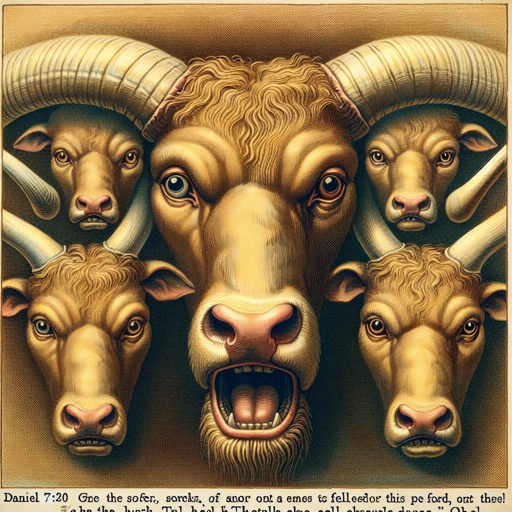
Daniel 7:20 - "And of the ten horns that were in his head, and of the other which came up, and before whom three fell; even of that horn that had eyes, and a mouth that spake very great things, whose look was more stout than his fellows."

and about the ten horns that were on its head, and the other horn that came up and before which three of them fell, the horn that had eyes and a mouth that spoke great things, and that seemed greater than its companions. Daniel 7:20
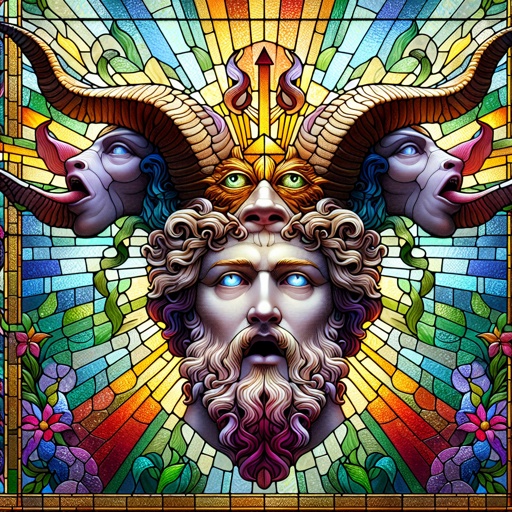
and about the ten horns that were on its head, and the other horn that came up and before which three of them fell, the horn that had eyes and a mouth that spoke great things, and that seemed greater than its companions. Daniel 7:20
"And of the ten horns that were in his head, and of the other which came up, and before whom three fell; even of that horn that had eyes, and a mouth that spake very great things, whose look was more stout than his fellows." - Daniel 7:20

Daniel 2:20 - "Daniel answered and said, Blessed be the name of God for ever and ever: for wisdom and might are his:"

Daniel 6:20 - "And when he came to the den, he cried with a lamentable voice unto Daniel: and the king spake and said to Daniel, O Daniel, servant of the living God, is thy God, whom thou servest continually, able to deliver thee from the lions?"
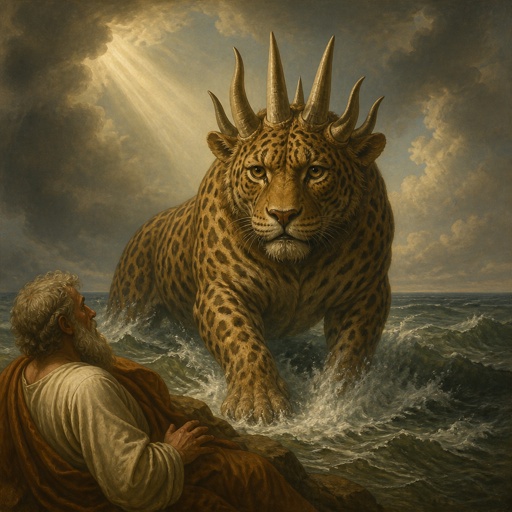
Daniel 7:8

Daniel 7:5

Daniel 7:4

Daniel 7:5

Daniel 7:5
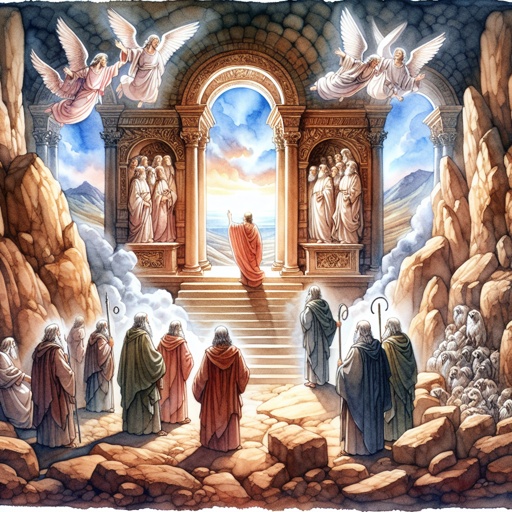
Daniel 7:8

Daniel 7:15 - "¶ I Daniel was grieved in my spirit in the midst of my body, and the visions of my head troubled me."

Daniel 7:9-10

Daniel 7: 9-10

Daniel 7:9-10

Daniel 7:9-10

Daniel 7:2 - "Daniel spake and said, I saw in my vision by night, and, behold, the four winds of the heaven strove upon the great sea."

"Daniel answered and said, Blessed be the name of God for ever and ever: for wisdom and might are his:" - Daniel 2:20
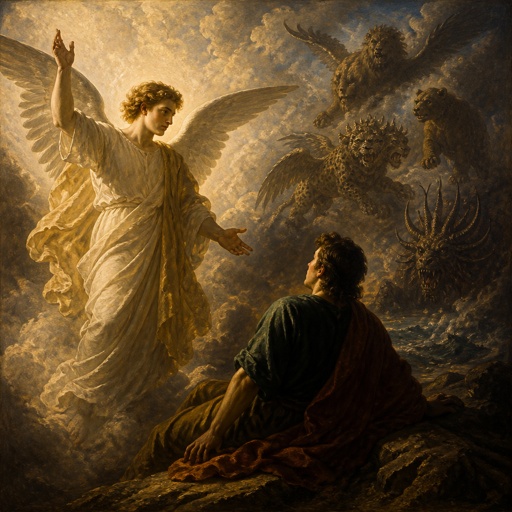
Gabriel speaking to Daniel in chapter 7

Daniel 8:20 - "The ram which thou sawest having two horns are the kings of Media and Persia."

Daniel 1:7 - "Unto whom the prince of the eunuchs gave names: for he gave unto Daniel the name of Belteshazzar; and to Hananiah, of Shadrach; and to Mishael, of Meshach; and to Azariah, of Abed-nego."

Daniel 7:28 - "Hitherto is the end of the matter. As for me Daniel, my cogitations much troubled me, and my countenance changed in me: but I kept the matter in my heart."

Daniel 10:7 - "And I Daniel alone saw the vision: for the men that were with me saw not the vision; but a great quaking fell upon them, so that they fled to hide themselves."

Daniel 7:1 - "In the first year of Belshazzar king of Babylon Daniel had a dream and visions of his head upon his bed: then he wrote the dream, and told the sum of the matters."

COSMIC COURTROOM OF FIRE DANIEL 7:9-10

Daniel 4:20 - "The tree that thou sawest, which grew, and was strong, whose height reached unto the heaven, and the sight thereof to all the earth;"

Daniel 7:21 - "I beheld, and the same horn made war with the saints, and prevailed against them;"

Daniel 7:9-10 – "His clothing was as white as snow; the hair of his head was white like wool."

Daniel 7:17 - "These great beasts, which are four, are four kings, which shall arise out of the earth."