Sowing in Faith: The Art of Diligent Labor
“In the morning sow thy seed, and in the evening withhold not thine hand: for thou knowest not whether shall prosper, either this or that, or whether they both shall be alike good.” — Ecclesiastes 11:6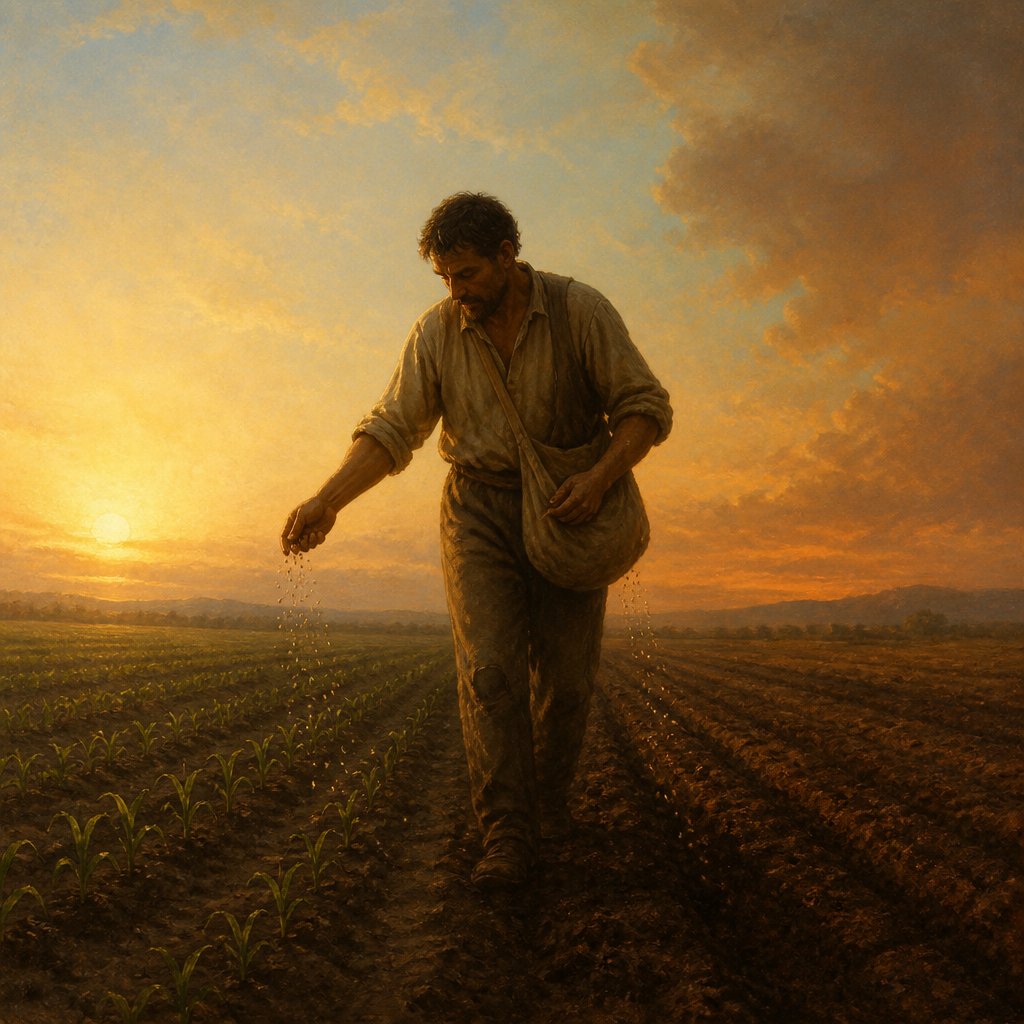
The book of Ecclesiastes is a profound piece of literature, rich in wisdom and complexity, often reflecting on the paradoxes of life. Chapter 11, verse 6, offers a powerful reflection on the nature of work, the act of sowing, and the unpredictable outcomes of our efforts: "In the morning sow thy seed, and in the evening withhold not thine hand: for thou knowest not whether shall prosper, either this or that, or whether they both shall be alike good."
As we delve into this verse, we recognize a call to action, a divine encouragement to engage earnestly in our labors. The metaphor of sowing seeds connects deeply with agricultural practices, a relatable concept for the original audience and still relevant today. In ancient cultures, sowing represented hope for future sustenance, and the act of casting seed was one filled with anticipation. To sow, therefore, is to invest in the future, fully aware yet undeterred by the unknowns that lie ahead.
The directive to sow "in the morning" suggests the importance of starting our day actively and positively, approaching each new sunrise with purpose. Mornings often symbolize new beginnings, and the metaphorical seed sown in the morning represents our intentions, efforts, and dreams. It is a reminder to begin each day with proactive faith. How often do we fill our mornings with thoughts that hold us back? Instead, we are challenged to sow seeds of ambition, creativity, and kindness, earningestly pursuing all that God calls us to do.
Then comes the instruction to labor "in the evening" as well. In the agricultural cycle, this would signify continued diligence, as the work of sowing doesn't cease when the sun sets. This dual exhortation emphasizes the necessity of consistent effort throughout our lives. While we may have long-term visions for our endeavors, our daily actions—what we do when our energy is waning or when distractions beckon—reflect our commitment to our goals. The work is not just in the initial sowing but in reaping the benefits of persistence.
The concluding part of the verse highlights an essential truth: the uncertainty of outcomes. The wisdom here is profound: "for thou knowest not whether shall prosper, either this or that, or whether they both shall be alike good." We often seek guarantees in our endeavors, wanting assurance that our efforts will lead to success. Yet life teaches us that such certainties are rare. This uncertainty can be disheartening, but it can also be liberating.
By recognizing that the outcome is ultimately beyond our control, we can release the heavy burden of perfectionism and fear of failure. We are invited instead to trust in God's sovereignty and wisdom. In His hands, our efforts, regardless of the immediate results, are valuable. Each seed sown with faith contributes to a greater purpose, often beyond our understanding.
When we sow in faith, we may witness unexpected blooms, or we might plant in challenging soil and see little immediate result. Either way, God can use our diligence and intent to fulfill His divine plan. This passage compels us to embrace each day with an attitude of expectancy and diligence, sowing seeds in careers, relationships, and spiritual growth, knowing that not every seed will sprout beautifully, but all are part of God's grand tapestry.
Therefore, let us go forth with seeded hands, ready to work in the morning and evening alike, embracing the unknowns with courage and steadfast faith. Let us commit our actions to the Lord and do our best, confident that, regardless of the outcome, we are fulfilling our purpose by sowing seeds in every season of life.
Get our apps


Artwork for Ecclesiastes 11:6

Ecclesiastes 11:6 - "In the morning sow thy seed, and in the evening withhold not thine hand: for thou knowest not whether shall prosper, either this or that, or whether they both shall be alike good."

"In the morning sow thy seed, and in the evening withhold not thine hand: for thou knowest not whether shall prosper, either this or that, or whether they both shall be alike good." - Ecclesiastes 11:6

Ecclesiastes 6:11 - "¶ Seeing there be many things that increase vanity, what is man the better?"

"¶ Seeing there be many things that increase vanity, what is man the better?" - Ecclesiastes 6:11

Ecclesiastes 1:11

ecclesiastes 12:2-6

Ecclesiastes 7:11 - "¶ Wisdom is good with an inheritance: and by it there is profit to them that see the sun."

Ecclesiastes 10:11 - "Surely the serpent will bite without enchantment; and a babbler is no better."

Ecclesiastes 11:7 - "¶ Truly the light is sweet, and a pleasant thing it is for the eyes to behold the sun:"

Ecclesiastes 10:6 - "Folly is set in great dignity, and the rich sit in low place."

Ecclesiastes 6:7 - "All the labour of man is for his mouth, and yet the appetite is not filled."

Ecclesiastes 3:6 - "A time to get, and a time to lose; a time to keep, and a time to cast away;"

Ecclesiastes 11:1 - "Cast thy bread upon the waters: for thou shalt find it after many days."

Ecclesiastes 11:4 - "He that observeth the wind shall not sow; and he that regardeth the clouds shall not reap."

Ecclesiastes 6:9 - "¶ Better is the sight of the eyes than the wandering of the desire: this is also vanity and vexation of spirit."

Ecclesiastes 6:1 - "There is an evil which I have seen under the sun, and it is common among men:"

Ecclesiastes 6:4 - "For he cometh in with vanity, and departeth in darkness, and his name shall be covered with darkness."

Ecclesiastes 7:6 - "For as the crackling of thorns under a pot, so is the laughter of the fool: this also is vanity."

Ecclesiastes 12:11 - "The words of the wise are as goads, and as nails fastened by the masters of assemblies, which are given from one shepherd."

Ecclesiastes 4:11 - "Again, if two lie together, then they have heat: but how can one be warm alone?"

Ecclesiastes 8:6 - "¶ Because to every purpose there is time and judgment, therefore the misery of man is great upon him."

Ecclesiastes 4:6 - "Better is an handful with quietness, than both the hands full with travail and vexation of spirit."

Ecclesiastes 6:6 - "¶ Yea, though he live a thousand years twice told, yet hath he seen no good: do not all go to one place?"

Ecclesiastes 11:2 - "Give a portion to seven, and also to eight; for thou knowest not what evil shall be upon the earth."

Ecclesiastes 2:6 - "I made me pools of water, to water therewith the wood that bringeth forth trees:"

Ecclesiastes 5:11 - "When goods increase, they are increased that eat them: and what good is there to the owners thereof, saving the beholding of them with their eyes?"

Ecclesiastes 1:11 - "There is no remembrance of former things; neither shall there be any remembrance of things that are to come with those that shall come after."

Ecclesiastes 12:6 - "Or ever the silver cord be loosed, or the golden bowl be broken, or the pitcher be broken at the fountain, or the wheel broken at the cistern."

Ecclesiastes 6:8 - "For what hath the wise more than the fool? what hath the poor, that knoweth to walk before the living?"

"¶ Wisdom is good with an inheritance: and by it there is profit to them that see the sun." - Ecclesiastes 7:11