What does Ecclesiastes 11:6 mean?
“In the morning sow thy seed, and in the evening withhold not thine hand: for thou knowest not whether shall prosper, either this or that, or whether they both shall be alike good.” — Ecclesiastes 11:6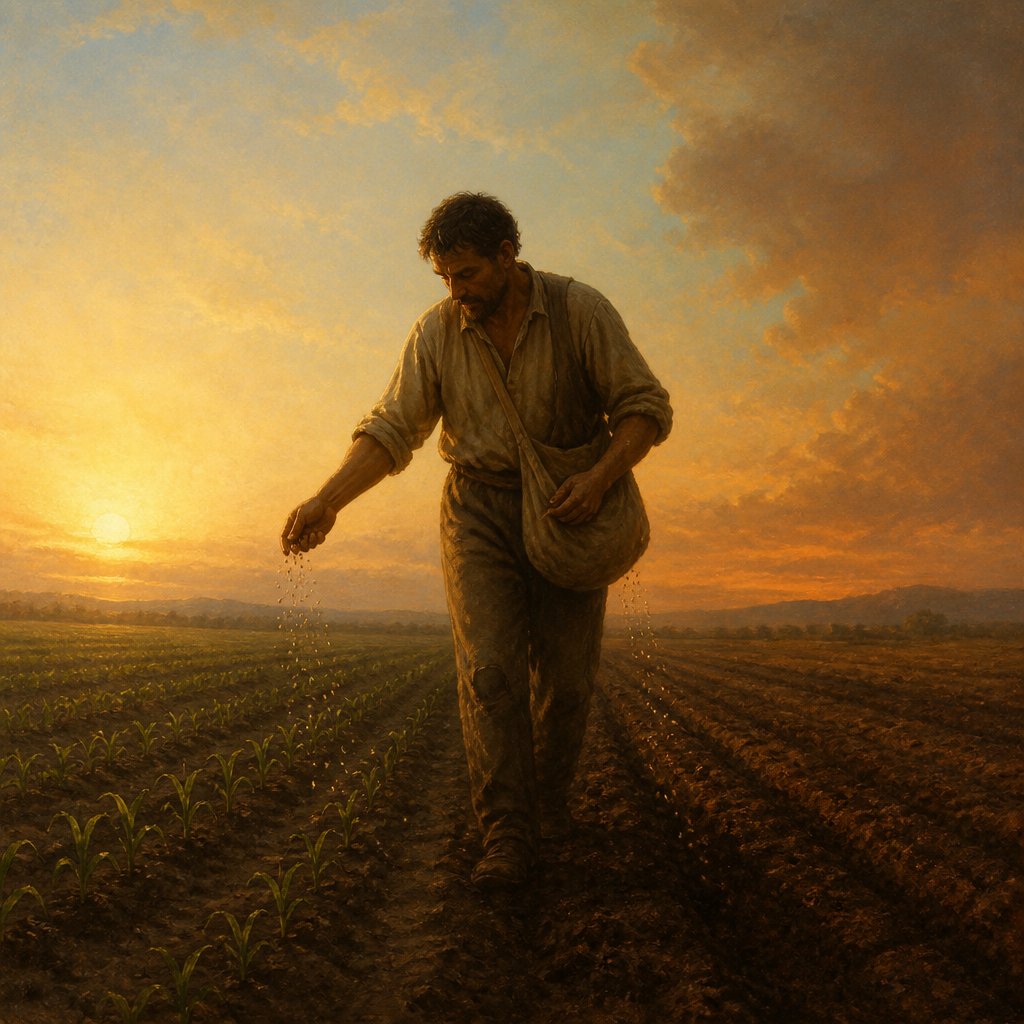
The King James Version (KJV) of Ecclesiastes 11:6 reads, "In the morning sow thy seed, and in the evening withhold not thine hand: for thou knowest not whether shall prosper, either this or that, or whether they both shall be alike good."
The book of Ecclesiastes, written by King Solomon, is known for its philosophical reflections on the meaning of life, the pursuit of wisdom, and the inevitability of death. The verse in question is part of a larger passage in which the author offers practical advice for navigating the uncertainties of life.
The verse begins with a call to action: "In the morning sow thy seed." This can be interpreted as a metaphor for taking initiative and investing in one's future. In ancient agricultural societies, the act of sowing seeds was fundamental to ensuring a bountiful harvest. Similarly, the author exhorts the reader to take proactive steps towards success and prosperity.
The next part of the verse states, "and in the evening withhold not thine hand." This admonition underscores the importance of diligence and perseverance. The idea is to work diligently throughout the day, without allowing weariness or discouragement to hinder one's efforts. The evening is a time when many people might be tempted to relax or give up on their tasks, but the author urges against such complacency.
The verse concludes with the reasoning behind this advice: "for thou knowest not whether shall prosper, either this or that, or whether they both shall be alike good." This acknowledges the inherent unpredictability of outcomes in life. Despite our best efforts and intentions, we cannot always control the results of our actions. The language used in the verse conveys a sense of uncertainty and ambiguity, reflecting the complex and often perplexing nature of human existence.
The theme of uncertainty and the unpredictability of life is central to the book of Ecclesiastes as a whole. Throughout the book, King Solomon reflects on the transitory nature of human existence and the futility of pursuing worldly pleasures and accomplishments. In light of this, the advice to "sow thy seed" and "withhold not thine hand" takes on added significance. It encourages the reader to engage with the world and to strive for success, despite the inherent uncertainty of outcomes.
The verse can also be seen as an expression of faith and trust in divine providence. By acknowledging that the ultimate outcome of one's efforts is beyond our knowledge or control, the author implicitly points towards a reliance on something greater than oneself. This aligns with the broader spiritual themes present throughout the book of Ecclesiastes, where the fleeting nature of human existence is contrasted with the enduring wisdom and sovereignty of God.
Furthermore, the agricultural imagery used in the verse carries symbolic weight. The act of sowing seeds and tending to the land speaks to the theme of growth, renewal, and the cyclical nature of life. It also suggests the idea of investing in the future, putting in the necessary work and effort in the present in anticipation of a future harvest. This aligns with the broader message of Ecclesiastes, which emphasizes the importance of living with purpose and intentionality, even in the face of life's uncertainties.
In conclusion, Ecclesiastes 11:6 offers practical wisdom for navigating the uncertainties of life, while also conveying deeper spiritual and existential insights. The verse encourages the reader to take proactive steps towards success and prosperity, to persevere in the face of challenges, and to approach life with faith and trust in divine providence. It also carries symbolic weight through its use of agricultural imagery, which reinforces the broader themes of growth, renewal, and the cyclical nature of life. Ultimately, the verse encapsulates the timeless wisdom and profound insights that continue to resonate with readers across cultures and generations.
Get our apps


Artwork for Ecclesiastes 11:6

Ecclesiastes 11:6 - "In the morning sow thy seed, and in the evening withhold not thine hand: for thou knowest not whether shall prosper, either this or that, or whether they both shall be alike good."

"In the morning sow thy seed, and in the evening withhold not thine hand: for thou knowest not whether shall prosper, either this or that, or whether they both shall be alike good." - Ecclesiastes 11:6

Ecclesiastes 6:11 - "¶ Seeing there be many things that increase vanity, what is man the better?"

"¶ Seeing there be many things that increase vanity, what is man the better?" - Ecclesiastes 6:11

Ecclesiastes 1:11

ecclesiastes 12:2-6

Ecclesiastes 7:11 - "¶ Wisdom is good with an inheritance: and by it there is profit to them that see the sun."

Ecclesiastes 10:11 - "Surely the serpent will bite without enchantment; and a babbler is no better."

Ecclesiastes 11:7 - "¶ Truly the light is sweet, and a pleasant thing it is for the eyes to behold the sun:"

Ecclesiastes 10:6 - "Folly is set in great dignity, and the rich sit in low place."

Ecclesiastes 6:7 - "All the labour of man is for his mouth, and yet the appetite is not filled."

Ecclesiastes 3:6 - "A time to get, and a time to lose; a time to keep, and a time to cast away;"

Ecclesiastes 11:1 - "Cast thy bread upon the waters: for thou shalt find it after many days."

Ecclesiastes 11:4 - "He that observeth the wind shall not sow; and he that regardeth the clouds shall not reap."

Ecclesiastes 6:9 - "¶ Better is the sight of the eyes than the wandering of the desire: this is also vanity and vexation of spirit."

Ecclesiastes 6:1 - "There is an evil which I have seen under the sun, and it is common among men:"

Ecclesiastes 6:4 - "For he cometh in with vanity, and departeth in darkness, and his name shall be covered with darkness."

Ecclesiastes 7:6 - "For as the crackling of thorns under a pot, so is the laughter of the fool: this also is vanity."

Ecclesiastes 12:11 - "The words of the wise are as goads, and as nails fastened by the masters of assemblies, which are given from one shepherd."

Ecclesiastes 4:11 - "Again, if two lie together, then they have heat: but how can one be warm alone?"

Ecclesiastes 8:6 - "¶ Because to every purpose there is time and judgment, therefore the misery of man is great upon him."

Ecclesiastes 4:6 - "Better is an handful with quietness, than both the hands full with travail and vexation of spirit."

Ecclesiastes 6:6 - "¶ Yea, though he live a thousand years twice told, yet hath he seen no good: do not all go to one place?"

Ecclesiastes 11:2 - "Give a portion to seven, and also to eight; for thou knowest not what evil shall be upon the earth."

Ecclesiastes 2:6 - "I made me pools of water, to water therewith the wood that bringeth forth trees:"

Ecclesiastes 5:11 - "When goods increase, they are increased that eat them: and what good is there to the owners thereof, saving the beholding of them with their eyes?"

Ecclesiastes 1:11 - "There is no remembrance of former things; neither shall there be any remembrance of things that are to come with those that shall come after."

Ecclesiastes 12:6 - "Or ever the silver cord be loosed, or the golden bowl be broken, or the pitcher be broken at the fountain, or the wheel broken at the cistern."

Ecclesiastes 6:8 - "For what hath the wise more than the fool? what hath the poor, that knoweth to walk before the living?"

"¶ Wisdom is good with an inheritance: and by it there is profit to them that see the sun." - Ecclesiastes 7:11