The Eternal Work of God: A Reflection on Ecclesiastes 3:14
“I know that, whatsoever God doeth, it shall be for ever: nothing can be put to it, nor any thing taken from it: and God doeth it, that men should fear before him.” — Ecclesiastes 3:14
The self-investigating musings of Ecclesiastes bring us to a profound realization about the nature of God and His divine plan. In Ecclesiastes 3:14, we read, "I know that, whatsoever God doeth, it shall be for ever: nothing can be put to it, nor any thing taken from it: and God doeth it, that men should fear before him." This verse serves as a cornerstone in understanding the sovereignty of God and the eternal significance of His works.
Solomon, believed to be the author of Ecclesiastes, pours his heart into exploring life’s seasons and the ultimate purpose behind them. Every moment of joy, sorrow, toil, and rest is woven into a divine tapestry that is crafted by God’s hand. When Solomon asserts that "whatsoever God doeth, it shall be for ever," he emphasizes the permanence and unchangeable nature of God’s actions. God’s work is not temporary; it endures through the ages. As we consider the world around us—with its fleeting trends, futile pursuits, and temporary pleasures—we are called to recognize the everlasting significance of what God has done, is doing, and will do.
This leads us to a tranquil acceptance that in the chaos of life's seasons, God's sovereignty reigns. Despite the uncertainties we face, we can find assurance that His plans cannot be altered by human interference. The phrase "nothing can be put to it, nor any thing taken from it" speaks to the completeness and perfection of God’s creation. It reminds us that His purpose is not subject to enhancement or diminishment. We are often caught in the throes of wanting to control outcomes or seeking to conform our understanding to fit our desires, but God’s intention remains steadfast and immutable. He is the Almighty, operating with a view towards eternity.
Moreover, as the verse concludes, "and God doeth it, that men should fear before him," we uncover a deep connection to reverence and awe in our relationship with God. The word "fear" in this context encompasses more than mere terror; it invites us into a space of worship, respect, and acknowledgment of God’s holiness. Recognizing the eternality of His works compels us to respond not just with understanding but with an attitude of submission to His divine authority. We are reminded that life is not merely about our individual narratives but rather part of a grand narrative orchestrated by an omniscient Creator.
In practical terms, this offers us a profound comfort amid trials. When we face struggles or when life seems chaotic, we can hold fast to the truth that God is at work, and His works are eternal. Our understanding may be clouded by circumstances, but faith urges us to trust that every moment has purpose within His greater plan. Just as He has orchestrated the cycles of creation and the rhythms of our lives, hallowed in His wisdom, we can hold onto hope that all things work together for our good according to His will (Romans 8:28).
As we meditate on Ecclesiastes 3:14, let us renew our perspective. Allow this truth to resonate in your heart: God is forever faithful. Embrace His unchanging nature, believe in the enduring quality of His work, and respond with a heart of reverence. In doing so, we align ourselves with His purpose, allowing us to live fully in the freedom of His eternal plan.
Today, consider areas of your life where you can submit control to God, acknowledging the beauty of His sovereignty. Fear Him in a way that inspires love and trust, and let His eternal work transform your perspective on all that you encounter in this temporal world.
Get our apps


Artwork for Ecclesiastes 3:14

Ecclesiastes 3:14 - "I know that, whatsoever God doeth, it shall be for ever: nothing can be put to it, nor any thing taken from it: and God doeth it, that men should fear before him."

"I know that, whatsoever God doeth, it shall be for ever: nothing can be put to it, nor any thing taken from it: and God doeth it, that men should fear before him." - Ecclesiastes 3:14

Ecclesiastes 3:1

Ecclesiastes 3:3 - "A time to kill, and a time to heal; a time to break down, and a time to build up;"

Ecclesiastes 3:7-8

Ecclesiastes 3:1 – "There is a time for everything, and a season for every activity under the heavens."

Ecclesiastes 3:1 - "To every thing there is a season, and a time to every purpose under the heaven:"

Ecclesiastes 3:9 - "What profit hath he that worketh in that wherein he laboureth?"

Ecclesiastes 3:4 - "A time to weep, and a time to laugh; a time to mourn, and a time to dance;"

Ecclesiastes 3:8 - "A time to love, and a time to hate; a time of war, and a time of peace."

Ecclesiastes 5:14 - "But those riches perish by evil travail: and he begetteth a son, and there is nothing in his hand."

Ecclesiastes 3:6 - "A time to get, and a time to lose; a time to keep, and a time to cast away;"

Ecclesiastes 7:3 - "Sorrow is better than laughter: for by the sadness of the countenance the heart is made better."

Ecclesiastes 4:14 - "For out of prison he cometh to reign; whereas also he that is born in his kingdom becometh poor."

Ecclesiastes 1:14 - "I have seen all the works that are done under the sun; and, behold, all is vanity and vexation of spirit."

Ecclesiastes 3:7 - "A time to rend, and a time to sew; a time to keep silence, and a time to speak;"

Ecclesiastes 12:14 - "For God shall bring every work into judgment, with every secret thing, whether it be good, or whether it be evil."

Ecclesiastes 3:21 - "Who knoweth the spirit of man that goeth upward, and the spirit of the beast that goeth downward to the earth?"

Ecclesiastes 3:2 - "A time to be born, and a time to die; a time to plant, and a time to pluck up that which is planted;"

Ecclesiastes 3:16 - "¶ And moreover I saw under the sun the place of judgment, that wickedness was there; and the place of righteousness, that iniquity was there."

Ecclesiastes 3:20 - "All go unto one place; all are of the dust, and all turn to dust again."

Ecclesiastes 3:12 - "I know that there is no good in them, but for a man to rejoice, and to do good in his life."

Ecclesiastes 5:3 - "For a dream cometh through the multitude of business; and a fool's voice is known by multitude of words."

Ecclesiastes 9:14 - "There was a little city, and few men within it; and there came a great king against it, and besieged it, and built great bulwarks against it:"

Ecclesiastes 12:13 Let us hear the conclusion of the whole matter: Fear God, and keep his commandments: for this is the whole duty of man. Ecclesiastes 12:14 For God shall bring every work into judgment, with every secret thing, whether it be good, or whether it be evil.

Ecclesiastes 1:3 - "What profit hath a man of all his labour which he taketh under the sun?"

Ecclesiastes 3:15 - "That which hath been is now; and that which is to be hath already been; and God requireth that which is past."

Ecclesiastes 3:10 - "I have seen the travail, which God hath given to the sons of men to be exercised in it."
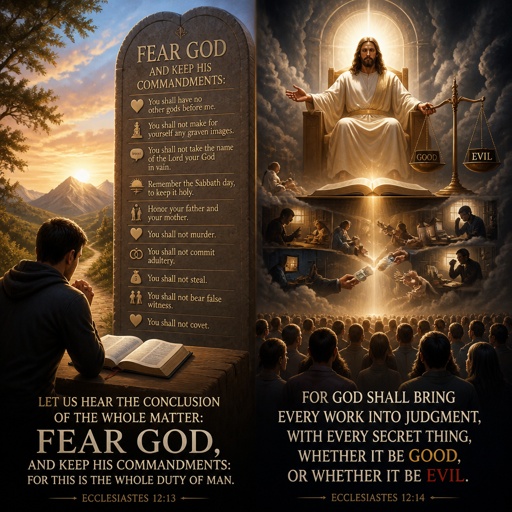
Ecclesiastes 12:13 Let us hear the conclusion of the whole matter: Fear God, and keep his commandments: for this is the whole duty of man. Ecclesiastes 12:14 For God shall bring every work into judgment, with every secret thing, whether it be good, or whether it be evil.

Ecclesiastes 2:14 - "The wise man's eyes are in his head; but the fool walketh in darkness: and I myself perceived also that one event happeneth to them all."