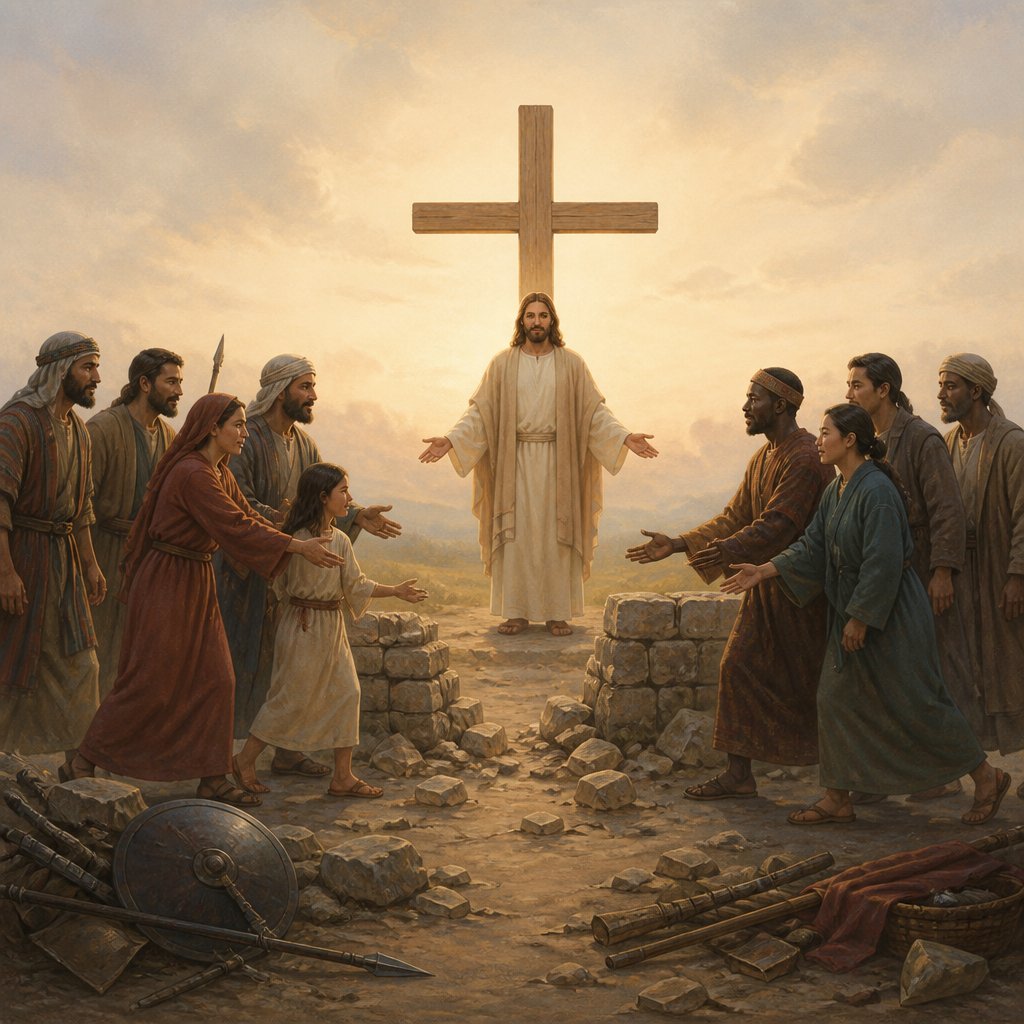
Ephesians 2:14-16 in the King James Version (KJV) reads: "For he is our peace, who hath made both one, and hath broken down the middle wall of partition between us; Having abolished in his flesh the enmity, even the law of commandments contained in ordinances; for to make in himself of twain one new man, so making peace; And that he might reconcile both unto God in one body by the cross, having slain the enmity thereby."
In an age marked by divisions—between nations, cultures, social classes, and even families—the message of reconciliation brings hope like no other. The Apostle Paul, in his letter to the Ephesians, provides profound insights into the means and purpose of peace that surpasses any human understanding. He boldly proclaims that God, through Christ, is the embodiment of peace, a peace that transcends our differences and bridges the gaps that sin and strife have created in our relationships.
The verse begins with a powerful declaration: "For he is our peace." This statement brings to light the very essence of Jesus Christ’s role in our lives. He is not merely a provider of peace; He embodies peace itself. Reflecting on this, we must ask ourselves: do we recognize Christ as our peace in the midst of chaos? In times of distress, we often seek peace through various means—a kind word, a comfortable setting, or even temporary distractions. However, Paul reminds us that true peace is found not in our circumstances but in Christ alone.
The passage continues, emphasizing that Christ "hath made both one, and hath broken down the middle wall of partition between us." This metaphorical wall represents the barriers that humanity constructs—barriers of race, class, religion, and personal grievances. In the context of the early church, it could specifically refer to the division between Jews and Gentiles. Through His death and resurrection, Jesus abolished these divisions, inviting all of humanity into one family under God. This truth challenges the Church today to reflect on how we maintain or break down such walls. Are there divisions we uphold? Are we actively tearing down barriers in our interactions with one another? Living into the truth of Christ’s reconciling work means finding unity in diversity, showcasing God’s love that is inclusive rather than exclusive.
Moreover, Paul states that Christ has "abolished in his flesh the enmity, even the law of commandments contained in ordinances." The law often serves as a source of division, highlighting our differences and failures. The Gospel, however, redefines our identity from being defined by the law to being defined by grace. This is a radical concept that invites us to examine how much we weigh ourselves and others against standards that Christ has already fulfilled. Instead of looking at one another through a lens of judgment, we are called to see each other through the lens of grace that Christ has extended to us.
The passage culminates with Paul declaring that Christ came "to make in himself of twain one new man, so making peace." The reconciliation that occurs in Christ does not erase our identities; instead, it brings a new wholeness that celebrates who we are in Him. The body of Christ—the Church—should be a reflection of this unity, a place where the richness of diversity contributes to a tapestry stronger than any single thread.
Finally, Paul concludes with a powerful affirmation: "And that he might reconcile both unto God in one body by the cross, having slain the enmity thereby." Reconciliation is not just about creating peace among ourselves; it’s ultimately about restoring our relationship with God. Jesus' sacrificial act on the cross reconciles us to God, allowing us to approach Him freely and inviting us to embody that same spirit of reconciliation to others.
As we meditate on Ephesians 2:14-16, let us embrace Jesus as our peace and pursue reconciliation across all divides. Let His spirit guide us in breaking down barriers, abolishing enmity, and forging a new identity rooted in love, grace, and peace. For in Christ, we are one.
Get our apps


Artwork for Ephesians 2:14-16

Ephesians 2:14-16 - "For he himself is our peace, who has made the two groups one and has destroyed the barrier, the dividing wall of hostility, by setting aside in his flesh the law with its commands and regulations. His purpose was to create in himself one new humanity out of the two, thus making peace, and in one body to reconcile both of them to God through the cross, by which he put to death their hostility."
"For he himself is our peace, who has made the two groups one and has destroyed the barrier, the dividing wall of hostility, by setting aside in his flesh the law with its commands and regulations. His purpose was to create in himself one new humanity out of the two, thus making peace, and in one body to reconcile both of them to God through the cross, by which he put to death their hostility." - Ephesians 2:14-16

Ephesians 2:16 - "And that he might reconcile both unto God in one body by the cross, having slain the enmity thereby:"

Ephesians 2:14 - "For he is our peace, who hath made both one, and hath broken down the middle wall of partition between us;"

Ephesians 4:16

Ephesians 5:16 - "Redeeming the time, because the days are evil."

Ephesians 1:16 - "Cease not to give thanks for you, making mention of you in my prayers;"

2 Samuel 16:14 - "And the king, and all the people that were with him, came weary, and refreshed themselves there."
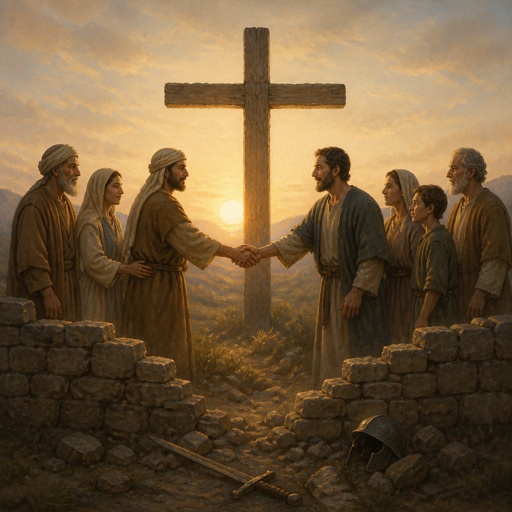
"And that he might reconcile both unto God in one body by the cross, having slain the enmity thereby:" - Ephesians 2:16

Ephesians 2:8

Ephesians 2:22

Ephesians 2:22

Ephesians 2:22

Ephesians 2:22

Ephesians 2:10

Ephesians 2:22

Ephesians 2:22

Ephesians 2:10
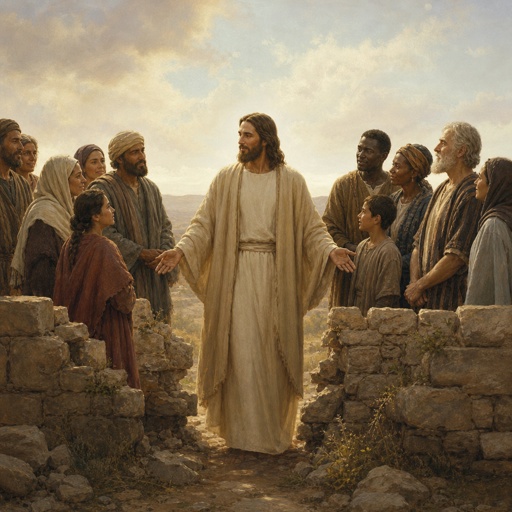
"For he is our peace, who hath made both one, and hath broken down the middle wall of partition between us;" - Ephesians 2:14
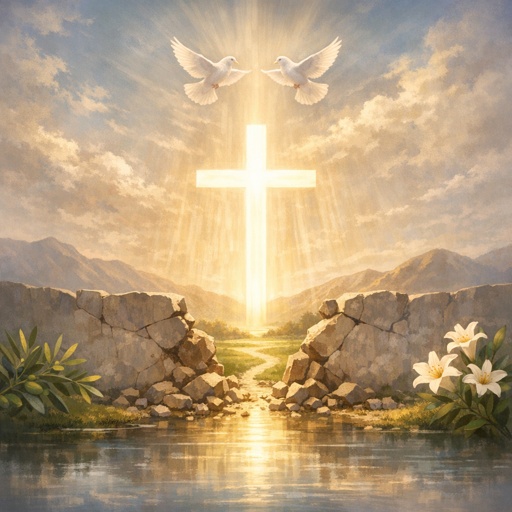
"For he is our peace, who hath made both one, and hath broken down the middle wall of partition between us;" - Ephesians 2:14

Ephesians 6:14 - "Stand therefore, having your loins girt about with truth, and having on the breastplate of righteousness;"

Ephesians 2-10

Ephesians 2:10

Ephesians 2:22

Ephesians 2:22

Ephesians 2:22

Ephesians 2:10

Ephesians 3:14 - "For this cause I bow my knees unto the Father of our Lord Jesus Christ,"

"Redeeming the time, because the days are evil." - Ephesians 5:16

Ephesians 1:14 - "Which is the earnest of our inheritance until the redemption of the purchased possession, unto the praise of his glory."