Courage in Silence: Esther's Call to Faith
“Again Esther spake unto Hatach, and gave him commandment unto Mordecai;” — Esther 4:10
In the book of Esther, we meet a young Jewish woman who rises from obscurity to a position of great influence in the Persian Empire. Her journey is one of courage and unwavering faith, illustrated in Esther 4:10, where she commands Hatach to relay her message to Mordecai, her beloved cousin and guardian. The verse states, "Again Esther spake unto Hatach, and gave him commandment unto Mordecai;" This moment marks a pivotal point in Esther's story, reflecting on themes of identity, faith, and God’s providence.
Esther, now queen, faces a dire situation. Her people are threatened by Haman’s decree to annihilate the Jews. Mordecai, who has raised her, implores her to intervene—urging her to speak to the king on behalf of her people. As she grapples with the peril of approaching the king uninvited, Esther embodies the complexity of courage. She is not a warrior in a conventional sense, but her heart beats with the weight of her people’s fate. To understand Esther's response to Mordecai, we must explore the backdrop of her time.
In ancient Persia, approaching the king without invitation was a serious offense that could lead to death. Therefore, Esther’s hesitance to move forward indicates a natural human instinct for self-preservation. Yet, Mordecai's counsel ignites a flame within her, emphasizing that perhaps her elevation as queen was part of God’s divine plan. In Esther 4:14, Mordecai reminds her, "...and who knoweth whether thou art come to the kingdom for such a time as this?" This profound statement speaks to the transformational power of purpose and calling.
Esther's response to the anxiety and fear around her is a lesson for all believers. Her resolve to rise, despite her fear, encapsulates the essence of faith. It reflects a belief that we often find ourselves chosen for tasks that seem insurmountable, but there is assurance in the knowledge that God's calling equips us with the strength we need.
In our lives, moments akin to Esther's command to Hatach often arise. We are faced with decisions that challenge our faith, decisions that require us to step out of our comfort zones into the unknown. God may be beckoning us to stand in the gap for someone, to speak truth into a dark situation, or to advocate for justice where it seems absent. It may feel easy to stay silent, to hold back out of fear or doubt, just as Esther initially hesitated.
The beauty of Esther's story is her eventual choice to act. After much contemplation and weighing of the circumstances, she requests prayers and fasting from Mordecai and the Jews, indicating her understanding of the spiritual battles at play. In Esther 4:16, she declares, "and so will I go in unto the king, which is not according to the law: and if I perish, I perish." This resolute statement exemplifies profound faith and unyielding courage.
Esther emphasizes that it is in the moments of profound decision that our faith can shine brightest. There, we must decide whether we allow fear to hold us back or if we are willing to trust in God’s provision as we step into our calling. This brave act not only paves the way for the salvation of the Jews but also encourages generations to come about the importance of standing firm in faith. It teaches us that even silence can sometimes be a powerful act of faith, but a spoken faith, acted upon, can bring about miraculous outcomes.
As we reflect on Esther's journey, may we be inspired by her example—her courage to confront, to command, and ultimately, to trust in God's plan. May we take our own crossroads with faithful hearts, knowing that we have a role to play in God’s greater narrative.
Get our apps


Artwork for Esther 4:10

Esther 4:10 - "¶ Again Esther spake unto Hatach, and gave him commandment unto Mordecai;"

"¶ Again Esther spake unto Hatach, and gave him commandment unto Mordecai;" - Esther 4:10

Esther 8:4 - "Then the king held out the golden sceptre toward Esther. So Esther arose, and stood before the king,"

Esther 4:15 - "¶ Then Esther bade them return Mordecai this answer,"

Esther 4:9 - "And Hatach came and told Esther the words of Mordecai."

Esther 4:17 - "So Mordecai went his way, and did according to all that Esther had commanded him."

Esther 2:10 - "Esther had not shewed her people nor her kindred: for Mordecai had charged her that she should not shew it."

Esther 8:4

Esther 4:12 - "And they told to Mordecai Esther's words."

"And Hatach came and told Esther the words of Mordecai." - Esther 4:9

"¶ Then Esther bade them return Mordecai this answer," - Esther 4:15

Esther 4:13 - "Then Mordecai commanded to answer Esther, Think not with thyself that thou shalt escape in the king's house, more than all the Jews."

Esther 5:4 - "And Esther answered, If it seem good unto the king, let the king and Haman come this day unto the banquet that I have prepared for him."
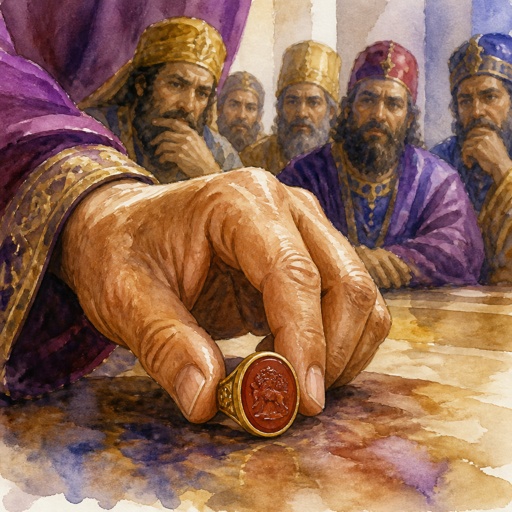
Esther 3:10 focus on ring

"Then the king held out the golden sceptre toward Esther. So Esther arose, and stood before the king," - Esther 8:4

Esther 4:5 - "Then called Esther for Hatach, one of the king's chamberlains, whom he had appointed to attend upon her, and gave him a commandment to Mordecai, to know what it was, and why it was."

Esther 10:1 - "And the king Ahasuerus laid a tribute upon the land, and upon the isles of the sea."
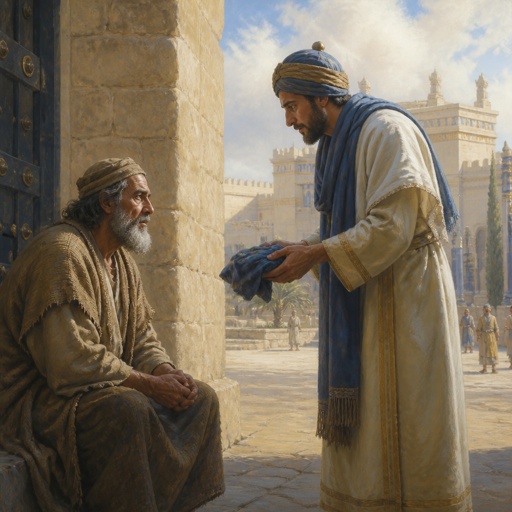
"And they told to Mordecai Esther's words." - Esther 4:12

Esther 9:10 - "The ten sons of Haman the son of Hammedatha, the enemy of the Jews, slew they; but on the spoil laid they not their hand."

Esther 7:10 - "So they hanged Haman on the gallows that he had prepared for Mordecai. Then was the king's wrath pacified."

"So Mordecai went his way, and did according to all that Esther had commanded him." - Esther 4:17
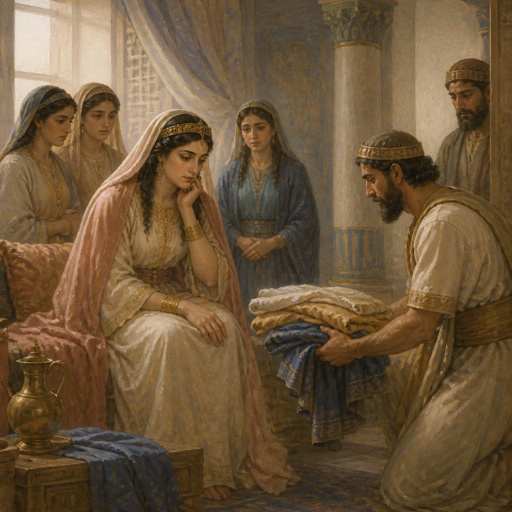
"¶ So Esther's maids and her chamberlains came and told it her. Then was the queen exceedingly grieved; and she sent raiment to clothe Mordecai, and to take away his sackcloth from him: but he received it not." - Esther 4:4

Esther 4:6 - "So Hatach went forth to Mordecai unto the street of the city, which was before the king's gate."

Esther 4:4 - "¶ So Esther's maids and her chamberlains came and told it her. Then was the queen exceedingly grieved; and she sent raiment to clothe Mordecai, and to take away his sackcloth from him: but he received it not."

"Esther had not shewed her people nor her kindred: for Mordecai had charged her that she should not shew it." - Esther 2:10

Esther 4:2 - "And came even before the king's gate: for none might enter into the king's gate clothed with sackcloth."

Esther 5:10 - "Nevertheless Haman refrained himself: and when he came home, he sent and called for his friends, and Zeresh his wife."

Esther 4:8 - "Also he gave him the copy of the writing of the decree that was given at Shushan to destroy them, to shew it unto Esther, and to declare it unto her, and to charge her that she should go in unto the king, to make supplication unto him, and to make request before him for her people."

Esther 3:10 - "And the king took his ring from his hand, and gave it unto Haman the son of Hammedatha the Agagite, the Jews' enemy."

"Then Mordecai commanded to answer Esther, Think not with thyself that thou shalt escape in the king's house, more than all the Jews." - Esther 4:13