The Divine Providence of Care: Lessons from Exodus 2:9
“And Pharaoh’s daughter said unto her, Take this child away, and nurse it for me, and I will give thee thy wages. And the woman took the child, and nursed it.” — Exodus 2:9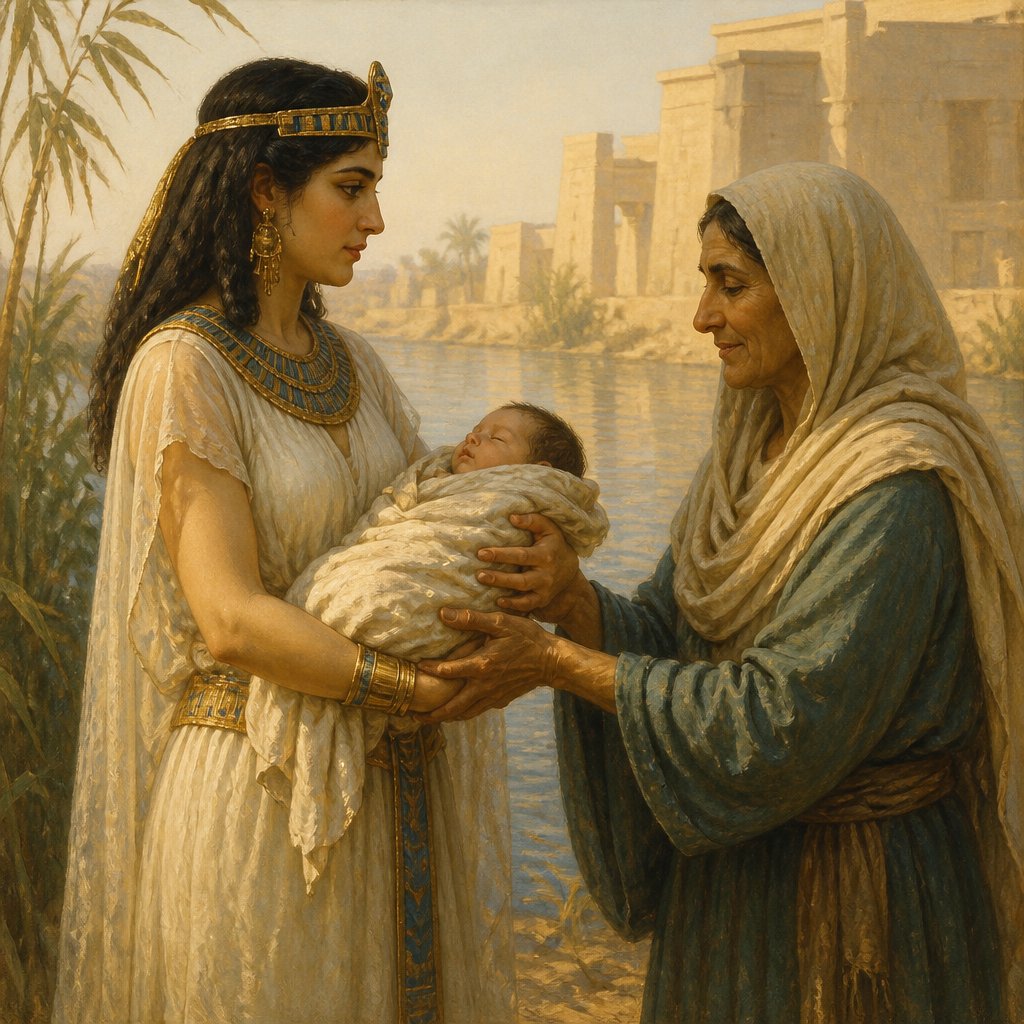
Exodus 2:9 reads: "And Pharaoh's daughter said unto her, Take this child away, and nurse it for me, and I will give thee thy wages. And the woman took the child, and nursed it." This passage, nestled within the broader story of Moses, reveals profound lessons about God’s providence and the unfolding of His plans in the lives of those who trust in Him.
At the heart of this verse is the unusual yet significant mention of God’s provision. Miriam, Moses' sister, steps into the scene at a critical moment. With remarkable cleverness and courage, she approaches Pharaoh’s daughter after finding her bathing in the river, where the basket containing her baby brother had been placed to save him from the Egyptian decree that threatened all Hebrew male infants. This moment clearly illustrates a hand of divine orchestration.
Pharaoh’s daughter, in her compassion, not only rescues a Hebrew child but empowers Miriam to find a nurse for him. The providence in this moment is immense, as God uses the very daughter of Moses' enemy to fulfill His plan for the deliverer of His people. God often works in whimsical and unexpected ways. Here, we see that God’s provision can come through unlikely channels and sources. This reminds us that His plans often transcend our limited understanding of the circumstances surrounding us.
When Miriam brings her mother, Jochebed, to Pharaoh’s daughter, the heartwarming reality unfolds that Jochebed gets to nurse and raise her child. An act of fear over a possible loss instead transforms into a period of nurturing, bonding, and preparing a future leader—Moses himself. As a mother, Jochebed plays a pivotal role. The fact that she is paid for caring for her own child is simply remarkable and highlights God’s justice coupled with mercy.
As we reflect on the significance of Jochebed’s role, we are reminded of the dignity and importance of mothers in God’s plan. They often bear testimony to God’s faithfulness through their unconditional love, perseverance, and care. The very traits exhibited by Jochebed reflect the heart of God—the protector, nurturer, and provider. God recognizes the value of nurturing in shaping character and purpose, fulfilling the divine directive that He can and does use mothers and caregivers not only to provide physical needs but also to instill spiritual foundations.
Additionally, this story compels us to reflect on our roles in the lives of others. Are there ways in which God is asking us to be a source of support and care? Even in the mundane tasks of nursing, raising, or mentoring, we participate in God’s design and purpose. We, too, can serve as vessels through which God’s will is carried out, whether in our family, community, or church. Our small acts of kindness can contribute to something much larger in God’s eternal plan.
Jochebed's experience also teaches us about faith and trusting divine timing. It could have been easy for her to despair, given the circumstances of Moses’s birth and the potential danger posed by the decree. However, God worked through her bravery. Much like Jochebed, we often face trials and daunting circumstances. In those times, we must remember that God is already weaving a story beyond our immediate view.
In conclusion, Exodus 2:9 reminds us that each of our lives is interwoven with a higher narrative governed by divine providence. Like Jochebed, when we surrender our plans to God and trust in His provisions—no matter how strange or unfamiliar those provisions may be—we can find peace. As we leave this moment, let us carry with us the assurance that God sees us, knows us, and will provide for our needs as we walk faithfully in His light.
Get our apps


Artwork for Exodus 2:9
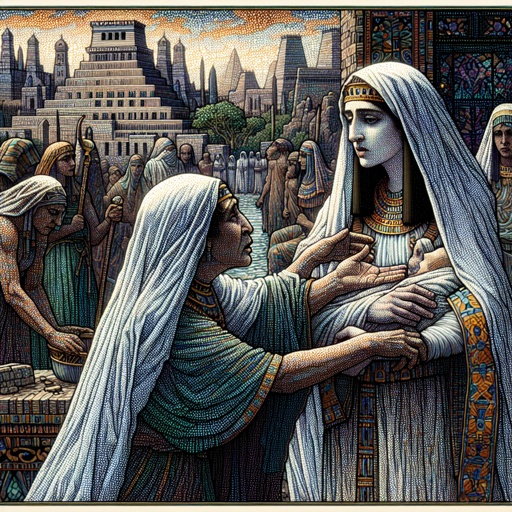
Exodus 2:9

Exodus 2:9

Exodus 2:9 - "And Pharaoh's daughter said unto her, Take this child away, and nurse it for me, and I will give thee thy wages. And the woman took the child, and nursed it."
"And Pharaoh's daughter said unto her, Take this child away, and nurse it for me, and I will give thee thy wages. And the woman took the child, and nursed it." - Exodus 2:9

Exodus 9:2 - "For if thou refuse to let them go, and wilt hold them still,"
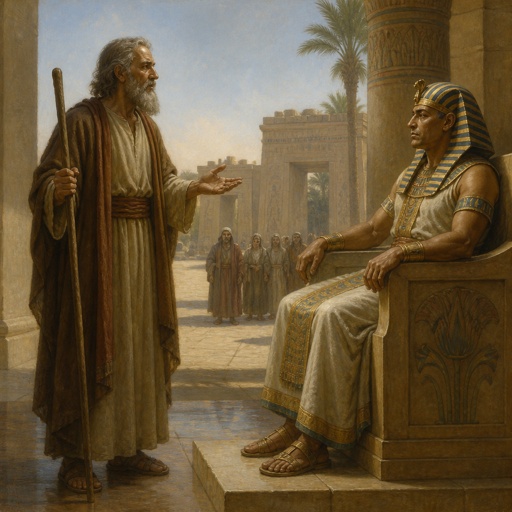
"For if thou refuse to let them go, and wilt hold them still," - Exodus 9:2

Exodus 40:9

Exodus 24:9-11

Exodus 35:9 - "And onyx stones, and stones to be set for the ephod, and for the breastplate."

Exodus 9:31 - "And the flax and the barley was smitten: for the barley was in the ear, and the flax was bolled."

Exodus 9:32 - "But the wheat and the rie were not smitten: for they were not grown up."

The Plague of Boils - Exodus 9:8-12

The Plague of Boils - Exodus 9:8-12

The Plague of Boils - Exodus 9:8-12.

The Plague of Hail - Exodus 9:13-35

The Plague of Boils - Exodus 9:8-12

The Plague of Hail - Exodus 9:13-35

The Plague of Boils - Exodus 9:8-12

The Plague on Livestock - Exodus 9:1-7

The Plague of Hail - Exodus 9:13-35

The Plague of Hail - Exodus 9:13-35

The Plague of Boils - Exodus 9:8-12

The Plague of Boils - Exodus 9:8-12

The Plague on Livestock - Exodus 9:1-7

The Plague of Boils - Exodus 9:8-12

Exodus 9:26 - "Only in the land of Goshen, where the children of Israel were, was there no hail."

Exodus 24:9 - "¶ Then went up Moses, and Aaron, Nadab, and Abihu, and seventy of the elders of Israel:"

Exodus 31:9 - "And the altar of burnt offering with all his furniture, and the laver and his foot,"

Exodus 20:9 - "Six days shalt thou labour, and do all thy work:"

The Plague Death on Livestock - Exodus 9:1-7