Reflecting Upon Our Cleansing: The Brazen Laver and the Heart
“And he made the laver of brass, and the foot of it of brass, of the lookingglasses of the women assembling, which assembled at the door of the tabernacle of the congregation.” — Exodus 38:8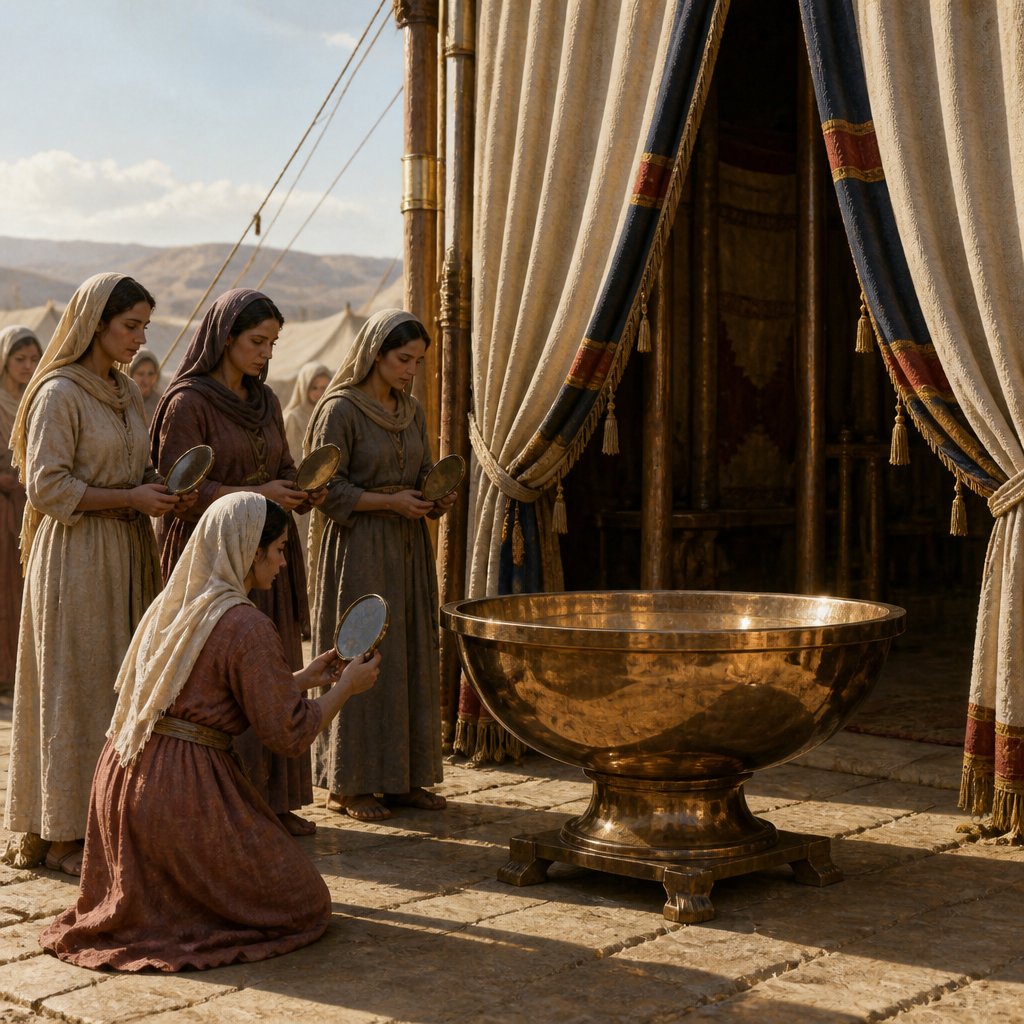
Exodus 38:8: "And he made the laver of brass, and the foot of it of brass, of the lookingglasses of the women assembling, which assembled at the door of the tabernacle of the congregation."
In Exodus 38:8, we find a profound and intricate detail about the construction of the Tabernacle. The brazen laver stands out as a unique artifact, designed to be a place for the priests to wash their hands and feet before entering the holy precincts. This act of cleansing was not just a formality, but a divine necessity. As we examine this verse more closely, we discover layers of meaning that speak to our spiritual condition and the importance of reflective cleansing.
The materials used to construct the laver—the brass and the lookingglasses (mirrors) from the women—carry significant symbolism. Brass is a metal that signifies strength and durability, reminding us of the strong fortification provided by God against sin and impurity. The laver's purpose was to ensure cleanliness as the priests approached God. Today, we too are called to a similar standard of cleanliness—not just physical, but spiritual. The brass can be seen as a representation of the strength of our resolve to live righteous lives, supported by God’s grace.
The inclusion of mirrors fashioned from bronze adds another layer of meaning. In a period lacking the clarity of glass mirrors, bronze would have offered a polished, reflective surface that would reveal the appearance of the one looking into it. In the context of spiritual preparation, mirrors are symbolic of self-examination. Just as the priests would gaze into the reflecting metal to inspect their physical state and cleanse themselves, we too are encouraged to look inward.
This brings to mind the key question: Are we examining our hearts regularly for signs of contamination by sin? The process of reflection often reveals truths about ourselves that we might otherwise overlook. Just as the priests would see their need for cleansing, we must regularly confront our own hearts in the light of God’s truth and grace. Psalm 139:23-24 beautifully articulates this desire for self-examination: "Search me, O God, and know my heart: try me, and know my thoughts: And see if there be any wicked way in me, and lead me in the way everlasting."
Furthermore, the act of assembling, as noted in the verse, points to the importance of community in our journey of faith. The women who contributed to the laver were gathering at the door of the tabernacle—a significant place of worship. Within the body of believers, there is strength, encouragement, and the opportunity for communal reflection. Just as the women were united in purpose, we are called to come together, to share our burdens, and to lift one another up in prayer as we seek spiritual cleansing.
Moreover, the laver's placement at the door of the tabernacle signifies that purification is the first step before entering into God’s presence. How often do we rush into our prayer times or church services without taking a moment to prepare our hearts? Just like the priests, we need that intentional act of coming before God with a clean heart and soul, asking for forgiveness and focusing on the holiness that He represents.
In conclusion, the brazen laver crafted from the mirrors of the faithful women is more than an ancient object; it is a powerful symbol representing our journey of reflection and cleansing. It calls us to lay aside our past, approach God earnestly, and seek His face in humility. As we stand at the door of our tabernacle—our hearts—let us remember to wash ourselves in the truth of God’s Word, allowing His grace to reflect back at us, leading us into deeper communion with Him. Let that reflective process cleanse us thoroughly so that we can serve Him with purity and purpose.
Get our apps


Artwork for Exodus 38:8

Exodus 38:8 - "¶ And he made the laver of brass, and the foot of it of brass, of the lookingglasses of the women assembling, which assembled at the door of the tabernacle of the congregation."
"¶ And he made the laver of brass, and the foot of it of brass, of the lookingglasses of the women assembling, which assembled at the door of the tabernacle of the congregation." - Exodus 38:8

Exodus 40.17-38

Exodus 38:13 - "And for the east side eastward fifty cubits."

Psalm 38:8

romans 8:38

Exodus 25:38 - "And the tongs thereof, and the snuffdishes thereof, shall be of pure gold."

The Plague on the Firstborn - Exodus 12:29-38

The Plague on the Firstborn - Exodus 12:29-38

The Plague on the Firstborn - Exodus 12:29-38

Exodus 38:6 - "And he made the staves of shittim wood, and overlaid them with brass."

Exodus 38:20 - "And all the pins of the tabernacle, and of the court round about, were of brass."

Exodus 38:29 - "And the brass of the offering was seventy talents, and two thousand and four hundred shekels."

Exodus 38:16 - "All the hangings of the court round about were of fine twined linen."

Exodus 39:38 - "And the golden altar, and the anointing oil, and the sweet incense, and the hanging for the tabernacle door,"

Romans 8:38-39

Exodus 38:5 - "And he cast four rings for the four ends of the grate of brass, to be places for the staves."

Exodus 38:14 - "The hangings of the one side of the gate were fifteen cubits; their pillars three, and their sockets three."

Exodus 38:10 - "Their pillars were twenty, and their brasen sockets twenty; the hooks of the pillars and their fillets were of silver."

"And for the east side eastward fifty cubits." - Exodus 38:13

Exodus 12:38 - "And a mixed multitude went up also with them; and flocks, and herds, even very much cattle."

Exodus 38:22 - "And Bezaleel the son of Uri, the son of Hur, of the tribe of Judah, made all that the LORD commanded Moses."

Exodus 38:4 - "And he made for the altar a brasen grate of network under the compass thereof beneath unto the midst of it."

Exodus 38:19 - "And their pillars were four, and their sockets of brass four; their hooks of silver, and the overlaying of their chapiters and their fillets of silver."

Exodus 36:38 - "And the five pillars of it with their hooks: and he overlaid their chapiters and their fillets with gold: but their five sockets were of brass."

Exodus 38:2 - "And he made the horns thereof on the four corners of it; the horns thereof were of the same: and he overlaid it with brass."

Exodus 38:7 - "And he put the staves into the rings on the sides of the altar, to bear it withal; he made the altar hollow with boards."

Exodus 30:38 - "Whosoever shall make like unto that, to smell thereto, shall even be cut off from his people."

Exodus 38:15 - "And for the other side of the court gate, on this hand and that hand, were hangings of fifteen cubits; their pillars three, and their sockets three."

Exodus 29:38 - "¶ Now this is that which thou shalt offer upon the altar; two lambs of the first year day by day continually."