The Crown of Holiness: A Call to Divine Purity
“And they made the plate of the holy crown of pure gold, and wrote upon it a writing, like to the engravings of a signet, HOLINESS TO THE LORD.” — Exodus 39:30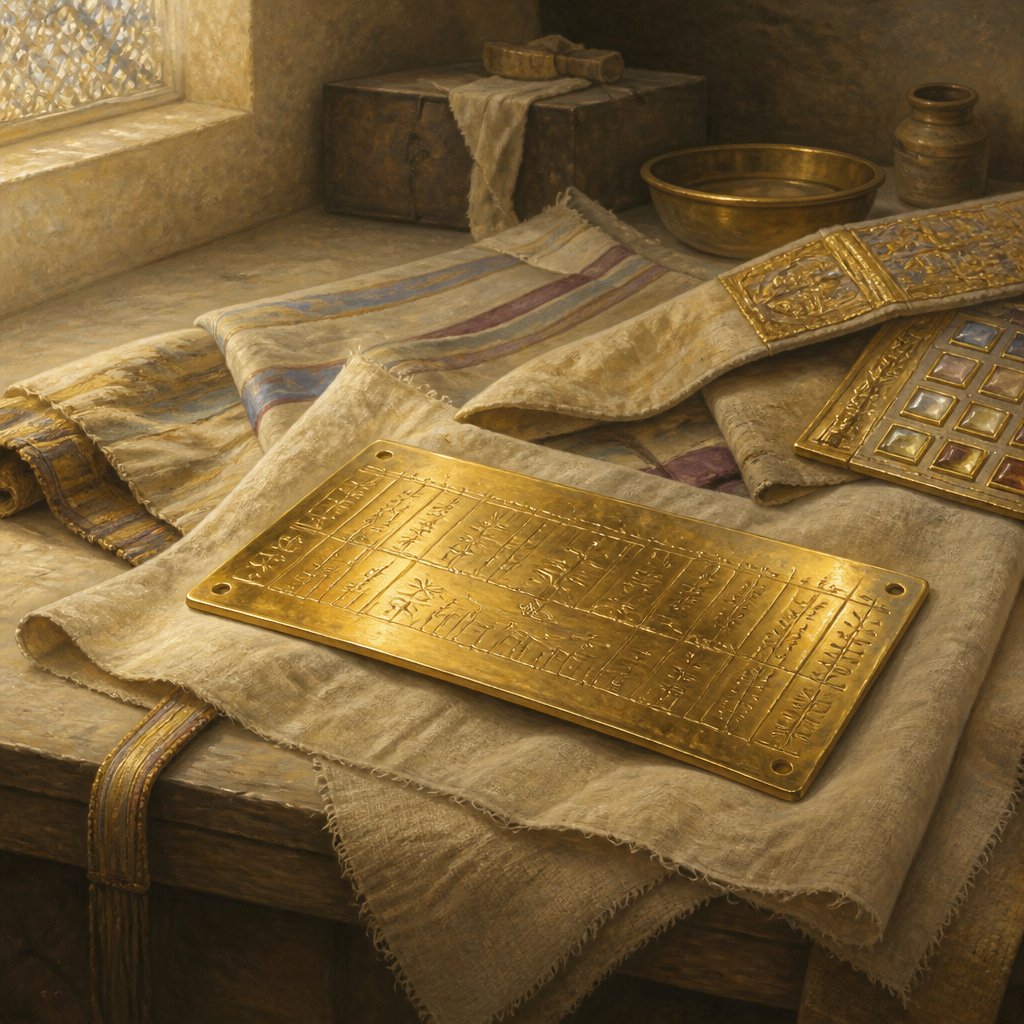
In Exodus 39:30, we are given a glimpse into the sacred articles crafted for the Tabernacle and the sacred duties of the priests. The verse states, "And they made the plate of the holy crown of pure gold, and wrote upon it a writing, like to the engravings of a signet, HOLINESS TO THE LORD." This passage invites us to explore the significance of holiness in our lives and the dedication with which we are called to pursue it.
The construction of the holy crown indicates not only the value of the materials used—pure gold—but also the importance placed on holiness in worship and service unto God. In ancient Israel, the priests played a pivotal role in mediating between the people and God. The crown, inscribed with the words "HOLINESS TO THE LORD", served as a constant reminder of their solemn commitment to a life set apart for divine service. It was not merely a decorative item but a vital symbol of what it means to be consecrated.
The word "holiness" derives from the Hebrew word "qodesh," which means to be set apart, sacred, or holy. Holiness in the context of the Israelites was an essential attribute of God Himself, and thus, the call upon the priests was to reflect that divine quality. The inscription on the crown signals that holiness is not an option but an imperative. This directive challenges us today. As followers of Christ, we too are called a royal priesthood (1 Peter 2:9). Are we living lives that proclaim "HOLINESS TO THE LORD"?
In a world that often glamorizes moral ambiguity and spiritual compromise, the crown invites us to uphold a standard of holiness. It compels us to ask ourselves questions like: What does it mean to represent holiness actively? How do we adorn our lives with the truth that we belong to the Lord?
The priesthood of the Old Testament was marked by strict codes of conduct, ceremonial washings, and sacrifices, all designed to keep them ritually pure as they entered the presence of God. Now, under the new covenant, holiness takes on a deeper meaning through the transformative power of grace. Believers are cleansed not through ritual but through the blood of Christ. Yet, this grace calls us to pursue purity with even greater fervor (Hebrews 12:14).
The inscription on the crown reflects God’s desire for us to be separate from the world, to live lives that reflect His character and beauty. When we embrace our identity as bearers of His name, we are invited to walk in a manner worthy of our calling (Ephesians 4:1). This participation in holiness is not about self-righteousness but is an expression of love—our love for Jesus Christ who made the ultimate sacrifice to cleanse us from sin.
We can contemplate the implications of holiness in our interactions, choices, and desires. When we engage with our communities, do we reflect the holiness of God? In our daily routines, do we acknowledge His presence? Are there areas in our lives where compromise has taken root? The holy crown depicts a life wholly devoted to God, and it beckons us to evaluate our commitment to that calling.
Moreover, as we meditate on this verse, we should reflect upon the authenticity of our witness. The crown, an external emblem, encourages us to examine the internal reality of our hearts. Are we truly living out the message of holiness with integrity? The engravings of a signet, permanent and visible, remind us that our lives should bear the unmistakable mark of God's ownership.
Ultimately, as we acknowledge the call to "HOLINESS TO THE LORD," we are not merely striving for an unattainable ideal; we are stepping into our identity in Christ, empowered by the Spirit to live differently, to shine brightly against the backdrop of a dark world. May we each wear our lives as a crown of holiness, reflecting the purity and majesty of our Lord, bringing honor to His name in all we do.
Get our apps


Artwork for Exodus 39:30

Exodus 39:30 - "¶ And they made the plate of the holy crown of pure gold, and wrote upon it a writing, like to the engravings of a signet, HOLINESS TO THE LORD."
"¶ And they made the plate of the holy crown of pure gold, and wrote upon it a writing, like to the engravings of a signet, HOLINESS TO THE LORD." - Exodus 39:30

Exodus 39:37

Exodus 39:37

Exodus 39:37

Exodus 39:39 - "The brasen altar, and his grate of brass, his staves, and all his vessels, the laver and his foot,"

Exodus 39:12 - "And the third row, a ligure, an agate, and an amethyst."

Exodus 39:36 - "The table, and all the vessels thereof, and the shewbread,"

Exodus 39:11 - "And the second row, an emerald, a sapphire, and a diamond."

Exodus 39:35 - "The ark of the testimony, and the staves thereof, and the mercy seat,"

Genesis 30:39 - "And the flocks conceived before the rods, and brought forth cattle ringstraked, speckled, and spotted."

Exodus 39:22 - "¶ And he made the robe of the ephod of woven work, all of blue."

Exodus 39:4 - "They made shoulderpieces for it, to couple it together: by the two edges was it coupled together."

Exodus 25:39 - "Of a talent of pure gold shall he make it, with all these vessels."

Exodus 39:15 - "And they made upon the breastplate chains at the ends, of wreathen work of pure gold."

Exodus 39:17 - "And they put the two wreathen chains of gold in the two rings on the ends of the breastplate."

Exodus 39:27 - "¶ And they made coats of fine linen of woven work for Aaron, and for his sons,"

Exodus 39:38 - "And the golden altar, and the anointing oil, and the sweet incense, and the hanging for the tabernacle door,"

Exodus 39:13 - "And the fourth row, a beryl, an onyx, and a jasper: they were inclosed in ouches of gold in their inclosings."

Exodus 39:2 - "And he made the ephod of gold, blue, and purple, and scarlet, and fine twined linen."

Exodus 39:24 - "And they made upon the hems of the robe pomegranates of blue, and purple, and scarlet, and twined linen."

Exodus 26:30

Exodus 39:34 - "And the covering of rams' skins dyed red, and the covering of badgers' skins, and the vail of the covering,"

Exodus 39:31 - "And they tied unto it a lace of blue, to fasten it on high upon the mitre; as the LORD commanded Moses."

Exodus 39:42 - "According to all that the LORD commanded Moses, so the children of Israel made all the work."

Exodus 39:23 - "And there was an hole in the midst of the robe, as the hole of an habergeon, with a band round about the hole, that it should not rend."

Exodus 39:29 - "And a girdle of fine twined linen, and blue, and purple, and scarlet, of needlework; as the LORD commanded Moses."

Exodus 39:10 - "And they set in it four rows of stones: the first row was a sardius, a topaz, and a carbuncle: this was the first row."

"And the third row, a ligure, an agate, and an amethyst." - Exodus 39:12

"The table, and all the vessels thereof, and the shewbread," - Exodus 39:36