The Depths of Mourning: Understanding Grief Through Ezekiel 27:31
“And they shall make themselves utterly bald for thee, and gird them with sackcloth, and they shall weep for thee with bitterness of heart and bitter wailing.” — Ezekiel 27:31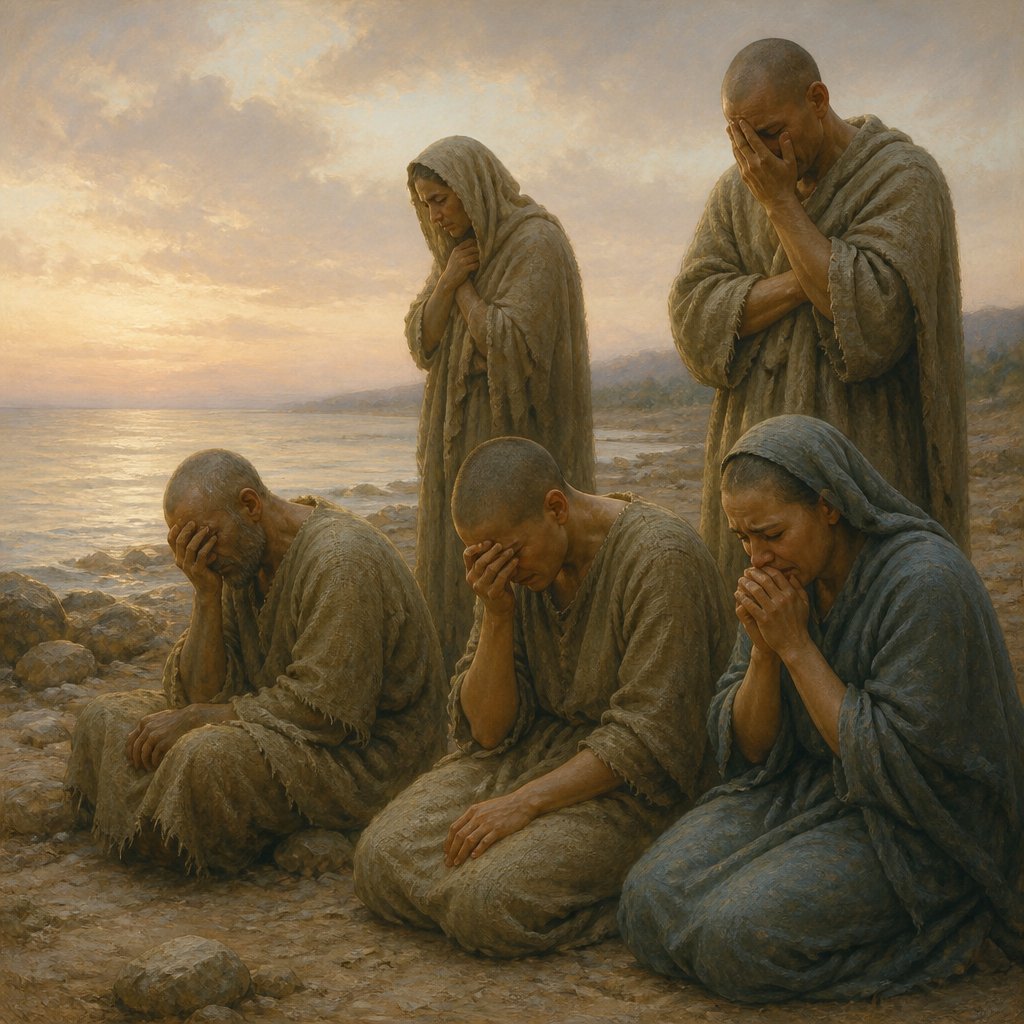
Ezekiel 27:31 states, "And they shall make themselves utterly bald for thee, and gird them with sackcloth, and they shall weep for thee with bitterness of heart and bitter wailing." In this poignant verse, we see a vivid expression of mourning and grief, deeply rooted in the culture of the ancient Israelites. To interpret this correctly, we must delve into both the historical and spiritual significances behind such heartbreaking actions.
In the ancient Near East, as in many cultures today, an outward demonstration of sorrow was often a precursor to the inner turmoil felt by the heart. The act of shaving one’s head was a declaration of loss—the loss of someone dear, a nation, a way of life, or even an inherent sense of identity. In this scripture, the baldness is emblematic of extreme grief, highlighting the emotional turmoil that accompanies profound loss.
Consider for a moment what the people of Tyre—the subject of Ezekiel's prophecies—must have felt as they mourned. They gird themselves with sackcloth, a coarse and uncomfortable fabric usually associated with repentance, poverty, and mourning. This symbolism is fortified by the act of weeping with "bitterness of heart" and engaging in "bitter wailing." Their tears and lamentations were not just a superficial facade but a deep, raw expression of sorrow that echoed through the ages.
When studying this verse, we must reflect on our own experiences with grief. Grief is universal and touches every life. Whether it be the loss of a loved one, the end of a cherished chapter, or the destruction of dreams, the avenues of our sorrow often lead us to a place where physical expressions seem inadequate. We may find ourselves wrestling with feelings, often conveyed through shouting, whispering, or silent tears. Yet, how often do we turn to God in such instances?
The practices mentioned in Ezekiel 27:31 are striking in their intensity, calling to recognize that God is not distant from our pain. His heart resonates with our grief. Just as the people grieved for Tyre, God grieves for His creation—He understands the fullness of our isolation and devastation. In essence, this scripture provides a dual insight: the outward expression of sorrow and the inward relational dynamic between humanity and the divine.
In 1 Thessalonians 4:13, Paul reminds us, "But I would not have you to be ignorant, brethren, concerning them which are asleep, that ye sorrow not, even as others which have no hope." Here, the Apostle distinguishes between grief devoid of hope and that which fosters a foundation of faith. Mourning can be a means of drawing near to God, allowing us to process our experiences under His grace. The depth of our sorrow can deepen our reliance on God, revealing His sufficiency and our own vulnerability.
Moreover, the scripture encourages us to confront our grief instead of sidestepping it. Sorrow ought not to plague us indefinitely; rather, it should teach us resilience and the vital importance of community comfort. When we allow our “bitter wailing” to ring, we recognize not only our need for God but also our need for each other. This collective experience fosters unity, empathy, and shared support amidst life's inevitable storms.
Ultimately, Ezekiel's declaration serves to remind us of the reality of loss and its attendant mourning. We need not fear our expressions of grief; they are holy offerings to God when rightly placed. In our anguish, may we rise with deeper faith, undeterred by our circumstances, recognizing that in God’s presence, even the most shattered of hearts can find solace and strength.
Let us embrace our grief as part of the healing process—lay it before God in prayer and worship, knowing that He is intimately aware of our hearts. And as we do, may we move toward a profound understanding of His abiding love and faithfulness, which carries us beyond our deepest sorrows to a place of peace and hope.
Get our apps


Artwork for Ezekiel 27:31

Ezekiel 27:31 - "And they shall make themselves utterly bald for thee, and gird them with sackcloth, and they shall weep for thee with bitterness of heart and bitter wailing."

Ezekiel 27:31 They will shave themselves completely bald because of you, Gird themselves with sackcloth, And weep for you With bitterness of heart and bitter wailing.
"And they shall make themselves utterly bald for thee, and gird them with sackcloth, and they shall weep for thee with bitterness of heart and bitter wailing." - Ezekiel 27:31

Proverbs 31:27 - "She looketh well to the ways of her household, and eateth not the bread of idleness."
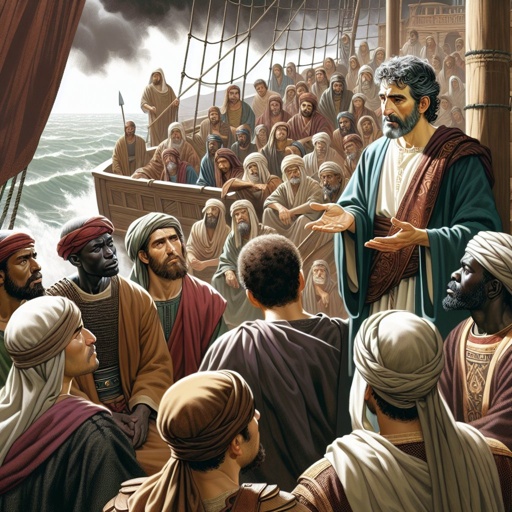
Acts 27:31 - "Paul said to the centurion and to the soldiers, Except these abide in the ship, ye cannot be saved."

Ezekiel 27:20 - "Dedan was thy merchant in precious clothes for chariots."

Job 31:27 - "And my heart hath been secretly enticed, or my mouth hath kissed my hand:"

1 Chronicles 27:31 - "And over the flocks was Jaziz the Hagerite. All these were the rulers of the substance which was king David's."

Ezekiel 27:28 - "The suburbs shall shake at the sound of the cry of thy pilots."

Ezekiel 27:1 - "The word of the LORD came again unto me, saying,"

Ezekiel 44:31 - "The priests shall not eat of any thing that is dead of itself, or torn, whether it be fowl or beast."

Ezekiel 27:14 - "They of the house of Togarmah traded in thy fairs with horses and horsemen and mules."

Ezekiel 27:2 - "Now, thou son of man, take up a lamentation for Tyrus;"

Leviticus 27:31 - "And if a man will at all redeem ought of his tithes, he shall add thereto the fifth part thereof."

Ezekiel 31:7 - "Thus was he fair in his greatness, in the length of his branches: for his root was by great waters."

Ezekiel 23:31 - "Thou hast walked in the way of thy sister; therefore will I give her cup into thine hand."

Jeremiah 31:27 - "¶ Behold, the days come, saith the LORD, that I will sow the house of Israel and the house of Judah with the seed of man, and with the seed of beast."

Ezekiel 27:23 - "Haran, and Canneh, and Eden, the merchants of Sheba, Asshur, and Chilmad, were thy merchants."

Ezekiel 48:27 - "And by the border of Zebulun, from the east side unto the west side, Gad a portion."

Ezekiel 27:4 - "Thy borders are in the midst of the seas, thy builders have perfected thy beauty."

Ezekiel 34:31 - "And ye my flock, the flock of my pasture, are men, and I am your God, saith the Lord GOD."

Ezekiel 37:27 - "My tabernacle also shall be with them: yea, I will be their God, and they shall be my people."

Ezekiel 31:1 - "And it came to pass in the eleventh year, in the third month, in the first day of the month, that the word of the LORD came unto me, saying,"

Numbers 31:27 - "And divide the prey into two parts; between them that took the war upon them, who went out to battle, and between all the congregation:"

Ezekiel 31:2 - "Son of man, speak unto Pharaoh king of Egypt, and to his multitude; Whom art thou like in thy greatness?"
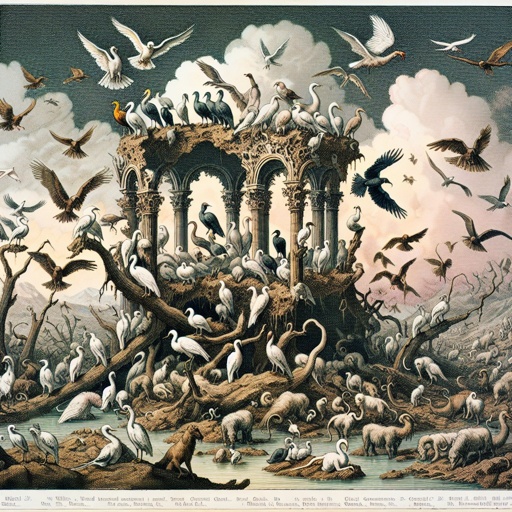
Ezekiel 31:13 - "Upon his ruin shall all the fowls of the heaven remain, and all the beasts of the field shall be upon his branches:"

Ezekiel 31:3 - "¶ Behold, the Assyrian was a cedar in Lebanon with fair branches, and with a shadowing shroud, and of an high stature; and his top was among the thick boughs."

Ezekiel 27:21 - "Arabia, and all the princes of Kedar, they occupied with thee in lambs, and rams, and goats: in these were they thy merchants."

Ezekiel 40:31 - "And the arches thereof were toward the utter court; and palm trees were upon the posts thereof: and the going up to it had eight steps."

Ezekiel 31:9 - "I have made him fair by the multitude of his branches: so that all the trees of Eden, that were in the garden of God, envied him."