The Sacred Transition: Embracing Holiness in Service
“When the priests enter therein, then shall they not go out of the holy place into the utter court, but there they shall lay their garments wherein they minister; for they are holy; and shall put on other garments, and shall approach to those things which are for the people.” — Ezekiel 42:14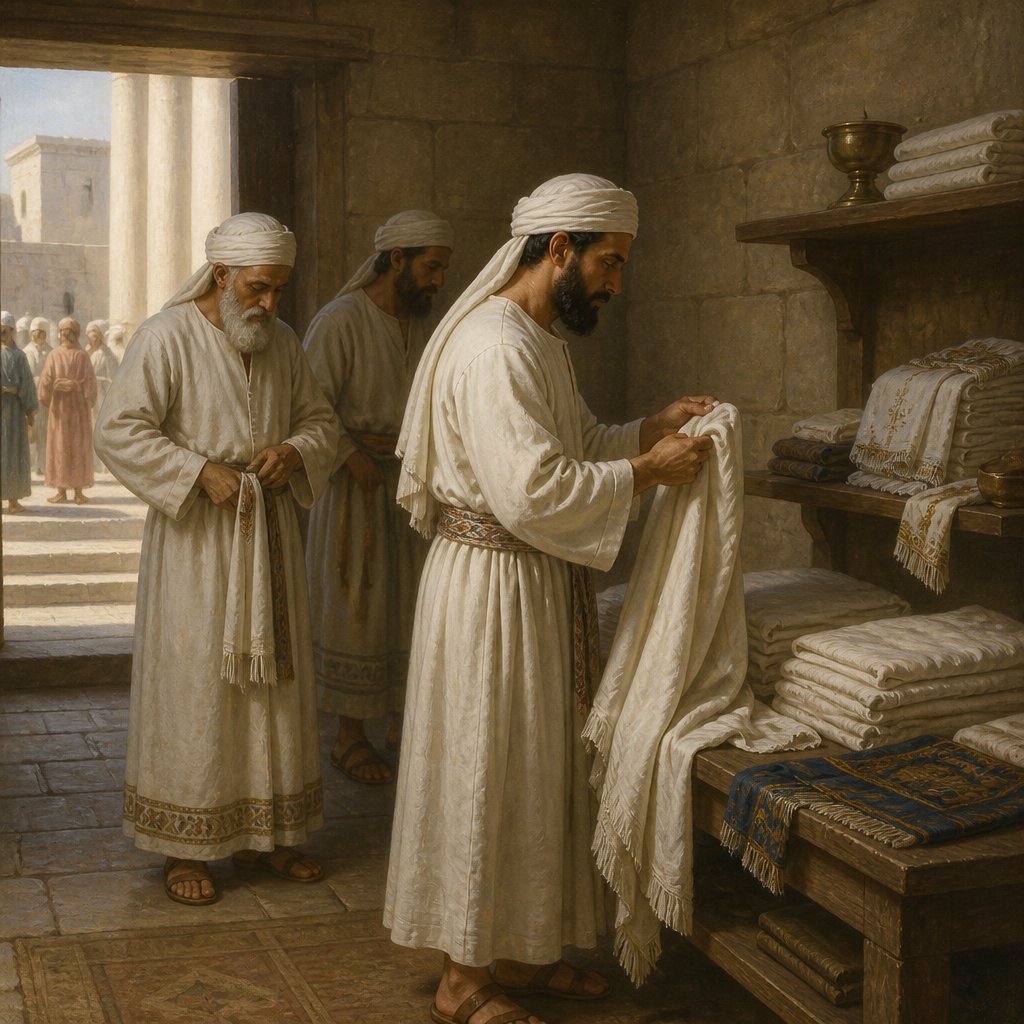
The verse from Ezekiel 42:14 (KJV) states, "When the priests enter therein, then shall they not go out of the holy place into the utter court, but there they shall lay their garments wherein they minister; for they are holy; and shall put on other garments, and shall approach to those things which are for the people." These words, nestled in a passage that speaks to the divine details of the temple's structure and function, offer rich insights into the nature of holiness and the responsibilities of those who serve in sacred capacities.
Ezekiel’s vision of the temple is replete with symbolism and significance. Through this view, we see a delineation of sacred spaces and the sacred duties of priests. This particular verse captures a critical aspect of their ministry - the transition between the holy and the secular, the divine and the mundane. It reminds us that in our walk with God, we are called not only to service but to discernment, especially in how we approach our duties before the Lord and towards His people.
Firstly, the instruction that priests shall not exit the holy place clad in their ministering garments is profound. The garments worn during service are emblematic of their sanctity. They symbolize the holiness required in approaching God’s presence. The act of changing out of those garments signifies more than simply a change of clothes; it represents a physical act of recognizing a transition from a sacred encounter to engagement with the people. In our modern context, we often find ourselves wearing many hats—worker, friend, volunteer, parent, and more. Like the priests, we must also be intentional about the roles we step into. When we leave our personal prayer closet, our times of worship, or moments of deep encounter with God, we carry with us a responsibility to approach others with holiness and grace, aware of the sacredness of our calling.
Moreover, this verse introduces the concept of preparing oneself anew for service. The priests lay down their ministerial garments, signifying humility and the sacred exchange between the holy and the communal. This practice suggests the importance of readiness—not only physical but spiritual. We must take the time to 'put on' the right mindset and heart posture before we approach those in need. The act of changing clothes becomes a metaphorical gesture for us, a reminder that we should be preparing ourselves spiritually and emotionally to serve others, approaching them with a heart of compassion set apart by God’s love.
This separation of garments speaks to our need for holiness in service. In a world that often blurs the lines between sacred and secular, this scripture calls us back to a place of reverence. When we interact with the community, whether as teachers, leaders, or simply individuals sharing God’s love, our approach should reflect grace and holiness. The garments of holiness that the priests wear are not just for their benefit; they symbolize preparation to minister to God’s people properly. Therefore, as we prepare ourselves to serve, we must ask ourselves: are we wearing the right garments of humility, compassion, understanding, and readiness to approach those around us?
Lastly, we are reminded that our ministries and services are not meant to be done in isolation. The priest did not serve solely for their benefit; they were there for the people. This communal aspect of ministry serves as a powerful reminder that our efforts should be in service of others, reflecting the broader mission of Christ to love, serve, and uplift humanity.
In conclusion, Ezekiel 42:14 challenges us to reflect on the garments we wear in ministry and service. Are we setting aside time to be with God to gain strength and direction in our holy calling? Are we willing to transition from those sacred moments into our everyday lives with intentionality and holiness? Let us strive to embody the spirit of this verse, being mindful of the sacredness of our service and the impact we have as we approach others with the garments of grace and love.
Get our apps


Artwork for Ezekiel 42:14

Ezekiel 42:14 - "When the priests enter therein, then shall they not go out of the holy place into the utter court, but there they shall lay their garments wherein they minister; for they are holy; and shall put on other garments, and shall approach to those things which are for the people."
"When the priests enter therein, then shall they not go out of the holy place into the utter court, but there they shall lay their garments wherein they minister; for they are holy; and shall put on other garments, and shall approach to those things which are for the people." - Ezekiel 42:14

Ezekiel 42:18 - "He measured the south side, five hundred reeds, with the measuring reed."

Ezekiel 42:2 - "Before the length of an hundred cubits was the north door, and the breadth was fifty cubits."

Ezekiel 42:19 - "¶ He turned about to the west side, and measured five hundred reeds with the measuring reed."

Ezekiel 42:17 - "He measured the north side, five hundred reeds, with the measuring reed round about."

Ezekiel 42:9 - "And from under these chambers was the entry on the east side, as one goeth into them from the utter court."

Ezekiel 42:16 - "He measured the east side with the measuring reed, five hundred reeds, with the measuring reed round about."

Ezekiel 42:8 - "For the length of the chambers that were in the utter court was fifty cubits: and, lo, before the temple were an hundred cubits."

Ezekiel 42:4 - "And before the chambers was a walk of ten cubits breadth inward, a way of one cubit; and their doors toward the north."

Ezekiel 42:10 - "The chambers were in the thickness of the wall of the court toward the east, over against the separate place, and over against the building."

Ezekiel 42:5 - "Now the upper chambers were shorter: for the galleries were higher than these, than the lower, and than the middlemost of the building."

Ezekiel 42:7 - "And the wall that was without over against the chambers, toward the utter court on the forepart of the chambers, the length thereof was fifty cubits."

Numbers 14:42 - "Go not up, for the LORD is not among you; that ye be not smitten before your enemies."

Mark 14:42 - "Rise up, let us go; lo, he that betrayeth me is at hand."

Genesis 42:14 - "And Joseph said unto them, That is it that I spake unto you, saying, Ye are spies:"

Ezekiel 42:6 - "For they were in three stories, but had not pillars as the pillars of the courts: therefore the building was straitened more than the lowest and the middlemost from the ground."

Job 42:14 - "And he called the name of the first, Jemima; and the name of the second, Kezia; and the name of the third, Keren-happuch."

1 Samuel 14:42 - "And Saul said, Cast lots between me and Jonathan my son. And Jonathan was taken."

Ezekiel 16:42 - "So will I make my fury toward thee to rest, and my jealousy shall depart from thee, and I will be quiet, and will be no more angry."

Ezekiel 42:12 - "And according to the doors of the chambers that were toward the south was a door in the head of the way, even the way directly before the wall toward the east, as one entereth into them."

Ezekiel 42:3 - "Over against the twenty cubits which were for the inner court, and over against the pavement which was for the utter court, was gallery against gallery in three stories."

"He measured the south side, five hundred reeds, with the measuring reed." - Ezekiel 42:18

"Before the length of an hundred cubits was the north door, and the breadth was fifty cubits." - Ezekiel 42:2

Ezekiel 42:1 - "Then he brought me forth into the utter court, the way toward the north: and he brought me into the chamber that was over against the separate place, and which was before the building toward the north."

Ezekiel 42:20 - "He measured it by the four sides: it had a wall round about, five hundred reeds long, and five hundred broad, to make a separation between the sanctuary and the profane place."

Ezekiel 42:11 - "And the way before them was like the appearance of the chambers which were toward the north, as long as they, and as broad as they: and all their goings out were both according to their fashions, and according to their doors."

Ezekiel 23:42 - "And a voice of a multitude being at ease was with her: and with the men of the common sort were brought Sabeans from the wilderness, which put bracelets upon their hands, and beautiful crowns upon their heads."

Ezekiel 42:15 - "Now when he had made an end of measuring the inner house, he brought me forth toward the gate whose prospect is toward the east, and measured it round about."

Ezekiel 14:6