Sacrifices Before Foundations: Faith in Action
“From the first day of the seventh month began they to offer burnt offerings unto the LORD. But the foundation of the temple of the LORD was not yet laid.” — Ezra 3:6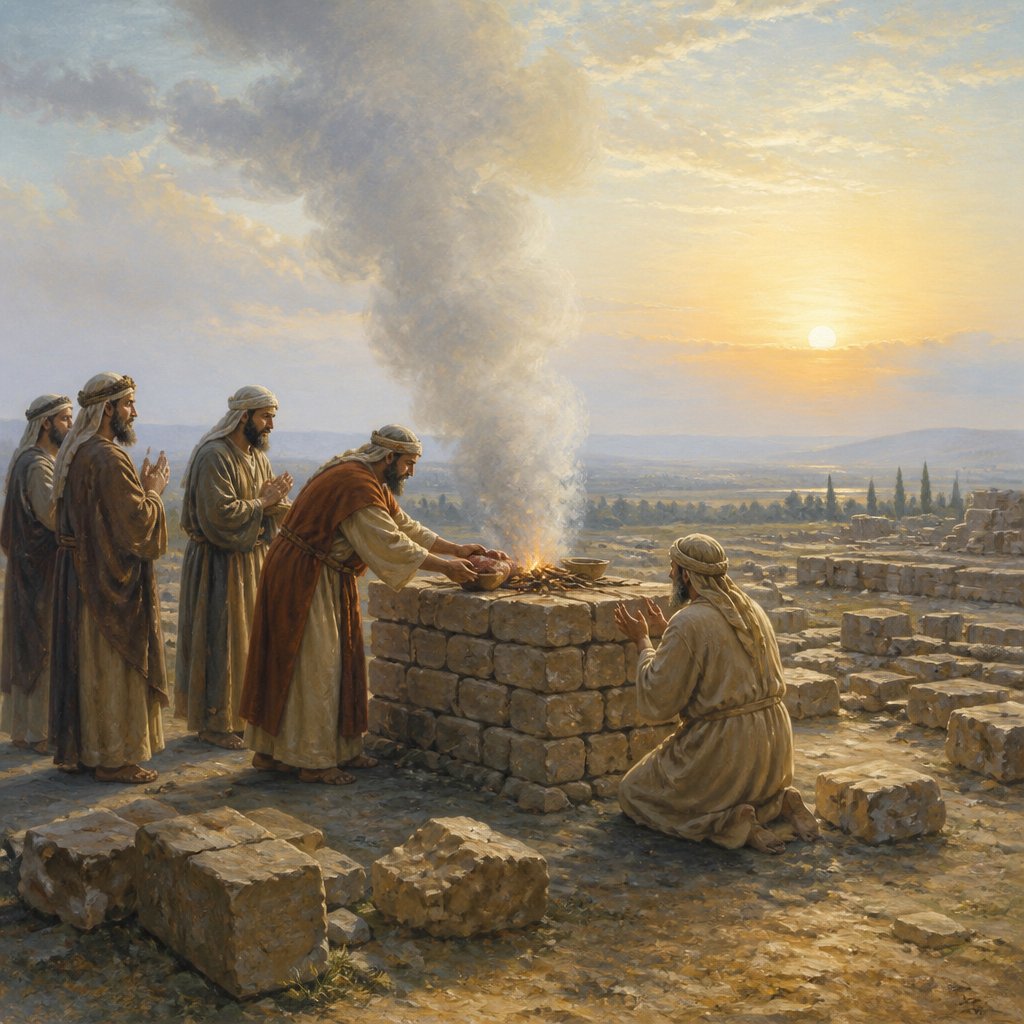
In Ezra 3:6, we read, "From the first day of the seventh month began they to offer burnt offerings unto the LORD. But the foundation of the temple of the LORD was not yet laid." At first glance, this verse seems to convey a simple chronological statement about the Israelites initiating their worship and sacrifices after their return from Babylonian exile. Yet, beneath its surface lies a profound insight into worship, community, and the faith that precedes tangible outcomes.
To understand this verse deeply, we must place it within the historical context of the Israelites’ return to Jerusalem. After decades of captivity in Babylon, they came back to a land that lay in ruins; the temple, the heart of their worship, was destroyed, and their city lay desolate. However, upon their return, they were met with not just the weight of a desolate city but also the heavy burden of rebuilding their lives and their relationship with God.
Their first act on the first day of the seventh month—to offer burnt offerings to the Lord—carries significant implications for worship and faith. The seventh month, particularly the first day, is noteworthy as it heralds the Feast of Trumpets (Rosh Hashanah), a time of new beginnings and spiritual renewal. This timing intentional draws a parallel with the themes of restoration and hope. It indicates that even amidst ruins, the people of Israel chose to reaffirm their covenant with God. They demonstrated profound faith by engaging in worship even without the temple’s groundwork laid.
This brings us to a critical aspect of faith: the act of worship itself. The burnt offering, a sacrificial act, expressed total dedication to God. The Israelites were acknowledging God's sovereignty, even when their situation appeared bleak. They realized that their relationship with God was not contingent upon the physical presence of the temple but was rooted in their hearts and their willingness to approach Him.
In the modern context, we often find ourselves in circumstances that seem hopeless or incomplete—relationships without restoration, dreams without fulfillment, goals that feel perpetually out of reach. Like the Israelites, we may become consumed by the daunting task of ‘laying foundations’ in our lives. But their actions encourage us to prioritize a posture of worship even before we see the realized promises or the fruits of our labor.
Worship is an act of faith; it declares that we trust God's plan and timing. Psalm 33:1-3 calls us to rejoice in the Lord and praise Him, irrespective of our external realities. When we lift our hearts in worship, we activate a divine connection that can transform our outlook. It positions us to receive God’s guidance, peace, and strength to face the rebuilding processes in our own lives.
As you reflect on Ezra 3:6, consider the foundations in your life that may appear absent or under construction. Are there areas where you have felt discouraged or overwhelmed? How can you intentionally engage in deeper worship during these times? It is often in the silence and the snares of uncertainty that our greatest calls to worship and sacrifice arise.
Commit to prioritizing worship, just as the Israelites did, even without the visible signs of progress. Let it be your offering to God in your trial, a fragrant aroma reminding you and everyone around you of God’s faithfulness and character. As you devote yourself to offering your heart in praise, trust that God is also at work laying the foundation for what is to come. By worshiping in the waiting, we not only honor God, but we open ourselves to receive the hope and encouragement necessary for our journeys ahead.
Ultimately, worship is not about what we see but about who we know—a God who is faithful, sovereign, and always present amid chaos. So let us lift our hearts and offer our praises, working faithfully towards the foundations yet to be laid.
Get our apps


Artwork for Ezra 3:6

Ezra 3:6 - "From the first day of the seventh month began they to offer burnt offerings unto the LORD. But the foundation of the temple of the LORD was not yet laid."
"From the first day of the seventh month began they to offer burnt offerings unto the LORD. But the foundation of the temple of the LORD was not yet laid." - Ezra 3:6

Ezra 9:6

Ezra 6:16

Ezra 3:2

Ezra 10:3

Ezra 3:2

Ezra 3:10

Ezra 3:9

Ezra 3:2

Zerubbabel in Ezra chapter 6

Ezra 6:1-12

Ezra 9:3

Ezra 3:2

Ezra 3:2

Ezra 10:3

Ezra 6:15-16

Ezra 6:15-16

Zerubbabel in Ezra chapter 3

Altar rebuilt in Jerusalem. Ezra 3:1-3

Ezra 6:3 - "In the first year of Cyrus the king the same Cyrus the king made a decree concerning the house of God at Jerusalem, Let the house be builded, the place where they offered sacrifices, and let the foundations thereof be strongly laid; the height thereof threescore cubits, and the breadth thereof threescore cubits;"

Ezra 7:3 - "The son of Amariah, the son of Azariah, the son of Meraioth,"

Ezra 6:19 - "And the children of the captivity kept the passover upon the fourteenth day of the first month."

Ezra 8:6 - "Of the sons also of Adin; Ebed the son of Jonathan, and with him fifty males."

Ezra 2:3 - "The children of Parosh, two thousand an hundred seventy and two."

Ezra 6:6 - "Now therefore, Tatnai, governor beyond the river, Shethar-boznai, and your companions the Apharsachites, which are beyond the river, be ye far from thence:"

Ezra 6:2 - "And there was found at Achmetha, in the palace that is in the province of the Medes, a roll, and therein was a record thus written:"

Ezra 2:6 - "The children of Pahath-moab, of the children of Jeshua and Joab, two thousand eight hundred and twelve."

Pagan women leave with their children ezra 10:3

Ezra 7:6 - "This Ezra went up from Babylon; and he was a ready scribe in the law of Moses, which the LORD God of Israel had given: and the king granted him all his request, according to the hand of the LORD his God upon him."