Facing Accusations: The Strength of Faith in Adversity
“And in the reign of Ahasuerus, in the beginning of his reign, wrote they unto him an accusation against the inhabitants of Judah and Jerusalem.” — Ezra 4:6
As we delve into the narrative of Ezra, specifically Ezra 4:6, we encounter a pivotal moment that reflects the struggles of a people seeking to restore their identity and worship after a period of exile. The KJV states, "And in the reign of Ahasuerus, in the beginning of his reign, wrote they unto him an accusation against the inhabitants of Judah and Jerusalem." This passage opens our understanding to the complexities of renewal amidst opposition, and it is imperative that we explore the implications of this moment for ourselves today.
### Context of Ezra 4:6
To appreciate the weight of this verse, we must grasp the historical context. The exiles of Judah had returned to Jerusalem with the hope of rebuilding the temple and reinstating their worship practices. However, their task was not only monumental in its physical demands but also fraught with potential backlash from surrounding nations. The mention of Ahasuerus (often identified with King Xerxes of Persia) indicates a political landscape rife with tension; accusations were often the weapon used by those who sought power to undermine God's people.
### Accusation as a Tool of the Enemy
Accusations can quickly become a catalyst for fear and division, particularly within the body of Christ. In this biblical account, we see how the adversaries of Judah took swift action by writing letters to the king. Their intent was to paint the inhabitants of Judah as a rebellious and troublesome people, putting their very mission of restoration at risk. The power of accusation holds the potential to destabilize, to create doubt, and to erode confidence not only in one's self but in God’s promises as well.
In our lives, we face similar accusations—whether they come from external sources or arise from our own insecurities and self-doubt. When the enemy whispers condemnation, it seeks to derail us from the purpose and plans God has set before us. The challenge is to recognize these accusations for what they are: attempts to incite fear and hinder the flourishing of God’s work in us and through us.
### Responding to Accusation with Faith
What can we learn from the inhabitants of Judah in this moment? They stood at a crossroads, faced with slander yet driven by a calling far greater than any external opposition. They knew their purpose was rooted in God’s promise. Therefore, rather than allowing the accusations to deter them, it became essential to cling to their identity as chosen people. We see this theme throughout Scripture; individuals like Daniel and Nehemiah faced relentless scoffing and positional threats yet demonstrated unwavering faith in God’s sovereignty.
When we find ourselves ensnared by accusations, it is vital that we respond not with fear, but with faith. We must turn our eyes to the Lord, remembering that our identity is found in Him. Romans 8:31 reminds us that if God is for us, who can be against us? When the enemy accuses, we can meditate on scriptures that reaffirm our position as heirs of Christ, redeemed and restored.
### Building in the Face of Opposition
As the people of Judah faced accusations, they had a choice: to succumb to fear or to build in faith. They made the courageous choice to continue their work on the temple, symbolizing their commitment to God’s presence. Likewise, let us also take up our calling, knowing that our work for the Lord, though often met with resistance, is of eternal significance. The act of moving forward in faith becomes an act of worship as we stand firm against the lies and accusations that attempt to bind us.
### Conclusion
As we reflect on Ezra 4:6, may we be inspired to recognize and confront the accusations in our lives, choosing to respond not with fear but with faith. Just as the inhabitants of Judah endured and rebuilt, let us rebuild the places in our hearts that have been broken by doubt. Let us hold onto the truth of God’s faithfulness as we march forward, undeterred by the accusations and assured in His everlasting love.
Get our apps


Artwork for Ezra 4:6

Ezra 4:6 - "And in the reign of Ahasuerus, in the beginning of his reign, wrote they unto him an accusation against the inhabitants of Judah and Jerusalem."

"And in the reign of Ahasuerus, in the beginning of his reign, wrote they unto him an accusation against the inhabitants of Judah and Jerusalem." - Ezra 4:6

Ezra 6:4 - "With three rows of great stones, and a row of new timber: and let the expenses be given out of the king's house:"

Ezra 4:4

Ezra 4:4

Ezra 9:6

Ezra 6:16

Zerubbabel in Ezra chapter 6

Ezra 6:1-12

Ezra 6:15-16

Ezra 6:15-16

Zerubbabel in Ezra chapter 4

Zerubbabel in Ezra chapter 4

Ezra 4:4 - "Then the people of the land weakened the hands of the people of Judah, and troubled them in building,"
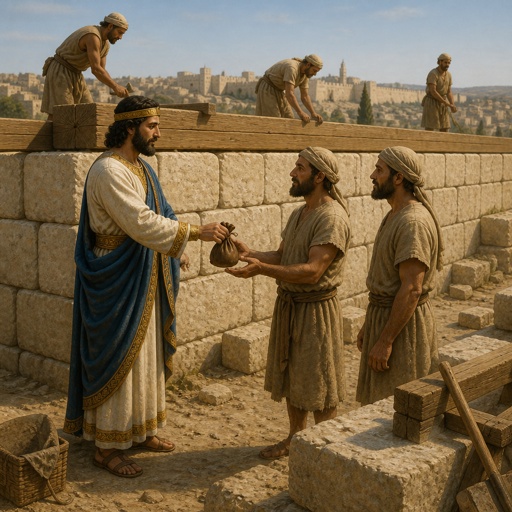
"With three rows of great stones, and a row of new timber: and let the expenses be given out of the king's house:" - Ezra 6:4

Letter to the king in Ezra chapter 4

Ezra 7:4 - "The son of Zerahiah, the son of Uzzi, the son of Bukki,"

Ezra 2:4 - "The children of Shephatiah, three hundred seventy and two."

Ezra 6:19 - "And the children of the captivity kept the passover upon the fourteenth day of the first month."

Ezra 8:6 - "Of the sons also of Adin; Ebed the son of Jonathan, and with him fifty males."

Ezra 6:6 - "Now therefore, Tatnai, governor beyond the river, Shethar-boznai, and your companions the Apharsachites, which are beyond the river, be ye far from thence:"

Ezra 6:2 - "And there was found at Achmetha, in the palace that is in the province of the Medes, a roll, and therein was a record thus written:"

Ezra 2:6 - "The children of Pahath-moab, of the children of Jeshua and Joab, two thousand eight hundred and twelve."

Ezra 8:4 - "Of the sons of Pahath-moab; Elihoenai the son of Zerahiah, and with him two hundred males."

Ezra 7:6 - "This Ezra went up from Babylon; and he was a ready scribe in the law of Moses, which the LORD God of Israel had given: and the king granted him all his request, according to the hand of the LORD his God upon him."

Ezra 6:15 - "And this house was finished on the third day of the month Adar, which was in the sixth year of the reign of Darius the king."

Ezra 6:16 - "¶ And the children of Israel, the priests, and the Levites, and the rest of the children of the captivity, kept the dedication of this house of God with joy,"

Ezra 6:18 - "And they set the priests in their divisions, and the Levites in their courses, for the service of God, which is at Jerusalem; as it is written in the book of Moses."

Ezra 6:10 - "That they may offer sacrifices of sweet savours unto the God of heaven, and pray for the life of the king, and of his sons."

Ezra 4:22 - "Take heed now that ye fail not to do this: why should damage grow to the hurt of the kings?"