Who Has Commanded You? Unpacking Authority in Our Divine Assignments
“At the same time came to them Tatnai, governor on this side the river, and Shethar-boznai, and their companions, and said thus unto them, Who hath commanded you to build this house, and to make up this wall?” — Ezra 5:3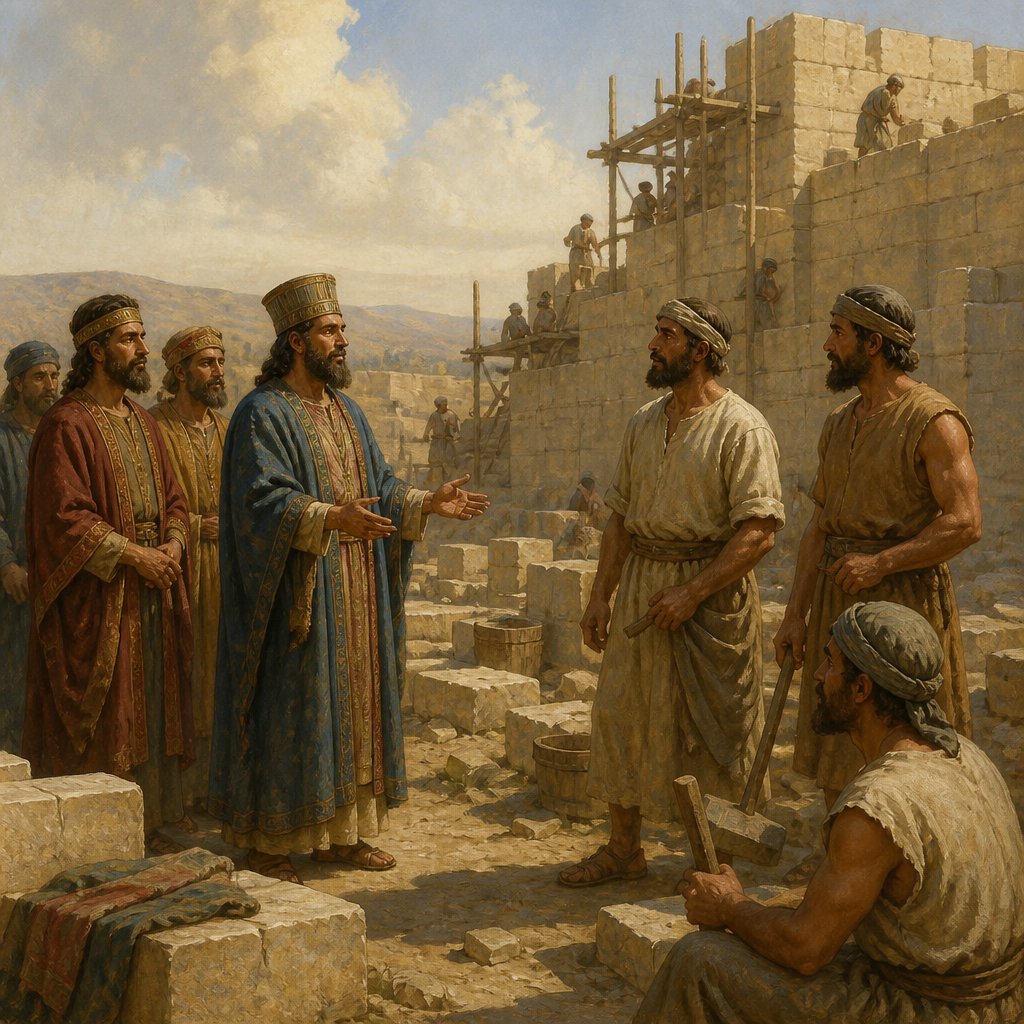
In the compelling narrative of Ezra, we witness the unfolding of a significant moment for the Jewish people returning from their Babylonian exile. Ezra 5:3 captures the tension and the challenge faced by the exiles as they set out to reconstruct God’s house in Jerusalem: "At the same time came to them Tatnai, governor on this side the river, and Shethar-boznai, and their companions, and said thus unto them, Who hath commanded you to build this house, and to make up this wall?"
This single verse is laden with implications about authority, purpose, and our divine calling. As we dive into this moment, we should reflect on who it is that truly commands our actions in our spiritual undertakings and in the tasks we take on in our lives.
**Understanding Authority**
Tatnai, the governor, along with his associates, represents worldly authority and skepticism. They arrive when the Jewish people are fervently working on rebuilding the temple, a tangible manifestation of their faith and commitment to God. Tatnai’s question embodies a challenge not only to their actions but to their very identities as a people set apart for God’s purposes. When he asks, "Who hath commanded you to build this house?" he is questioning their legitimacy, authority, and motivation to embark on such a monumental task.
This scenario is reminiscent of the struggles we often face in our pursuits. Whenever we step out to follow God’s calling—be it in ministry, in our jobs, or in our communities—there could be naysayers asking, "Who told you to go there?" or "Who gave you the authority to act?" This line of questioning can sometimes strike at the core of our faith. We may even experience moments of doubt about whether we have truly been called or authorized to proceed.
**Divine Command**
As believers, we must remind ourselves that our ultimate authority comes from God. Just as he commanded the Israelites to rebuild the temple, He gives each of us distinct assignments for our lives. In biblical terms, God’s commands are not merely suggestions but are the very blueprint for our lives. In times of questioning, we can find reassurance in His promises, knowing that if He sends us, He equips us with the authority to carry out His work.
Consider the example of Nehemiah, who faced opposition yet remained steadfast in his resolve to rebuild the walls of Jerusalem. He found his strength in prayer and in the assurance that he was acting on divine orders. In similar fashion, when Tatnai questioned the Jews in Ezra, they were tasked not only with the physical act of construction but also with the spiritual restoration of their community.
**Our Rebuilding Efforts**
As modern-day Christians, we, too, are called to rebuild—to restore faith, relationships, or even entire communities. Each of us has our own "house" or "wall" to build that represents our individual and collective obedience to God. This could manifest in various forms: serving the marginalized, supporting the broken-hearted, or spreading the gospel. However, we must be committed to ensuring that all we do is rooted in God’s command, not human approval.
In response to questions about their authority, the Jews later declared of their actions, "The God of heaven... he will prosper us; therefore we his servants will arise and build..." (Ezra 5:11). They were aware that earthly authority held no candle to the mandates of the Almighty.
**Conclusion**
Ultimately, we must ask ourselves: who has commanded you? If it is God, then we must be bold and act upon His instructions, regardless of opposition that may come our way. Let us remember that each pushback or question can serve as an opportunity to articulate our faith. Whether it be in our churches, families, workplaces, or communities, let us hold on tightly to our divine orders, equipping ourselves with knowledge from God’s word and the courage to stand firm amid challenges. In every aspect of rebuilding, we must rest assured that we do not labor in vain but under the auspices of a divine calling that transcends earthly authority.
Get our apps


Artwork for Ezra 5:3

Ezra 5:3 - "¶ At the same time came to them Tatnai, governor on this side the river, and Shethar-boznai, and their companions, and said thus unto them, Who hath commanded you to build this house, and to make up this wall?"
"¶ At the same time came to them Tatnai, governor on this side the river, and Shethar-boznai, and their companions, and said thus unto them, Who hath commanded you to build this house, and to make up this wall?" - Ezra 5:3

Ezra 3:5 - "And afterward offered the continual burnt offering, both of the new moons, and of all the set feasts of the LORD that were consecrated, and of every one that willingly offered a freewill offering unto the LORD."

Ezra 10:5 - "Then arose Ezra, and made the chief priests, the Levites, and all Israel, to swear that they should do according to this word. And they sware."

Ezra 10:3

Ezra 3:10

Ezra 3:2

Ezra 3:2

Ezra 3:9

Ezra 3:2

Zerubbabel in Ezra chapter 5

Ezra 9:3

Ezra 3:2

Ezra 3:2

Ezra 10:3

Zerubbabel in Ezra chapter 3

Altar rebuilt in Jerusalem. Ezra 3:1-3

Ezra 2:5 - "The children of Arah, seven hundred seventy and five."

Zerubbabel in Ezra chapter 5 but zerubbabel is not a priest

Ezra 7:3 - "The son of Amariah, the son of Azariah, the son of Meraioth,"

Ezra 8:5 - "Of the sons of Shechaniah; the son of Jahaziel, and with him three hundred males."

Ezra 2:3 - "The children of Parosh, two thousand an hundred seventy and two."

Ezra 7:5 - "The son of Abishua, the son of Phinehas, the son of Eleazar, the son of Aaron the chief priest:"

Ezra 5:5 - "But the eye of their God was upon the elders of the Jews, that they could not cause them to cease, till the matter came to Darius: and then they returned answer by letter concerning this matter."

Pagan women leave with their children ezra 10:3

Ezra 5:4 - "Then said we unto them after this manner, What are the names of the men that make this building?"

Pagan women leave with their children ezra 10:3

Ezra 5:13 - "But in the first year of Cyrus the king of Babylon the same king Cyrus made a decree to build this house of God."

"Then arose Ezra, and made the chief priests, the Levites, and all Israel, to swear that they should do according to this word. And they sware." - Ezra 10:5

Ezra 5:7 - "They sent a letter unto him, wherein was written thus; Unto Darius the king, all peace."