The Cost of Immediate Satisfaction: Lessons from Esau
“And Esau said, Behold, I am at the point to die: and what profit shall this birthright do to me?” — Genesis 25:32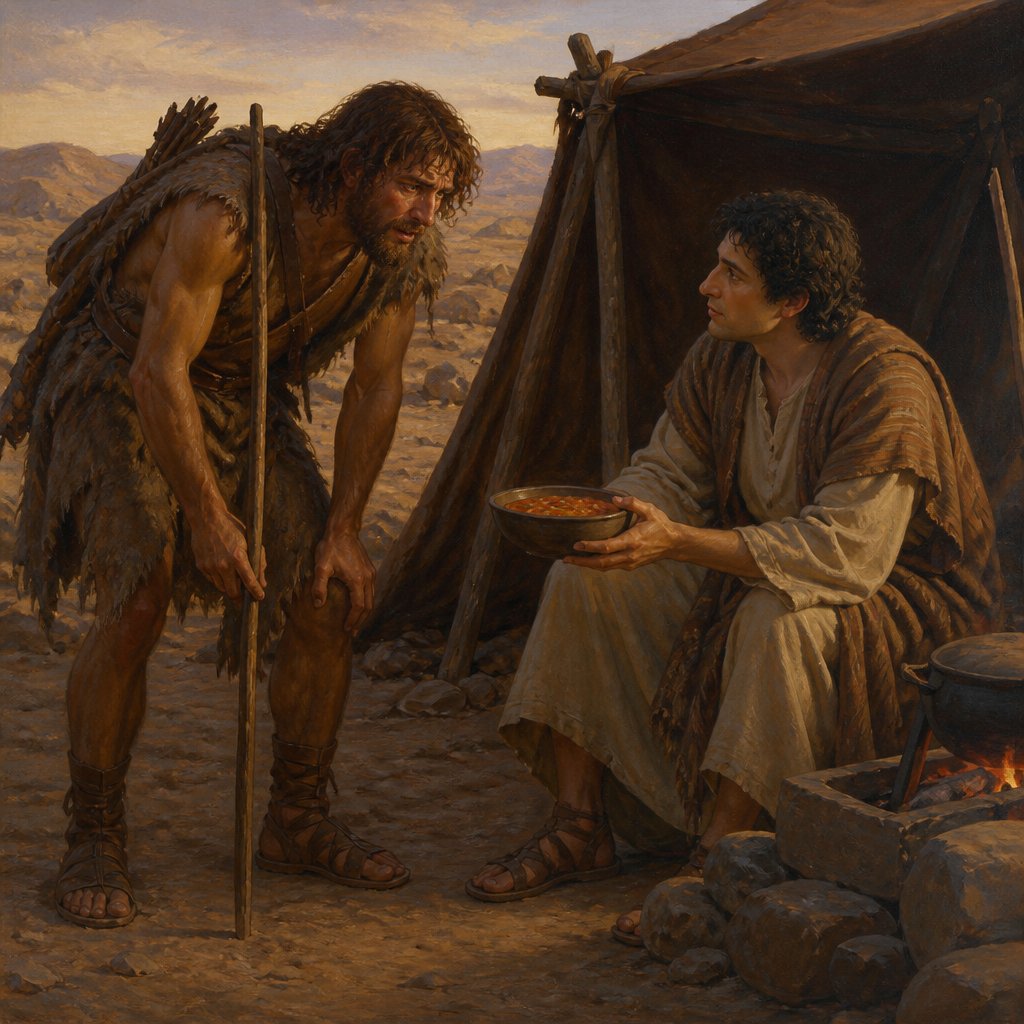
In the narrative of Genesis 25, we encounter a pivotal moment in the life of Esau—a moment that speaks volumes about the human condition and our tendency to prioritize immediate needs over long-term benefits. The verse we focus on, Genesis 25:32 (KJV), reads: ‘And Esau said, Behold, I am at the point to die: and what profit shall this birthright do to me?’
To fully appreciate the gravity of Esau's statement, we must delve into the context surrounding it. Esau, the firstborn son of Isaac, was the rightful heir to both a material and spiritual birthright. In that culture, the birthright carried immense significance, entailing a double portion of the inheritance and the spiritual blessing from the father. However, in this intense moment of hunger, Esau's immediate desire for food clouded his judgment, leading him to trivialize what should have been of utmost importance.
Esau was weary and faint from hunting, and in that moment of desperation, he viewed his birthright as less valuable than a single meal. This scenario highlights a critical aspect of our nature: the propensity to succumb to impulse. It is easy to judge Esau harshly—after all, who would trade a lifetime of heritage for a bowl of stew? Yet, how often do we find ourselves in similar positions? In our daily lives, we often encounter temptations that beckon us to forsake long-standing commitments for immediate gratification.
Esau’s phrase, ‘at the point to die,’ suggests not only physical hunger but also an existential dilemma. In our fast-paced world, we often feel pressured, overwhelmed, and starved for immediate relief—whether through food, entertainment, relationships, or other earthly pleasures. This urgent craving can distort our perspective, leading us to make choices that conflict with our higher values and commitments. Esau's choice to sell his birthright for a meal was not merely about hunger; it symbolized a lack of faith in the future and a disregard for spiritual lineage in favor of physical satisfaction.
From a spiritual standpoint, what does it mean for us today? It correlates with making decisions under duress or pressure. When faced with significant decisions, we ought to assess whether our choices reflect our identity as children of God, bearing in mind His promises. We often forget that whether during trials or triumphs, God is eternally faithful and worthy of trust.
Reflecting further on Esau’s lament, we recognize that he realized too late the enormity of his loss. Once he made the trade, he could not reclaim his birthright. The consequences of his impulsive decision echoed throughout generations, as the struggle between Jacob and Esau marked the beginning of a longstanding enmity that affected their descendants, the nations of Israel and Edom.
Today, we are reminded of the need to evaluate our priorities consistently and to anchor our decisions in God’s eternal truth rather than fleeting desires. When temptation knocks, we must ask ourselves:
- What do I stand to lose if I act on this impulse?
- Am I trading something valuable, possibly my peace, integrity, or future blessings, for a moment of satisfaction?
The story of Esau challenges us to be mindful of what we hold dear, guiding us to cherish our spiritual inheritance and purpose. As believers, we are called to seek God’s Kingdom first (Matthew 6:33), understanding that His provisions surpass our immediate needs. Let us cultivate a heart that seeks long-term fulfillment rather than momentary pleasures, ensuring we do not sell our birthright, riches in Christ, simply to satiate a temporary hunger.
Get our apps


Artwork for Genesis 25:32

Genesis 25-32

Genesis 25:32 - "And Esau said, Behold, I am at the point to die: and what profit shall this birthright do to me?"
"And Esau said, Behold, I am at the point to die: and what profit shall this birthright do to me?" - Genesis 25:32

Genesis 32:25 - "And when he saw that he prevailed not against him, he touched the hollow of his thigh; and the hollow of Jacob's thigh was out of joint, as he wrestled with him."

Romans 11:25-32

Genesis 25:25

Genesis 19-32

Genesis 27:32

Genesis 24-32

Genesis 18-32
Genesis 21-32

Genesis 1:1-25

Genesis 1:1-25

Genesis 1:1-25

Leviticus 25:32 - "Notwithstanding the cities of the Levites, and the houses of the cities of their possession, may the Levites redeem at any time."

Genesis 49:32 - "The purchase of the field and of the cave that is therein was from the children of Heth."

Genesis 25-18

Genesis 25-24

Genesis 25-2

Genesis 25-7

Genesis 25-23

Genesis 25-14

Genesis 50:25

Genesis 25:1

Genesis 26:25

Genesis 25-15

Genesis 21:25

Genesis 25-13

Genesis 25-26

Genesis 50:25