Obedience in the Journey: Lessons from Jacob's Path to Padan-aram
“And that Jacob obeyed his father and his mother, and was gone to Padan-aram;” — Genesis 28:7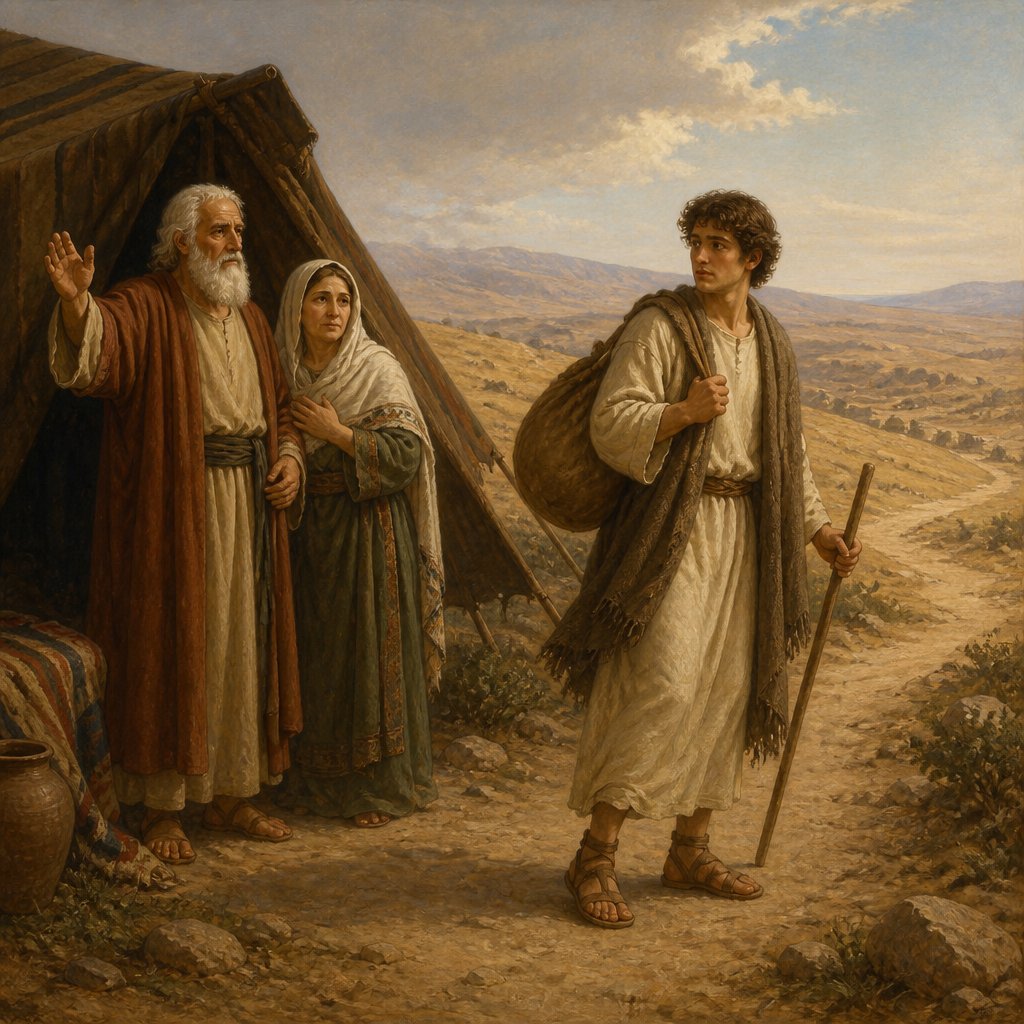
In an age where the voices of authority and tradition often clash with personal desires, the story of Jacob in Genesis 28:7 beckons us to reflect on the nature of obedience within familial structures. The verse states: "And that Jacob obeyed his father and his mother, and was gone to Padan-aram;" This moment in Jacob's life is critical, not just for his personal journey, but as a framework for understanding the broader implications of obeying one’s parents, especially within the Biblical covenant context.
To fully appreciate this passage, we must consider the circumstances surrounding it. Jacob was directed by his parents, Isaac and Rebekah, to leave the land of Canaan for Padan-aram, a decision rooted in the cultural and spiritual heritage of the time. Following the incident with Esau, Jacob found himself in a precarious situation, one that necessitated wisdom from his elders. His journey was not simply a physical relocation; it was a divine mandate cloaked in the practice of familial honor and submission.
Obedience, in this context, is pivotal. Jacob's decision to heed his parents’ instruction reflects a deeper understanding of his role within the family structure. Proverbs 1:8 encourages us, saying, "My son, hear the instruction of thy father, and forsake not the law of thy mother." This principle of honoring one’s father and mother is foundational, deeply embedded in the fabric of God’s law. By obeying his parents, Jacob was not merely following tradition; he was fulfilling a divine principle that transcends time.
Furthermore, Jacob's obedience to his parents was not just an act of compliance; it was an expression of faith in God's greater plan for his life. This is illustrated beautifully in Hebrews 11:8, where we read about Abraham's faith to obey God’s call, which would also extend to his descendants, including Jacob. There is a profound connection between obedience and faith, suggesting that when we obey our earthly authorities, we are, in effect, aligning ourselves with God’s economy of grace and providence.
As we reflect on our own lives, we are invited to ask ourselves: how do we respond to authority? In a society that often champions individualism and personal freedom, the concept of obedient submission is frequently misconstrued as weakness or subservience. However, true humility in obedience signifies strength of character and an acknowledgment of God’s sovereignty. We are called to trust that God uses our circumstances – including our relationships with our parents – as a means of shaping our destiny.
Jacob’s obedience to his parents paved the way for extraordinary events in his life: his eventual encounter with God at Bethel, his growth into a nation of promise, and the deepening of his understanding of God's covenant. Disobedience, on the other hand, would have likely led him down a far more tumultuous path, similar to that of his brother Esau. Furthermore, obeying our parents can often lead us to unexpected blessings, as seen in Jacob’s future familial encounters, which serve as foundational stories for the Israelite nation.
In conclusion, Genesis 28:7 serves not only as a record of Jacob's obedience but as a profound lesson on God’s design for our relationships. As we navigate our lives, may we embrace the wisdom of listening to and honoring our parents, understanding that through our obedience, we may discover the path God has set before us. Let us trust in His good purposes, knowing that even in the simple act of obeying our parents, we are fulfilling His divine will.
Get our apps


Artwork for Genesis 28:7

Genesis 28:7 - "And that Jacob obeyed his father and his mother, and was gone to Padan-aram;"

Genesis 28:7 KJV And that Jacob obeyed his father and his mother, and was gone to Padan–aram;

Genesis 28:7 KJV And that Jacob obeyed his father and his mother, and was gone to Padan–aram;
"And that Jacob obeyed his father and his mother, and was gone to Padan-aram;" - Genesis 28:7

Genesis 28-15

Genesis 28-12

Genesis 28-16

Genesis 28-21

Genesis 28-22

Genesis 28-17

Genesis 21:28

Genesis 28:18

Genesis 24:28

Genesis 28:18

Genesis 28-20

Genesis 28-13

Genesis 28-19

Genesis 28-14

Genesis 28-11

Genesis 19-28

Genesis 28:10

Genesis 18-28

Genesis 10:28 - "And Obal, and Abimael, and Sheba,"

Genesis 36:28 - "The children of Dishan are these; Uz, and Aran."

Genesis 35:28 - "And the days of Isaac were an hundred and fourscore years."

Genesis 21:28 - "And Abraham set seven ewe lambs of the flock by themselves."

"And Obal, and Abimael, and Sheba," - Genesis 10:28

Genesis 5:28 - "¶ And Lamech lived an hundred eighty and two years, and begat a son:"

Genesis 30:28 - "And he said, Appoint me thy wages, and I will give it."

1 Samuel 28:7