The Art of Divine Strategy: Lessons from Jacob's Faith
“And Jacob took him rods of green poplar, and of the hazel and chesnut tree; and pilled white strakes in them, and made the white appear which was in the rods.” — Genesis 30:37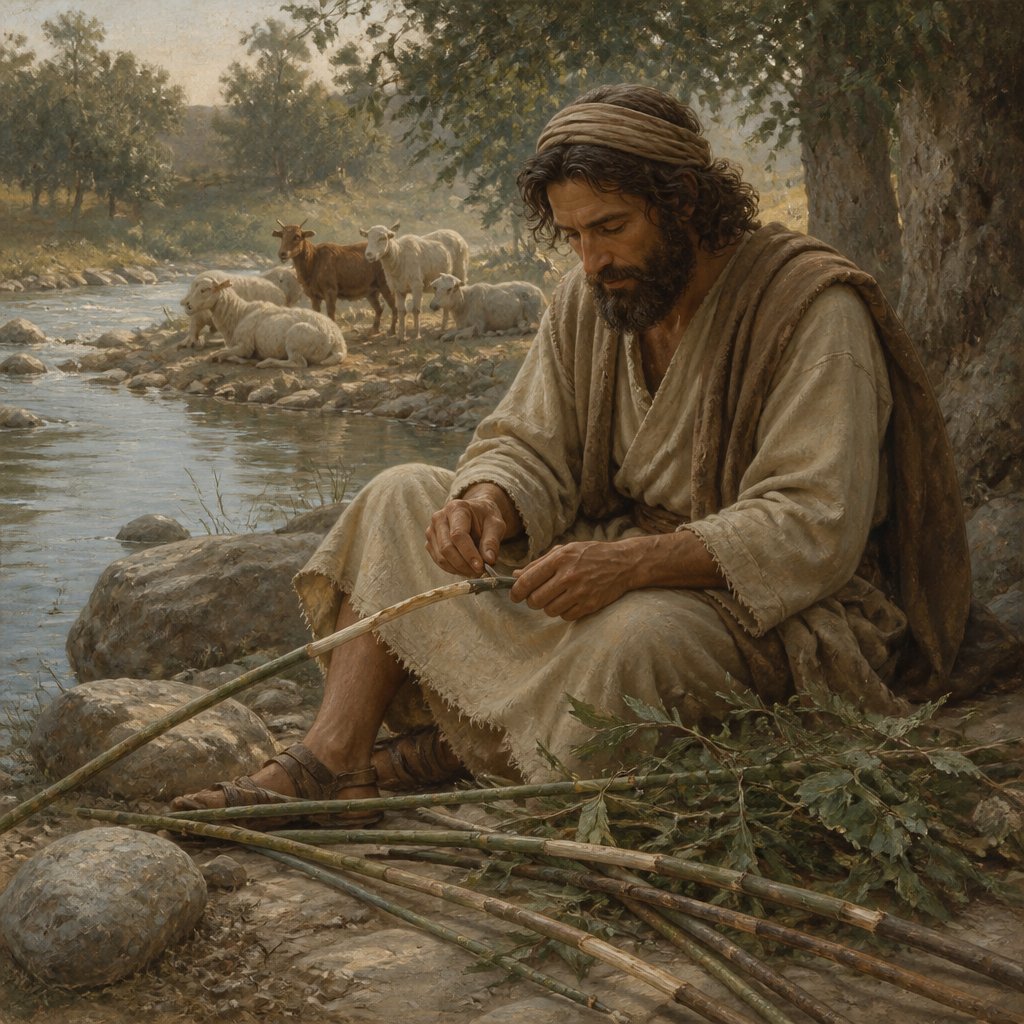
Genesis 30:37 (KJV) states, "And Jacob took him rods of green poplar, and of the hazel and chesnut tree; and pilled white strakes in them, and made the white appear which was in the rods." This verse points us to an intriguing account in the life of Jacob, which is steeped in themes of trust, creativity, and divine intervention.
At this juncture in his life, Jacob is fleeing from Laban, his uncle. He has spent many years working for Laban, and though he has prospered, he yearns for freedom and the fulfillment of God’s promise to him—a covenant that speaks of a multitude of descendants and prosperity. His relationship with Laban is fraught with tension, and Jacob seeks a way to ensure his future, especially concerning the livestock that he has acquired from Laban. In this instance, he begins to use what can only be described as a divine strategy.
Jacob's decision to take rods from the poplar, hazel, and chestnut trees may seem curious at first. However, within this action lies a profound lesson on the intersection of faith and practical action. Jacob takes a step that appears unconventional; he employs the natural world around him to achieve a desired outcome. By peeling the rods in such a way that the white in the wood is exposed, Jacob creates an environment where certain genetic traits in the animals he is breeding may reflect in the offspring. In many ways, this act reflects Jacob's blend of human ingenuity and dependence on God's provision.
There’s a beautiful irony here. Jacob has had a lifetime of experience dealing with Laban’s trickery; he himself is no stranger to deception. However, in this moment, rather than relying purely on his wits or manipulation, he invokes a blend of strategy and divine faith. This teaches us that God often works through our creativity, resourcefulness, and proactive measures. While Jacob's actions may seem like an exercise in superstition to some, he was essentially placing his trust in God's promise while using the resources within his reach to fulfill that promise.
This leads us to reflect on our own lives. How often do we find ourselves in situations where we are waiting for God to move while we sit idly by? Jacob exemplifies a crucial aspect of faith: being active participants in God’s plan. We are called to be diligent, to work with what we have, and to trust God for the increase. The Bible tells us in James 2:26 that “faith without works is dead.” Jacob’s story exemplifies that faith is not passive; it is an active, living engagement with God’s promises.
Moreover, consider how this passage illustrates the importance of seeing beyond our current circumstances. Jacob used the peeling of the bark to create an expectation for the outcome he desired. This correlates directly with the concept of hope—seeing things not as they are but as they could be. Are we willing to peel back the layers in our lives, to be vulnerable and open, trusting that God can transform our situations? We must, like Jacob, declare that we have faith in what we cannot yet see.
Finally, as we meditate on Jacob’s actions, let us consider the outcome. Despite the potential for frustration and conflict, Jacob’s faith allows him to prosper ultimately—not just in livestock but in his relationship with his family and God. Likewise, when we exercise our faith with combined action, we may witness God’s miraculous work in our lives.
May we enter each day knowing that we, too, can engage in the art of divine strategy. Let us seek wisdom, act diligently, and trust that God will bring about His purposes in, through, and all around us, just as He did for Jacob.
In conclusion, Genesis 30:37 offers us a rich tapestry of lessons. It reminds us that God honors both our faith and our actions. Let us strive to partner with Him, using every resource at our disposal while awaiting His abundant blessings.
Get our apps


Artwork for Genesis 30:37

Genesis 30:37 - "¶ And Jacob took him rods of green poplar, and of the hazel and chesnut tree; and pilled white strakes in them, and made the white appear which was in the rods."

"¶ And Jacob took him rods of green poplar, and of the hazel and chesnut tree; and pilled white strakes in them, and made the white appear which was in the rods." - Genesis 30:37

Genesis 37:30 - "And he returned unto his brethren, and said, The child is not; and I, whither shall I go?"

"And he returned unto his brethren, and said, The child is not; and I, whither shall I go?" - Genesis 37:30

genesis 37

Genesis 19-37

Genesis 24-37

Genesis 37:2

Psalms 37:30 - "The mouth of the righteous speaketh wisdom, and his tongue talketh of judgment."

Genesis 37:19 - "And they said one to another, Behold, this dreamer cometh."

Genesis 19-30

Genesis 24-30

Genesis 18-30

Genesis 21-30

Genesis 37:12 - "¶ And his brethren went to feed their father's flock in Shechem."

Genesis 37:24 - "And they took him, and cast him into a pit: and the pit was empty, there was no water in it."

Genesis 37:11 - "And his brethren envied him; but his father observed the saying."

Genesis 41:37 - "¶ And the thing was good in the eyes of Pharaoh, and in the eyes of all his servants."
Genesis 36:37 - "And Samlah died, and Saul of Rehoboth by the river reigned in his stead."

Genesis 37:31 - "And they took Joseph's coat, and killed a kid of the goats, and dipped the coat in the blood;"

Genesis 37:1 - "And Jacob dwelt in the land wherein his father was a stranger, in the land of Canaan."

Genesis 30:10-11

Genesis 29:15-30

Exodus 30:37 - "And as for the perfume which thou shalt make, ye shall not make to yourselves according to the composition thereof: it shall be unto thee holy for the LORD."

Genesis 37:36 - "And the Midianites sold him into Egypt unto Potiphar, an officer of Pharaoh's, and captain of the guard."

"The mouth of the righteous speaketh wisdom, and his tongue talketh of judgment." - Psalms 37:30

Genesis 30:5 - "And Bilhah conceived, and bare Jacob a son."

Genesis 11:30 - "But Sarai was barren; she had no child."

Genesis 37:29 - "¶ And Reuben returned unto the pit; and, behold, Joseph was not in the pit; and he rent his clothes."

Genesis 37:5 - "¶ And Joseph dreamed a dream, and he told it his brethren: and they hated him yet the more."