The Cost of Survival: A Lesson from Genesis 47:19
“Wherefore shall we die before thine eyes, both we and our land? buy us and our land for bread, and we and our land will be servants unto Pharaoh: and give us seed, that we may live, and not die, that the land be not desolate.” — Genesis 47:19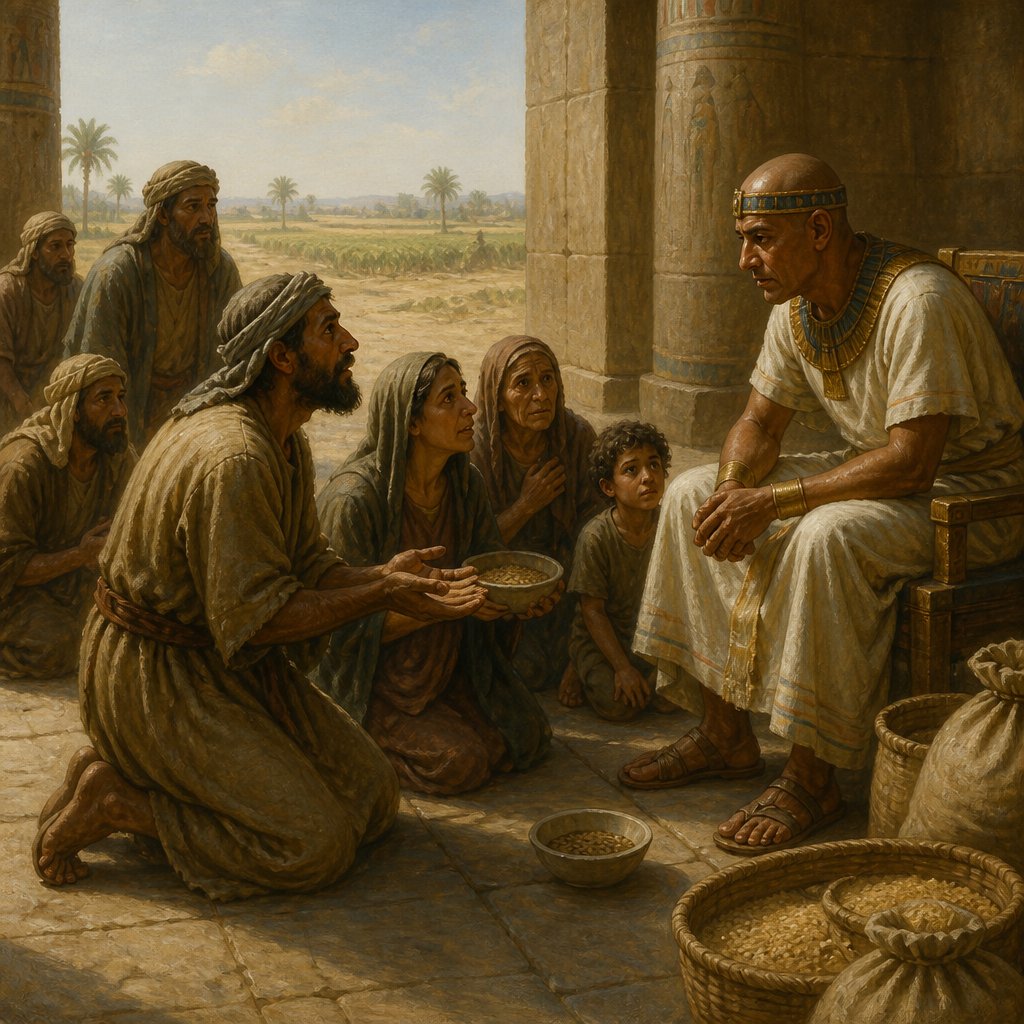
In Genesis 47:19, we encounter a powerful moment of desperation and existential need: "Wherefore shall we die before thine eyes, both we and our land? buy us and our land for bread, and we and our land will be servants unto Pharaoh: and give us seed, that we may live, and not die, that the land be not desolate." This plea from Joseph’s brothers echoes not only across the ages but also resonates deeply with our current struggles in life. It serves as a profound reminder of the choices we make in times of crisis and the larger narratives of dependence, survival, and submission to authority.
This verse captures a bleak reality. Famine has gripped the land of Egypt, and Joseph, in his wisdom and foresight, has prepared to confront the impending catastrophe. His brothers, representing the desperate multitude, approach him with an unmistakable urgency. This moment is not a mere transaction; it is emblematic of humanity’s age-old struggle for sustenance. The question posed, "Wherefore shall we die before thine eyes?" captures their plight—their fear of death, of losing everything that holds value, including their very identity as free men.
Their words reveal a raw vulnerability, showcasing the harsh term of servitude they are willing to accept to survive. "Buy us and our land for bread... and give us seed." In essence, they are trading their liberty for sustenance. In their quest for life, they are prepared to submit to Pharaoh, relinquishing their autonomy in exchange for the means to live. This is a dual act of desperation and pragmatism. They understand that survival has a cost, and sometimes that cost includes surrendering aspects of ourselves that we hold dear.
From a spiritual perspective, this account offers profound insights into our own lives. Often in our quest for survival—be it emotional, spiritual, or physical—we find ourselves grappling with the question of what we are willing to sacrifice. Just as the brothers were facing famine, we too encounter drought in our souls, times of spiritual barrenness. What are we trading for sustenance? God desires for us to thrive, yet we sometimes find ourselves on the brink of spiritual starvation, opting for worldly solutions rather than leaning into His abundance.
The brothers' desperate plea for seed is an echo of the need for revival, a request for the very tools that will enable them to not just survive but also cultivate life once more. In a similar fashion, we are encouraged to seek God for provision—not merely for immediate needs but for the spiritual seed that ignites growth in our lives. When we plead for God to provide for us, we are not just asking for survival; we are yearning for seeds of faith, hope, and love to take root in our hearts.
Moreover, the phrase "that the land be not desolate" highlights the sanctity of life and the collective responsibility we have. Life is not merely individualistic; our well-being often intersects with the well-being of our communities, families, and the earth itself. When we, like Joseph's brothers, find ourselves in positions of desperation, we must also consider how our choices affect those around us. Are we pursuing life in isolation, or are we engaging in actions that contribute to the health of our community?
As we meditate on Genesis 47:19, may we strive to recognize our own moments of famine. Let us not wait until we are utterly destitute before we realize our need for God’s sustenance. Instead, may we approach Him humbly, acknowledging that while survival often requires sacrifice, grace and abundance await those who trust in Him. In these moments of trial, let us find our prayer to be one of surrender, asking God for bread, seeds of hope, and the wisdom to navigate the complexities of life with grace—the kind that leads to nurturing not only our own land but also impacting the world.
Thus, the story of Joseph’s brothers is not just theirs; it’s ours. Let us choose not to perish before His eyes, but rather come forth demanding life, not in the form of bread alone, but in the vibrant, eternal hope that we find in the seed of faith given by God.
Get our apps


Artwork for Genesis 47:19

Genesis 47:19 - "Wherefore shall we die before thine eyes, both we and our land? buy us and our land for bread, and we and our land will be servants unto Pharaoh: and give us seed, that we may live, and not die, that the land be not desolate."
"Wherefore shall we die before thine eyes, both we and our land? buy us and our land for bread, and we and our land will be servants unto Pharaoh: and give us seed, that we may live, and not die, that the land be not desolate." - Genesis 47:19

Genesis 24-47

Genesis 31:47 - "And Laban called it Jegarsahadutha: but Jacob called it Galeed."

Genesis 41:47 - "And in the seven plenteous years the earth brought forth by handfuls."

Genesis 47:10 - "And Jacob blessed Pharaoh, and went out from before Pharaoh."

Genesis 47:8 - "And Pharaoh said unto Jacob, How old art thou?"

Genesis 47:2 - "And he took some of his brethren, even five men, and presented them unto Pharaoh."

Luke 19:47 - "And he taught daily in the temple. But the chief priests and the scribes and the chief of the people sought to destroy him,"

Genesis 47:12 - "And Joseph nourished his father, and his brethren, and all his father's household, with bread, according to their families."

Genesis 47:16 - "And Joseph said, Give your cattle; and I will give you for your cattle, if money fail."

Genesis 47:27 - "¶ And Israel dwelt in the land of Egypt, in the country of Goshen; and they had possessions therein, and grew, and multiplied exceedingly."

Genesis 47:7 - "And Joseph brought in Jacob his father, and set him before Pharaoh: and Jacob blessed Pharaoh."

Genesis 47:5 - "And Pharaoh spake unto Joseph, saying, Thy father and thy brethren are come unto thee:"

"And Laban called it Jegarsahadutha: but Jacob called it Galeed." - Genesis 31:47

Genesis 47:28 - "And Jacob lived in the land of Egypt seventeen years: so the whole age of Jacob was an hundred forty and seven years."

Genesis 47:21 - "And as for the people, he removed them to cities from one end of the borders of Egypt even to the other end thereof."

Genesis 47:13 - "¶ And there was no bread in all the land; for the famine was very sore, so that the land of Egypt and all the land of Canaan fainted by reason of the famine."

Genesis 47:31 - "And he said, Swear unto me. And he sware unto him. And Israel bowed himself upon the bed's head."

Ezekiel 47:19 - "And the south side southward, from Tamar even to the waters of strife in Kadesh, the river to the great sea. And this is the south side southward."

Genesis 47:25 - "And they said, Thou hast saved our lives: let us find grace in the sight of my lord, and we will be Pharaoh's servants."

"And in the seven plenteous years the earth brought forth by handfuls." - Genesis 41:47

Genesis 47:11 - "¶ And Joseph placed his father and his brethren, and gave them a possession in the land of Egypt, in the best of the land, in the land of Rameses, as Pharaoh had commanded."

Genesis 47:14 - "And Joseph gathered up all the money that was found in the land of Egypt, and in the land of Canaan, for the corn which they bought: and Joseph brought the money into Pharaoh's house."

Genesis 19-19

"And Jacob blessed Pharaoh, and went out from before Pharaoh." - Genesis 47:10

Genesis 47:3 - "And Pharaoh said unto his brethren, What is your occupation? And they said unto Pharaoh, Thy servants are shepherds, both we, and also our fathers."

"And Pharaoh said unto Jacob, How old art thou?" - Genesis 47:8

Genesis 47:30 - "But I will lie with my fathers, and thou shalt carry me out of Egypt, and bury me in their buryingplace. And he said, I will do as thou hast said."

Genesis 47:23 - "Then Joseph said unto the people, Behold, I have bought you this day and your land for Pharaoh: lo, here is seed for you, and ye shall sow the land."