“Here Am I”: The Holy Courage to Say Yes to God’s Call
“Also I heard the voice of the Lord, saying, Whom shall I send, and who will go for us? Then said I, Here am I; send me.” — Isaiah 6:8
“Also I heard the voice of the Lord, saying, Whom shall I send, and who will go for us? Then said I, Here am I; send me.” (Isaiah 6:8, KJV)
Isaiah 6:8 places us in a sacred moment—one that exposes the heart of true discipleship. Isaiah is not casually volunteering for a religious task. He is responding to the voice of the Lord after encountering God’s holiness. This is important: the call of God is not primarily an invitation to prove ourselves; it is a summons that comes after we have been confronted by who God is. When the Lord speaks—“Whom shall I send, and who will go for us?”—it is not because God lacks power or options. It is because God, in His wisdom, chooses to work through willing people.
Notice the tenderness and weight in the Lord’s question. God could have issued a command with undeniable force, but instead He asks, “Whom shall I send…?” The question is not merely about ability; it is about availability. Many can do something, but fewer will go when the path is costly, misunderstood, or unseen. God’s question searches the room, so to speak, for a heart that is yielded. It searches our lives as well. In our schedules, our plans, our ambitions, our fears—God still asks, “Who will go?”
Then comes Isaiah’s response: “Here am I; send me.” It is short, but it is full of meaning. “Here am I” is not just a statement of location; it is a statement of surrender. Isaiah is placing his whole self before God—his mouth, his mind, his future, his reputation. He does not negotiate terms or ask for a complete map of what lies ahead. He simply offers himself to the Lord who has revealed Himself as holy and worthy.
This verse confronts a common struggle in the spiritual life: we often want clarity before obedience. We want assurance before surrender. We want safety before mission. But Isaiah’s words show another way. He does not begin with “Here are my strengths,” or “Here is what I can manage,” or “Here is what I prefer.” He begins with “Here am I.” God’s calling is not limited to the polished and the fearless; it reaches for the willing. The Lord can strengthen what is weak, teach what is untrained, and steady what is trembling—when a person truly says, “Send me.”
At the same time, Isaiah’s response is not reckless self-confidence. It is devotion. There is a difference between volunteering to be seen and volunteering to serve. Isaiah is not chasing attention; he is answering a voice he recognizes as the Lord’s. That is what makes this verse so searching: it asks whether our “yes” is rooted in love for God or in love for comfort, image, or control.
The phrase “who will go for us?” also reminds us that God’s sending is representation. To be sent by the Lord is to carry His message and reflect His character. It means our lives become a kind of testimony—public or private—of what we believe about God. Some are sent across oceans; others are sent across the room. Some are sent into roles that look like ministry; others are sent into ordinary faithfulness: parenting with patience, working with integrity, forgiving the undeserving, speaking truth gently, praying when no one applauds, serving when no one notices. In each case, the question remains the same: “Whom shall I send…?”
Isaiah 6:8 invites us to consider: Have we been listening for the voice of the Lord, or only for the noise of our own plans? God’s call may not always come with dramatic moments, but it does come with conviction—an inner drawing toward obedience. When the Lord brings a person to mind to encourage, a sin to confess, a burden to carry, a place to serve, a step of faith to take, He is asking again, “Who will go?”
A faithful response does not require that we feel brave; it requires that we trust God more than we trust ourselves. Today, the simplest and most powerful prayer may be the one Isaiah prayed with his life: “Here am I; send me.” Not “use someone else,” not “when I’m ready,” not “when it’s convenient,” but “Here am I.” And if we truly mean it, God will shape our willingness into obedience, and our obedience into fruit that lasts.
Get our apps


Artwork for Isaiah 6:8

Isaiah 6:8

Isaiah 6:8

Isaiah 6:8 - "Also I heard the voice of the Lord, saying, Whom shall I send, and who will go for us? Then said I, Here am I; send me."
!["Also I heard the voice of the Lord, saying, Whom shall I send, and who will go for us? Then said I, Here [am] I; send me." - Isaiah 6:8](https://media.bible.art/ed06eeba-1af5-4d64-bffc-d9cd082f4246-thumbnail.jpg)
"Also I heard the voice of the Lord, saying, Whom shall I send, and who will go for us? Then said I, Here [am] I; send me." - Isaiah 6:8

"Also I heard the voice of the Lord, saying, Whom shall I send, and who will go for us? Then said I, Here am I; send me." - Isaiah 6:8

"Also I heard the voice of the Lord, saying, Whom shall I send, and who will go for us? Then said I, Here am I; send me." - Isaiah 6:8

• A glowing cross or star at the top center as the focal point. • A silhouette of a figure standing in awe, arms raised, with light shining down from above (symbolizing answering the call). • Snowflakes or a subtle holiday wreath border for a Christmas touch. Background should be Deep, rich blue background with a subtle texture (symbolizing the heavens). • Accents of gold and white for text and design elements (symbolizing divinity and purity). • Add a bunch of hands in the background like a sea of hands reaching up This image will be based on Isaiah 6:8

Isaiah 8:6 - "Forasmuch as this people refuseth the waters of Shiloah that go softly, and rejoice in Rezin and Remaliah's son;"
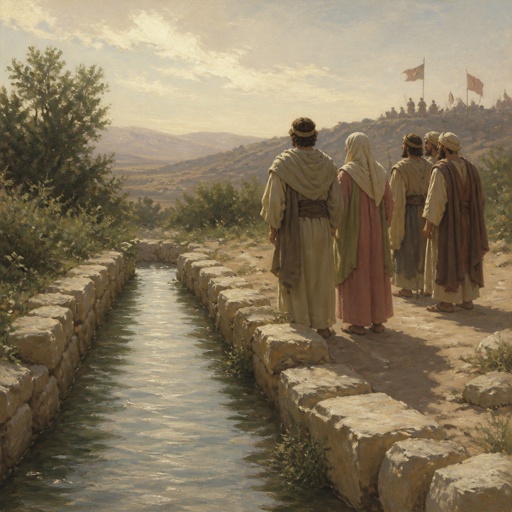
"Forasmuch as this people refuseth the waters of Shiloah that go softly, and rejoice in Rezin and Remaliah's son;" - Isaiah 8:6

isaiah 6:6

Isaiah 6

Isaiah 6

Isaiah 6:1-5

Isaiah 6:1-5

isaiah 6:7

Isaiah 6:1-5

Isaiah 6:1-5

Isaiah 19:8

Isaiah 64:8

Isaiah 9:6

Isaiah 9:6

Isaiah 9:6

isaiah 6:7

Isaiah 29:6

Isaiah 33:6

Isaiah 12:6

Isaiah 12:6

isaiah 60:6

Isaiah 6:1

Isaiah 33:6