Celebrating Jerusalem: A Call to Joy in Community and Faith
“Rejoice ye with Jerusalem, and be glad with her, all ye that love her: rejoice for joy with her, all ye that mourn for her:” — Isaiah 66:10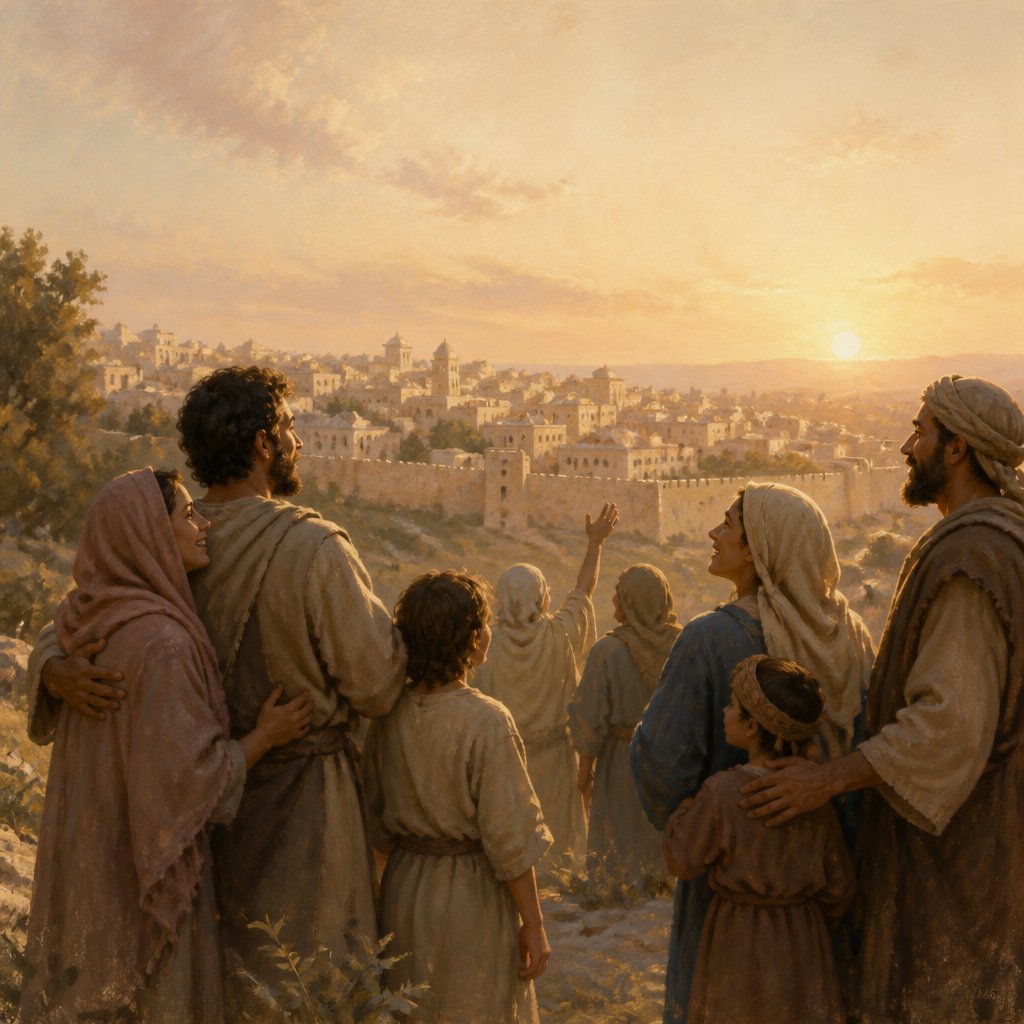
In the beautiful tapestry of scripture, Isaiah 66:10 stands out with a profound invitation: "Rejoice ye with Jerusalem, and be glad with her, all ye that love her: rejoice for joy with her, all ye that mourn for her." This verse serves as a powerful reminder of the interconnectedness of the body of Christ and the importance of shared joy and sorrow within our communities.
Jerusalem, often referred to as the Holy City, is more than just a geographical location. It represents the heart of the people of Israel, a symbol of God’s covenant and presence. In the context of scripture, Jerusalem encapsulates the hopes, dreams, and struggles of a nation. Thus, rejoicing with Jerusalem is an invitation not only to celebrate the significant moments but also to empathize with her mourners. The duality of this verse enriches our understanding of community: we are called to rejoice with those who rejoice and mourn with those who mourn (Romans 12:15).
As believers in Christ, we become the spiritual descendants of Jerusalem. Through Christ, we partake in the blessings of faith and community. Isaiah’s urging to rejoice is thus an echo that reverberates through time, calling all who love the Lord to align their hearts with His. The first call to rejoice is a beckoning to participate in the joy that comes from God’s faithfulness. It reminds us that there is much to celebrate as we witness the manifestations of God’s glory in our lives and those around us.
Moreover, the call to "be glad with her" speaks to the depth of unity required among believers. Our rejoicing alongside Jerusalem reflects a corporate gratitude for God’s grace. Such a union fosters a deeper relational connection as we share in both triumphs and trials. Think of the joy you feel when a friend achieves something great or the collective heartache during a trying time. We, as a body, are not isolated; our emotions intertwine, and thus our responsibilities toward each other expand.
The latter part of the verse — “rejoice for joy with her, all ye that mourn for her” — introduces a dynamic aspect to our spiritual journey. It acknowledges that within our communities, there will inevitably be those who grieve. Mourning comes in various forms: loss of loved ones, sorrow for sin, or struggles for justice and peace. In a world plagued by hardship, the call to rejoice is not merely a directive for our jubilant seasons; it is a wise reminder that God’s joy extends even in our deepest sorrow.
In our own lives, how often do we find it easy to celebrate with others yet struggle to walk alongside them in grieving? Isaiah challenges us here — transcending mere empathy, he calls us to actively join in both rejoicing and mourning. This is the essence of Christian love and support: to be present for one another, to acknowledge pain without shying away, and to foster hope in the darkest of times. As we bear one another’s burdens (Galatians 6:2), we also ignite an atmosphere of healing and connection.
This call to rejoice in the good and grieve in the bad is not simply passive acceptance; it is a dynamic, active engagement with the life of our community. It demands honesty, vulnerability, and a willingness to enter into one another’s lives — to know both the joy of the Lord and the heartache of the world.
As we ponder Isaiah 66:10, let us take this command to heart. May we be a people characterized by our capacity to rejoice with Jerusalem, to uplift one another in our joyful celebrations, and to sit alongside our family in faith during their times of mourning. In doing so, we fulfill the beautiful command of loving one another, echoing God’s unwavering love for His people.
Get our apps


Artwork for Isaiah 66:10

Isaiah 66:10 - "Rejoice ye with Jerusalem, and be glad with her, all ye that love her: rejoice for joy with her, all ye that mourn for her:"
"Rejoice ye with Jerusalem, and be glad with her, all ye that love her: rejoice for joy with her, all ye that mourn for her:" - Isaiah 66:10

Isaiah 66:1

Isaiah 66:1-2

Isaiah 66:1-2

Isaiah 66:21 - "And I will also take of them for priests and for Levites, saith the LORD."

Isaiah 66:1-2. Without depicting God's face.

Isaiah 66:1-2. Without depicting God's face.

Isaiah 66:1-2. Without depicting God's face.

Isaiah 66:16 - "For by fire and by his sword will the LORD plead with all flesh: and the slain of the LORD shall be many."

Isaiah 66:1-2. Without depicting God's face.

Isaiah 66:1-2. Without depicting God's face.

Isaiah 66:1-2. Without depicting God's face.

Isaiah 66:6 - "A voice of noise from the city, a voice from the temple, a voice of the LORD that rendereth recompence to his enemies."

Isaiah 66:13 - "As one whom his mother comforteth, so will I comfort you; and ye shall be comforted in Jerusalem."

Isaiah 66:7 - "Before she travailed, she brought forth; before her pain came, she was delivered of a man child."

Isaiah 66:15 - "For, behold, the LORD will come with fire, and with his chariots like a whirlwind, to render his anger with fury, and his rebuke with flames of fire."

Isaiah 66:18 - "For I know their works and their thoughts: it shall come, that I will gather all nations and tongues; and they shall come, and see my glory."

Psalms 66:10 - "For thou, O God, hast proved us: thou hast tried us, as silver is tried."

Isaiah 66:13 - "As one whom his mother comforteth, so will I comfort you; and ye shall be comforted in Jerusalem."

"And I will also take of them for priests and for Levites, saith the LORD." - Isaiah 66:21

Isaiah 66:9 - "Shall I bring to the birth, and not cause to bring forth? saith the LORD: shall I cause to bring forth, and shut the womb? saith thy God."

Isaiah 66:17 - "They that sanctify themselves, and purify themselves in the gardens behind one tree in the midst, eating swine's flesh, and the abomination, and the mouse, shall be consumed together, saith the LORD."

Isaiah 66:1 - "Thus saith the LORD, The heaven is my throne, and the earth is my footstool: where is the house that ye build unto me? and where is the place of my rest?"

"For thus saith the LORD, Behold, I will extend peace to her like a river, and the glory of the Gentiles like a flowing stream: then shall ye suck, ye shall be borne upon her sides, and be dandled upon her knees." - Isaiah 66:12

Isaiah 66:22 - "For as the new heavens and the new earth, which I will make, shall remain before me, saith the LORD, so shall your seed and your name remain."

Isaiah 66:1-2. Without depicting God's face. Any human images should appear as ancient Israel. .

Isaiah 66:1-2. Without depicting God's face. Any human images should appear middle eastern.

Isaiah 66:23 - "And it shall come to pass, that from one new moon to another, and from one sabbath to another, shall all flesh come to worship before me, saith the LORD."

Isaiah 66:1-2. Without depicting God's face. Any human images should appear as ancient Israel. .