Breaking Up Fallow Ground: A Call to Spiritual Renewal
“For thus saith the LORD to the men of Judah and Jerusalem, Break up your fallow ground, and sow not among thorns.” — Jeremiah 4:3
As we delve into the profound truth contained in Jeremiah 4:3, we find ourselves confronted with the directive of God: "For thus saith the LORD to the men of Judah and Jerusalem, Break up your fallow ground, and sow not among thorns." This verse carries a weighty significance that resonates throughout the ages, calling for introspection, renewal, and commitment in our walk with God.
The context of this message speaks to the people of Judah and Jerusalem, who faced spiritual lethargy and a turning away from the ways of the Lord. The imagery of "fallow ground" serves as a powerful metaphor for the state of their spiritual lives. Fallow ground is land that has been left unplowed and unsown, lying dormant and unproductive. It is dry, hard, and in need of a strong hand to break it up and cultivate it anew.
In many ways, this description is applicable to our own lives. Each of us can identify areas where we may have become spiritually barren, where routine may have dulled our senses to the things of God, and where once fertile ground has become overrun with the thorns of distraction, sin, and apathy. The call to break up our fallow ground is an invitation to engage with God actively; it beckons us to examine ourselves and to break free from the cycles that keep us stagnant.
Breaking up our fallow ground requires intentional effort. The first step involves confession—acknowledging the areas within us that have become hard and unyielding. Perhaps it’s our prayer life that has grown weak, our study of the Word that has become infrequent, or our desire to serve others that has waned. In any of these responses, we find thorns that choke the growth of spiritual fruit. Jesus spoke of these thorns in the Parable of the Sower, where he reveals that the cares of this world and the deceitfulness of riches can lead to unfruitfulness (Matthew 13:22). Therefore, when God urges us not to sow among thorns, it is a call to clear away the obstacles that prevent us from producing a bountiful harvest.
After confession comes the act of repentance. To repent is to turn—turning away from the distractions that dominate our attention and turning back toward God, who is ever eager to meet us in our need. This returning requires us to actively seek Him through prayer, scripture, and worship. As we immerse ourselves in His presence and allow His Spirit to work within us, the hard ground of our hearts begins to soften, and the growth of new life becomes possible.
Moreover, breaking up our fallow ground also involves making room for new seeds to be planted—God’s seeds of grace, truth, and love. We must examine what we are sowing in our lives. Are we cultivating things that lead to righteousness, or are we indulging in pursuits that hinder our spiritual growth? Taking the time to sow the right seeds ensures that we are nurturing a garden that reflects our Creator. We need to seek out opportunities to serve, to encourage one another, and to grow in our faith. This is how we create an environment conducive to thriving spiritual growth.
In practical terms, what might breaking up our fallow ground look like? It might mean reconnecting with a prayer group, volunteering in our community, or even setting aside daily time to read and meditate on God’s Word. It is a commitment to take the necessary steps to fertilize our hearts with His promises and His presence.
As we reflect on Jeremiah 4:3, let us embrace the challenge given to the men of Judah and Jerusalem. We have an open invitation to engage with God and allow Him to transform our lives. By breaking up the fallow ground of our hearts, we will cultivate a rich soil for spiritual growth and fruitfulness. Let us be diligent in tending to our inner garden, for it holds the potential for a harvest beyond our imagination—one that glorifies God and impacts the world around us.
Get our apps


Artwork for Jeremiah 4:3

Jeremiah 4:3 - "¶ For thus saith the LORD to the men of Judah and Jerusalem, Break up your fallow ground, and sow not among thorns."
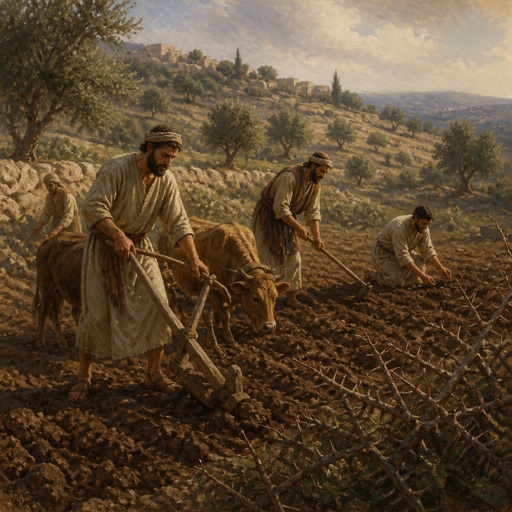
"¶ For thus saith the LORD to the men of Judah and Jerusalem, Break up your fallow ground, and sow not among thorns." - Jeremiah 4:3

Jeremiah 3:4 - "Wilt thou not from this time cry unto me, My father, thou art the guide of my youth?"

Jeremiah 18:3-4 – "So I went down to the potter's house, and there he was working at the wheel."

Jeremiah 21:3 - "¶ Then said Jeremiah unto them, Thus shall ye say to Zedekiah:"

Jeremiah 3:2

Jeremiah 33:3

Jeremiah 20:4

Jeremiah 37:4 - "Now Jeremiah came in and went out among the people: for they had not put him into prison."

Jeremiah 33:3

Jeremiah 3:1

Jeremiah 3:49

"Wilt thou not from this time cry unto me, My father, thou art the guide of my youth?" - Jeremiah 3:4

Jeremiah 20:3 - "And it came to pass on the morrow, that Pashur brought forth Jeremiah out of the stocks. Then said Jeremiah unto him, The LORD hath not called thy name Pashur, but Magor-missabib."

Jeremiah 29: 4-14

Jeremiah 29: 4-14

Jeremiah 36:4 - "Then Jeremiah called Baruch the son of Neriah: and Baruch wrote from the mouth of Jeremiah all the words of the LORD, which he had spoken unto him, upon a roll of a book."

Jeremiah 29: 4-14

Jeremiah 29: 4-14

Jeremiah 29: 4-14

Jeremiah 35:3 - "Then I took Jaazaniah the son of Jeremiah, the son of Habaziniah, and his brethren, and all his sons, and the whole house of the Rechabites;"

Jeremiah 1:4 - "Then the word of the LORD came unto me, saying,"

Jeremiah 30:4 - "¶ And these are the words that the LORD spake concerning Israel and concerning Judah."

Jeremiah 3:3 - "Therefore the showers have been withholden, and there hath been no latter rain; and thou hadst a whore's forehead, thou refusedst to be ashamed."

Jeremiah 10:4 - "They deck it with silver and with gold; they fasten it with nails and with hammers, that it move not."

Jeremiah 24:4 - "¶ Again the word of the LORD came unto me, saying,"

Jeremiah 46:3 - "Order ye the buckler and shield, and draw near to battle."

Jeremiah 37:3 - "And Zedekiah the king sent Jehucal the son of Shelemiah and Zephaniah the son of Maaseiah the priest to the prophet Jeremiah, saying, Pray now unto the LORD our God for us."

Jeremiah 48:3 - "A voice of crying shall be from Horonaim, spoiling and great destruction."

"¶ Then said Jeremiah unto them, Thus shall ye say to Zedekiah:" - Jeremiah 21:3