The Cross and Golgotha: A Journey of Suffering and Salvation
“And he bearing his cross went forth into a place called the place of a skull, which is called in the Hebrew Golgotha:” — John 19:17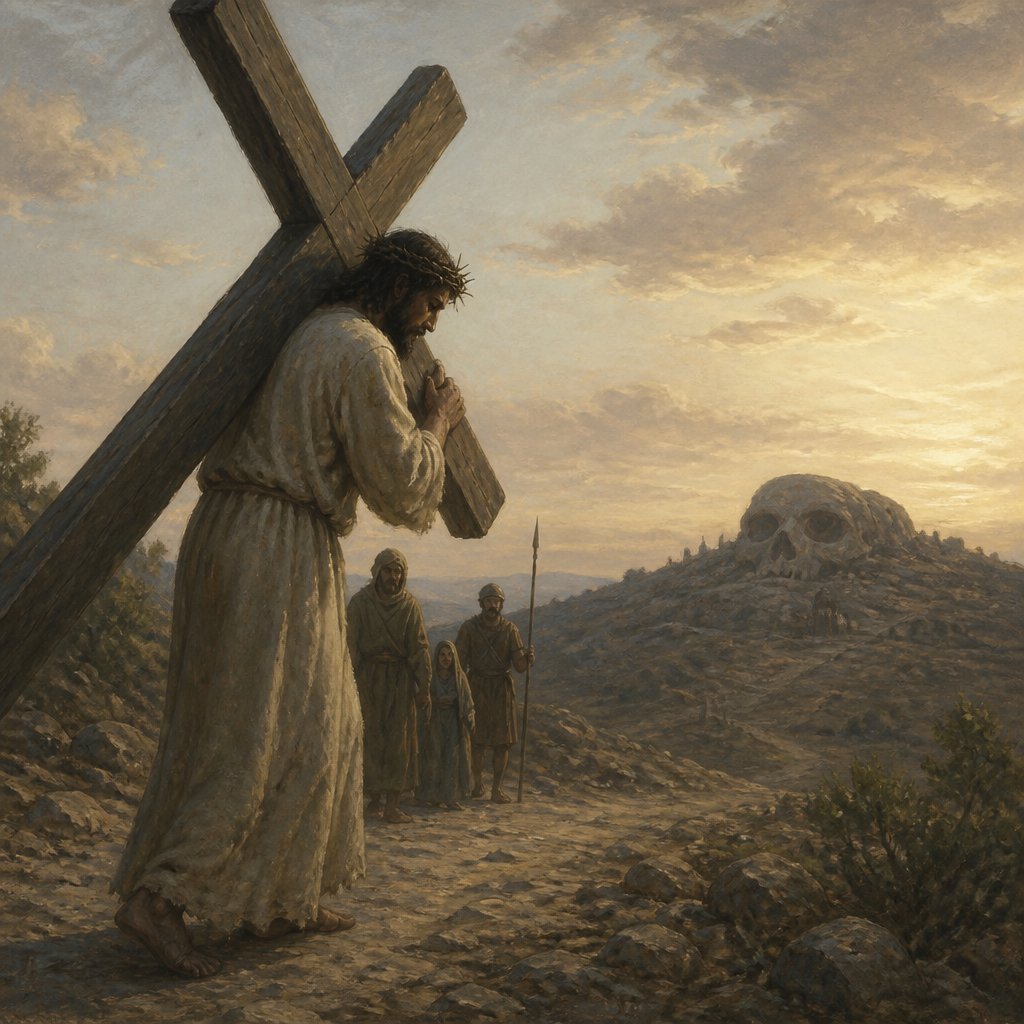
As we delve into the profound depths of John 19:17, we are confronted with the stark imagery of Jesus Christ carrying His cross and entering Golgotha. The King James Version reads, "And he bearing his cross went forth into a place called the place of a skull, which is called in the Hebrew Golgotha." This single verse encapsulates both the physical and spiritual agony of our Savior, the ultimate sacrifice, and the monumental weight of human sin.
### The Weight of the Cross
Firstly, we must appreciate the significance of "bearing his cross." The act of carrying a cross is not merely a historical detail but a poignant representation of Jesus's willingness to embrace suffering for the sake of humanity. The cross is a symbol of shame and pain, yet it is through the disgrace of the cross that the path to redemption is forged. Jesus, the sinless Lamb of God, carries not just the wooden beams that will soon become His place of crucifixion but the weight of the world's sin upon His shoulders.
Reflect on the physical toll this act took on Him. We often picture Jesus, fatigue etched in His every feature, navigating the cobblestones of Jerusalem, His strength ebbing away with every step. The Roman soldiers had already scourged Him mercilessly, yet He did not turn back. His commitment to our salvation was unwavering, a testimony of His divine love.
### The Place of a Skull
Next, we need to consider the place to which Jesus travels: Golgotha, or the “place of a skull.” Symbolically, this place stands in stark contrast to the vibrant life that Jesus brought during His ministry. Golgotha represents death, defeat, and sorrow. Yet it is here, amidst the echoes of despair, that the greatest triumph over sin and death is about to unfold. By entering into this place, Jesus demonstrates that He is not afraid to confront the harsh realities of sin and its consequences.
Golgotha is intricately woven into the fabric of our salvation story. The very name evokes death, and yet it was at this very spot that Jesus would declare, "It is finished." The crucifixion at Golgotha serves as the fulcrum of history, transforming a site of anguish into one of hope and new beginnings. When we visualize this scene, we must not forget that what looks like defeat is ultimately the gateway to everlasting victory.
### Identifying with Suffering
Jesus's journey to Golgotha also connects us intimately to our suffering. He faced betrayal, loneliness, mockery, and excruciating pain. Yet through it all, He continues to step forward. In our own lives, we encounter moments of profound grief and hardship. Jesus's willingness to endure the cross speaks to the truth that no suffering is outside of His understanding. He intermediates our pain, assuring us that He knows our hearts and our struggles.
When we are overwhelmed by challenges, we can find solace knowing that our Lord does not distance Himself from the suffering. Instead, He journeys alongside us, inviting us to cast our cares upon Him. Herein lies the beauty of the cross—it is not just an emblem of suffering but a pathway to hope, healing, and divine consolation.
### Conclusion: A Call to Bear Our Cross
Finally, John 19:17 reminds us of our own call to discipleship. Jesus's journey to Golgotha serves as an impetus for us to bear our crosses daily. We are invited to participate in His sufferings, which allows us to reflect His love to the world. As we face our tribulations, we carry our crosses with the assurance that we follow in the steps of our Savior, who bore His cross for us.
In our daily lives, let us remember that every time we serve the least among us, show forgiveness, or endure suffering for a greater purpose, we are echoing the heart of Christ. The cross may symbolize suffering, but it is also a profound declaration of love.
As we reflect on John 19:17 today, may we be inspired by Christ’s courage. His road to Golgotha was paved with love, sacrifice, and ultimate victory—a victory that is now ours to embrace. Let us go forth into the world, bearing our own crosses, knowing that through Him, we too can have life, and have it more abundantly.
Get our apps


Artwork for John 19:17

John 19:17 - "And he bearing his cross went forth into a place called the place of a skull, which is called in the Hebrew Golgotha:"

John 19:17-18 - "And he bearing his cross went forth into a place called the place of a skull, which is called in the Hebrew Golgotha: Where they crucified him, and two other with him, on either side one, and Jesus in the midst."
"And he bearing his cross went forth into a place called the place of a skull, which is called in the Hebrew Golgotha:" - John 19:17
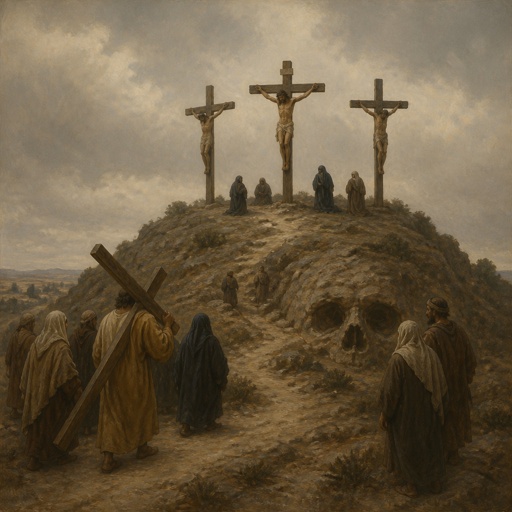
"And he bearing his cross went forth into a place called the place of a skull, which is called in the Hebrew Golgotha: Where they crucified him, and two other with him, on either side one, and Jesus in the midst." - John 19:17-18

John 19:17-27 - "And he bearing his cross went forth into a place called the place of a skull, which is called in the Hebrew Golgotha: Where they crucified him, and two other with him, on either side one, and Jesus in the midst. And Pilate wrote a title, and put it on the cross. And the writing was JESUS OF NAZARETH THE KING OF THE JEWS. This title then read many of the Jews: for the place where Jesus was crucified was nigh to the city: and it was written in Hebrew, and Greek, and Latin. Then said the chief priests of the Jews to Pilate, Write not, The King of the Jews; but that he said, I am King of the Jews. Pilate answered, What I have written I have written. Then the soldiers, when they had crucified Jesus, took his garments, and made four parts, to every soldier a part; and also his coat: now the coat was without seam, woven from the top throughout. They said therefore among themselves, Let us not rend it, but cast lots for it, whose it shall be: that the scripture might be fulfilled, which saith, They parted my raiment among them, and for my vesture they did cast lots. These things therefore the soldiers did. Now there stood by the cross of Jesus his mother, and his mother's sister, Mary the wife of Cleophas, and Mary Magdalene. When Jesus therefore saw his mother, and the disciple standing by, whom he loved, he saith unto his mother, Woman, behold thy son! Then saith he to the disciple, Behold thy mother! And from that hour that disciple took her unto his own home."
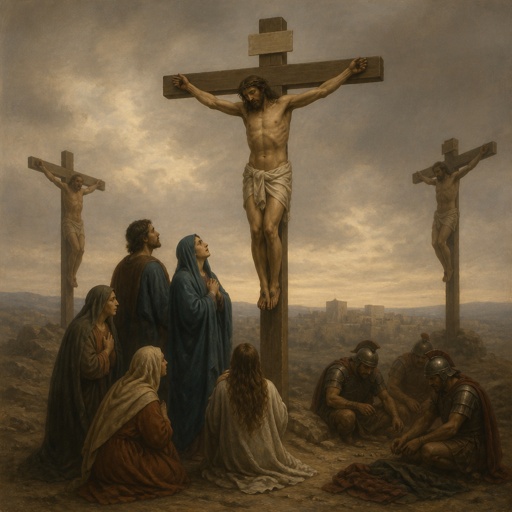
"And he bearing his cross went forth into a place called the place of a skull, which is called in the Hebrew Golgotha: Where they crucified him, and two other with him, on either side one, and Jesus in the midst. And Pilate wrote a title, and put it on the cross. And the writing was JESUS OF NAZARETH THE KING OF THE JEWS. This title then read many of the Jews: for the place where Jesus was crucified was nigh to the city: and it was written in Hebrew, and Greek, and Latin. Then said the chief priests of the Jews to Pilate, Write not, The King of the Jews; but that he said, I am King of the Jews. Pilate answered, What I have written I have written. Then the soldiers, when they had crucified Jesus, took his garments, and made four parts, to every soldier a part; and also his coat: now the coat was without seam, woven from the top throughout. They said therefore among themselves, Let us not rend it, but cast lots for it, whose it shall be: that the scripture might be fulfilled, which saith, They parted my raiment among them, and for my vesture they did cast lots. These things therefore the soldiers did. Now there stood by the cross of Jesus his mother, and his mother's sister, Mary the wife of Cleophas, and Mary Magdalene. When Jesus therefore saw his mother, and the disciple standing by, whom he loved, he saith unto his mother, Woman, behold thy son! Then saith he to the disciple, Behold thy mother! And from that hour that disciple took her unto his own home." - John 19:17-27

John 17:19 - "And for their sakes I sanctify myself, that they also might be sanctified through the truth."
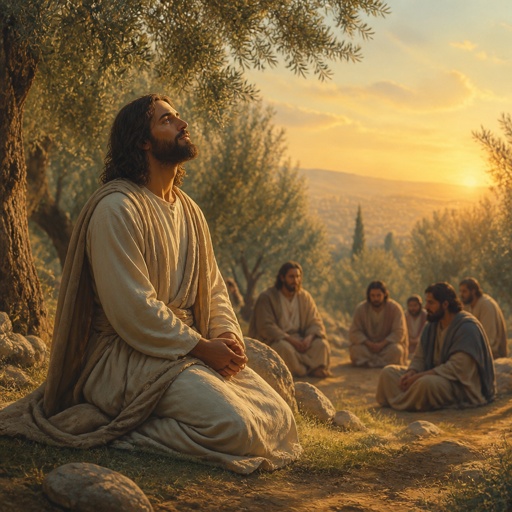
"And for their sakes I sanctify myself, that they also might be sanctified through the truth." - John 17:19

John 7:17-18

John 7:17-18

John 7:17-18

John 7:17-18

John 19:38

John 19:1

John 17:17 - "Sanctify them through thy truth: thy word is truth."

John 19:19 - "¶ And Pilate wrote a title, and put it on the cross. And the writing was, JESUS OF NAZARETH THE KING OF THE JEWS."

John 1:17

John 21:17

John 1:17

John 1:17

John 17.6-19

Luke 10:17-19

Luke 10:17-19

John 19:1-3

John 19:25-27

Genesis 17-19

Genesis 19-17

John 1:19 - "¶ And this is the record of John, when the Jews sent priests and Levites from Jerusalem to ask him, Who art thou?"
John 14:16-17

John 19:25-27