Obedience: The Key to Miracles
“His mother saith unto the servants, Whatsoever he saith unto you, do it.” — John 2:5
In the Gospel of John, chapter 2, verse 5, we read, "His mother saith unto the servants, Whatsoever he saith unto you, do it." These words, spoken by Mary, the mother of Jesus, hold incredible significance. They were uttered at the wedding feast in Cana, just before Jesus performed His first miracle—turning water into wine. This passage provides profound insight not only into Mary’s faith in Jesus but also into the nature of obedience and the transformative power it can bring into our lives.
To understand the depth of Mary’s instruction, we need to consider the context. The wedding at Cana was a pivotal moment, not just in Jesus’ ministry but in Mary’s understanding of who her son was. In the midst of a crisis—a shortage of wine that could bring shame to the hosts—Mary turned to her son. She understood that He had the power to intervene. When she instructs the servants to do whatever Jesus tells them, she isn’t merely offering practical advice; she is imparting a profound spiritual principle: obedience to Christ leads to miraculous outcomes.
At its core, obedience is a theme woven throughout Scripture. God has always called His people to trust and obey His commands, often in ways that defy human logic. Consider the Israelites marching around Jericho (Joshua 6), Moses striking a rock for water (Exodus 17:6), or Naaman dipping himself in the Jordan River to heal his leprosy (2 Kings 5). In each instance, the act of obedience, however absurd it might have seemed, paved the way for God’s glory to be revealed.
Mary’s directive to the servants is a lesson in faith. It mirrors what God seeks from each of us: a heart willing to follow His guidance without hesitation. When we choose to obey, we align ourselves with God's will and open the door for Him to work in our lives and the lives of those around us. It is in the act of trusting His Word that we often find our greatest blessings. The servants at the wedding had to overcome their natural doubts. They could have reasoned, "What can be done with water?" Yet, they obeyed, and it led to the miraculous transformation of a mundane substance into something extraordinary.
There is also a profound implication in Mary’s words that speaks to the authority of Christ. When she says, "Whatsoever he saith unto you, do it," she recognizes Jesus’ authority as the Son of God. In an age where many question authority and seek autonomy, we are reminded here that true freedom is found in submission to Christ. The world promotes a self-directed life, often leading us to dissatisfaction and unfulfilled desires. In contrast, surrendering our will to Jesus invites His divine wisdom into our decision-making. It is an invitation to cultivate a trusting relationship with our Savior, allowing Him to lead us into paths of righteousness.
Furthermore, Mary’s instruction encourages us to listen for God’s voice in our everyday lives. How often do we dismiss that gentle whisper urging us to act? Through prayer, Scripture reading, and the leading of the Holy Spirit, Jesus speaks to us, directing our lives with purpose. Our willingness to respond to His call, to follow His commands, can result in profound changes—not only in our lives but also in our communities.
Finally, this passage calls us to reflect on our response to Christ. Are we, like the servants at the wedding, quick to follow His direction, no matter how unconventional it may be? Each day, we will encounter situations that require a choice—will we trust Christ enough to act obediently?
As we meditate on the words of Mary, let us remember that obedience is not just a matter of duty; it is a pathway to experiencing God's abundant grace and miracles. May we strive to echo her faith in our own lives: "Whatsoever He saith unto you, do it." This is not merely a suggestion; it is the essence of walking in faith. Let us commit ourselves to obediently following His command, with the assurance that He is capable of turning our ordinary experiences into divine testimonies.
Get our apps


Artwork for John 2:5

John 2:5 - "His mother saith unto the servants, Whatsoever he saith unto you, do it."

1 John 2:5 - "But whoso keepeth his word, in him verily is the love of God perfected: hereby know we that we are in him."

"But whoso keepeth his word, in him verily is the love of God perfected: hereby know we that we are in him." - 1 John 2:5

"His mother saith unto the servants, Whatsoever he saith unto you, do it." - John 2:5

"But whoso keepeth his word, in him verily is the love of God perfected: hereby know we that we are in him." - 1 John 2:5

John 5:2

John 5:2 - "Now there is at Jerusalem by the sheep market a pool, which is called in the Hebrew tongue Bethesda, having five porches."

1 John 5:2 - "By this we know that we love the children of God, when we love God, and keep his commandments."

2 John 1:5 - "And now I beseech thee, lady, not as though I wrote a new commandment unto thee, but that which we had from the beginning, that we love one another."

John 15:5

John 15:5

John 5:33 - "Ye sent unto John, and he bare witness unto the truth."

John 5:5 - "And a certain man was there, which had an infirmity thirty and eight years."

John 5:28

John 5:28

John 5:28

1 John 5:5 - "Who is he that overcometh the world, but he that believeth that Jesus is the Son of God?"
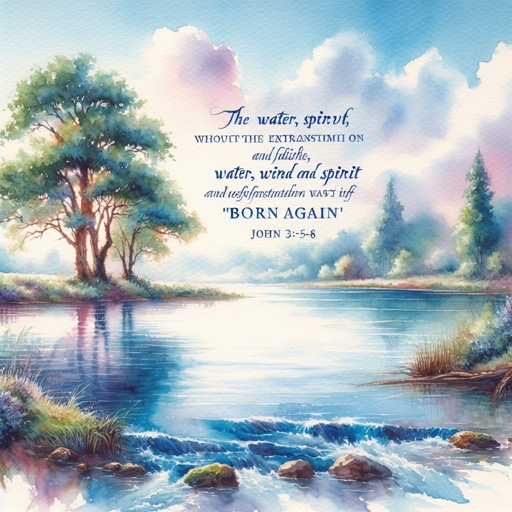
John 3:5-8

John 1:1-5

John 1:1-5

John 3:5-8

1 John 5:18

John 3:5-8

John 1:5 - "And the light shineth in darkness; and the darkness comprehended it not."

John 5:41 - "I receive not honour from men."
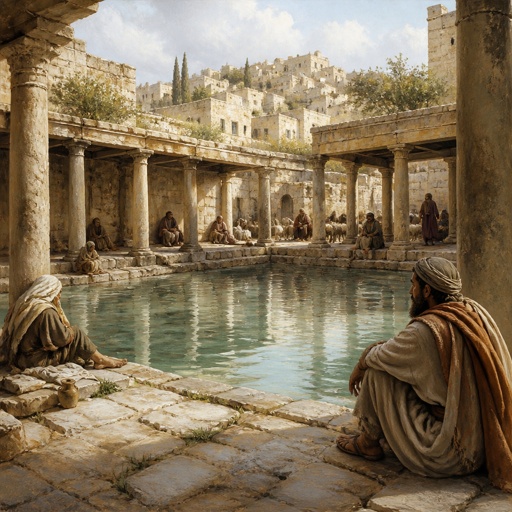
"Now there is at Jerusalem by the sheep market a pool, which is called in the Hebrew tongue Bethesda, having five porches." - John 5:2

John 5:40 - "And ye will not come to me, that ye might have life."

1 John 5:17 - "All unrighteousness is sin: and there is a sin not unto death."

John 5:1 - "After this there was a feast of the Jews; and Jesus went up to Jerusalem."

John 7:5 - "For neither did his brethren believe in him."