The Altar of Unity and Purpose: Lessons from Joshua 22:10
“And when they came unto the borders of Jordan, that are in the land of Canaan, the children of Reuben and the children of Gad and the half tribe of Manasseh built there an altar by Jordan, a great altar to see to.” — Joshua 22:10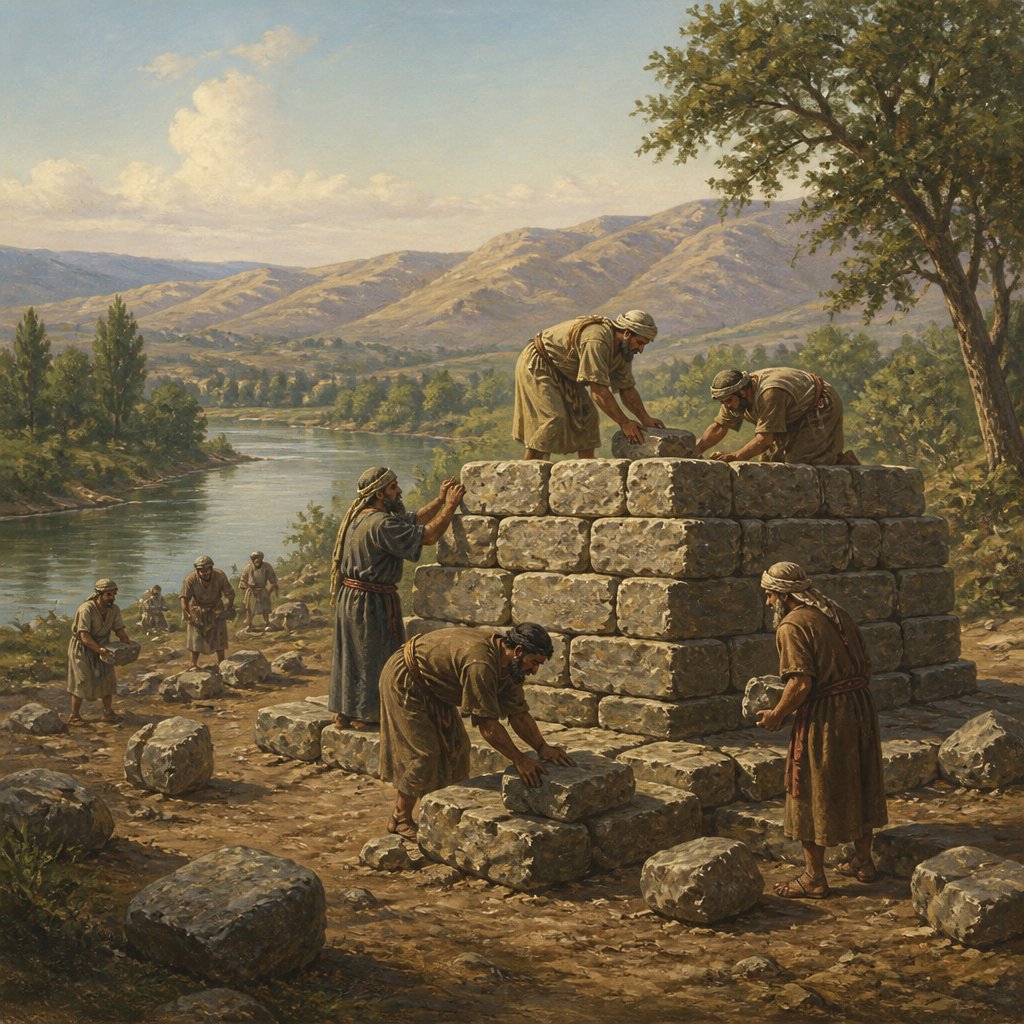
As we immerse ourselves in the rich narrative of the book of Joshua, we encounter a pivotal moment in the lives of the tribes of Reuben, Gad, and the half tribe of Manasseh. Joshua 22:10 details a significant event: "And when they came unto the borders of Jordan, that are in the land of Canaan, the children of Reuben and the children of Gad and the half tribe of Manasseh built there an altar by Jordan, a great altar to see to." This passage invites us to explore the complexities of faith, identity, and community among these tribes as they transition into their promised inheritance.
The setting of this verse is profound. Israel has completed a monumental journey under Joshua's leadership, with God’s promise of land fulfilled. After years of wandering in the wilderness, these tribes stand on the brink of the promised land of Canaan, symbolizing the fulfillment of God's faithfulness. Yet, rather than settling behind the Jordan River in the land now theirs, the two and a half tribes construct an altar. Why an altar, and why at this moment?
The act of building this altar is more than mere architecture; it is a significant declaration of identity and intent. An altar in biblical times served as a meeting point between God and His people, signifying worship, community, and remembrance. The tribes of Reuben, Gad, and Manasseh express a desire to maintain their connection to God and to their brethren on the other side of the Jordan. By constructing a "great altar to see to," the tribes made a statement—this altar would serve as a witness, a reminder that they were part of the same community of faith.
However, this act is met with tension. When the rest of Israel hears of this altar, misunderstandings arise, leading to fears that these tribes are creating a division, a separation concerning the worship of God. They worry that this altar might symbolize a departure from the covenant community, prompting them to question the loyalty of their brothers.
This moment brings forth a crucial point for us as believers. How often do misunderstandings arise in our own communities, especially when individuals seek to express their faith differently? The altar represents both a positive assertion of faith and a potential miscommunication that creates discord. We, too, can build our own altars—through the traditions we embrace, the practices we adopt, or even the ways we worship—yet, we must be vigilant to ensure that our expressions of faith reflect unity rather than division.
The account unfolds further, revealing that the tribes of Reuben, Gad, and Manasseh constructed the altar not to rival the true altar of God at Shiloh but to act as a reminder for future generations that they belong to God’s chosen people. They want their children to understand where their faith lies, reasserting that their connection was not severed by geography. Their intent was to reinforce unity and preserve the spiritual legacy of the covenant community.
As followers of Christ, we are reminded of the importance of our communal identity. Each altar we erect in our lives—be it through our witness, our engagement with the church, or our expressions of love—should always point back to the greater understanding of our unity in Christ. We are urged to foster communities that do not just tolerate differences but embrace them, ensuring that all believers are welcomed, valued, and reminded of their inheritance in God.
This passage beckons us to reflect on our roles within our communities: Are we fortifying connections as the Reubenites and Gadites intended, or are we creating barriers through misunderstandings?
Let us also remember the truth that regardless of our geographical or spiritual placements, our ultimate calling is to build lives that glorify God and reflect our unity as His people, reigniting our commitment to communal worship and shared purpose. May we heed the lessons of Joshua 22:10, building altars that proclaim Him and celebrate our bonds with one another.
Get our apps


Artwork for Joshua 22:10

Joshua 22:10 - "¶ And when they came unto the borders of Jordan, that are in the land of Canaan, the children of Reuben and the children of Gad and the half tribe of Manasseh built there an altar by Jordan, a great altar to see to."
"¶ And when they came unto the borders of Jordan, that are in the land of Canaan, the children of Reuben and the children of Gad and the half tribe of Manasseh built there an altar by Jordan, a great altar to see to." - Joshua 22:10

Joshua 10:22 - "Then said Joshua, Open the mouth of the cave, and bring out those five kings unto me out of the cave."

"Then said Joshua, Open the mouth of the cave, and bring out those five kings unto me out of the cave." - Joshua 10:22

Joshua 22:1 - "Then Joshua called the Reubenites, and the Gadites, and the half tribe of Manasseh,"

Joshua 22:6 - "So Joshua blessed them, and sent them away: and they went unto their tents."

Joshua 1:10 - "¶ Then Joshua commanded the officers of the people, saying,"

Joshua 7:22 - "¶ So Joshua sent messengers, and they ran unto the tent; and, behold, it was hid in his tent, and the silver under it."

Joshua 15:22 - "And Kinah, and Dimonah, and Adadah,"

Joshua 10:43 - "And Joshua returned, and all Israel with him, unto the camp to Gilgal."

Joshua 10:38 - "¶ And Joshua returned, and all Israel with him, to Debir; and fought against it:"

Joshua 10:15 - "¶ And Joshua returned, and all Israel with him, unto the camp to Gilgal."

Joshua 18:10 - "¶ And Joshua cast lots for them in Shiloh before the LORD: and there Joshua divided the land unto the children of Israel according to their divisions."

Joshua 10:17 - "And it was told Joshua, saying, The five kings are found hid in a cave at Makkedah."

Joshua 18:22 - "And Beth-arabah, and Zemaraim, and Beth-el,"

Rubenites buyilding alter in Joshua 22

"Then Joshua called the Reubenites, and the Gadites, and the half tribe of Manasseh," - Joshua 22:1

Joshua 10:9 - "Joshua therefore came unto them suddenly, and went up from Gilgal all night."

Joshua 10:29 - "Then Joshua passed from Makkedah, and all Israel with him, unto Libnah, and fought against Libnah:"

Joshua 10:36 - "And Joshua went up from Eglon, and all Israel with him, unto Hebron; and they fought against it:"

Joshua 10:18 - "And Joshua said, Roll great stones upon the mouth of the cave, and set men by it for to keep them:"

"¶ Then Joshua commanded the officers of the people, saying," - Joshua 1:10

Joshua 24:22 - "And Joshua said unto the people, Ye are witnesses against yourselves that ye have chosen you the LORD, to serve him. And they said, We are witnesses."

Joshua 10:31 - "¶ And Joshua passed from Libnah, and all Israel with him, unto Lachish, and encamped against it, and fought against it:"

Joshua 12:22 - "The king of Kedesh, one; the king of Jokneam of Carmel, one;"

Joshua 10:34 - "¶ And from Lachish Joshua passed unto Eglon, and all Israel with him; and they encamped against it, and fought against it:"

Joshua 10:7 - "So Joshua ascended from Gilgal, he, and all the people of war with him, and all the mighty men of valour."

Joshua 10:42 - "And all these kings and their land did Joshua take at one time, because the LORD God of Israel fought for Israel."

Joshua 7:10 - "¶ And the LORD said unto Joshua, Get thee up; wherefore liest thou thus upon thy face?"

"And Kinah, and Dimonah, and Adadah," - Joshua 15:22