What does Joshua 22:10 mean?
“And when they came unto the borders of Jordan, that are in the land of Canaan, the children of Reuben and the children of Gad and the half tribe of Manasseh built there an altar by Jordan, a great altar to see to.” — Joshua 22:10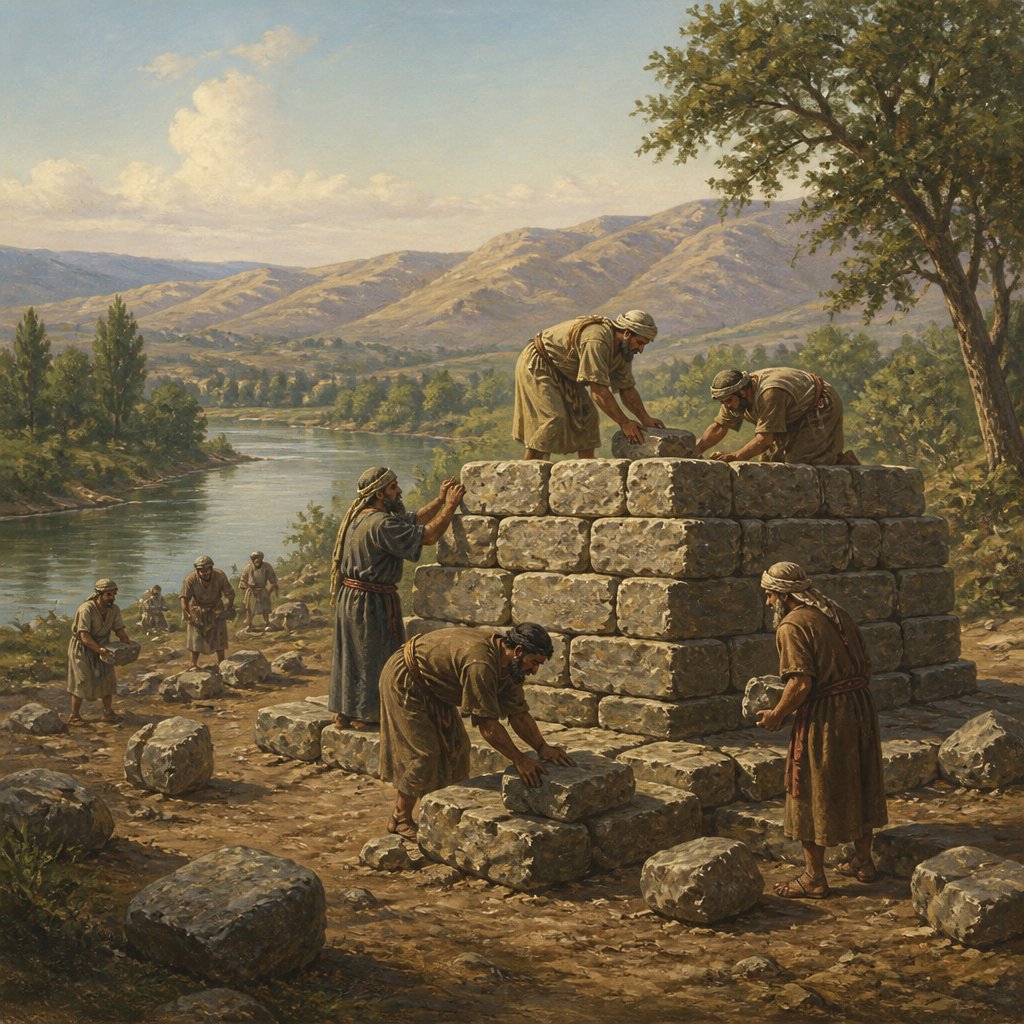
The Bible verse Joshua 22:10 from the King James Version (KJV) reads:
"And when they came unto the borders of Jordan, that are in the land of Canaan, the children of Reuben and the children of Gad and the half tribe of Manasseh built there an altar by Jordan, a great altar to see to."
This verse is located in the book of Joshua, which details the Israelites' conquest of the Promised Land under the leadership of Joshua. The specific passage deals with the construction of an altar by the tribes of Reuben, Gad, and the half tribe of Manasseh near the Jordan River. The story behind this verse holds several key themes and lessons that are relevant for Christians today.
The construction of the altar by these tribes is significant because it causes alarm among the other Israelite tribes. They feared that the tribes of Reuben, Gad, and half tribe of Manasseh had built an altar as a separate place of worship, which would have been a violation of the stipulations of the Mosaic Law. This situation led to the other tribes preparing for war against them.
In the larger context of the book of Joshua, this episode highlights the importance of unity among God's people. The tribes on the eastern side of the Jordan River were concerned that they would be excluded from the worship at the tabernacle in Shiloh, which was the central place of worship for the Israelites at that time. In response to this concern, they built their own altar, presumably to offer sacrifices and worship to God.
This situation reflects a common human tendency – the desire for self-sufficiency and autonomy. Instead of seeking unity and common worship with their fellow Israelites, the tribes of Reuben, Gad, and half tribe of Manasseh chose to build their own altar. This decision raised suspicions and led the other tribes to prepare for war against them.
As the story progresses, it becomes clear that there was a misunderstanding. The tribes of Reuben, Gad, and half tribe of Manasseh did not build the altar for the purpose of offering sacrifices or worshiping other gods. Rather, they built the altar as a memorial, a witness, to their connection with the rest of the tribes and to their faithfulness to the God of Israel.
This misunderstanding is resolved through communication and reconciliation. Representatives from the other tribes are sent to the eastern banks of the Jordan River, and after a dialogue, it becomes clear that the altar was not meant for idolatrous worship. The tribes of Reuben, Gad, and half tribe of Manasseh explain that the altar was built as a symbol of their shared faith and heritage with the rest of the tribes. They did not want to be cut off from their fellow Israelites, and they wanted to ensure that future generations would remember their common identity and allegiance to the God of Israel.
The resolution of this conflict teaches important lessons about unity, communication, and the dangers of jumping to conclusions. It also emphasizes the importance of maintaining a common worship and faith, as well as the need for reconciliation and understanding when conflicts arise among God's people.
In terms of symbolism, the altar that was built by the tribes of Reuben, Gad, and half tribe of Manasseh serves as a reminder of the need for a shared spiritual foundation and unity among God's people. It symbolizes the importance of recognizing and preserving our common faith and heritage, and the dangers of allowing misunderstandings to divide us. The altar also reminds us of the need for communication and reconciliation when conflicts arise within the body of Christ.
Overall, the verse Joshua 22:10 has deep significance in highlighting the themes of unity, communication, reconciliation, and the dangers of autonomy and division within the community of faith. Its message is relevant for believers today, encouraging us to seek common ground and understanding in the midst of conflicts and misunderstandings.
Get our apps


Artwork for Joshua 22:10

Joshua 22:10 - "¶ And when they came unto the borders of Jordan, that are in the land of Canaan, the children of Reuben and the children of Gad and the half tribe of Manasseh built there an altar by Jordan, a great altar to see to."
"¶ And when they came unto the borders of Jordan, that are in the land of Canaan, the children of Reuben and the children of Gad and the half tribe of Manasseh built there an altar by Jordan, a great altar to see to." - Joshua 22:10

Joshua 10:22 - "Then said Joshua, Open the mouth of the cave, and bring out those five kings unto me out of the cave."

"Then said Joshua, Open the mouth of the cave, and bring out those five kings unto me out of the cave." - Joshua 10:22

Joshua 22:1 - "Then Joshua called the Reubenites, and the Gadites, and the half tribe of Manasseh,"

Joshua 22:6 - "So Joshua blessed them, and sent them away: and they went unto their tents."

Joshua 1:10 - "¶ Then Joshua commanded the officers of the people, saying,"

Joshua 7:22 - "¶ So Joshua sent messengers, and they ran unto the tent; and, behold, it was hid in his tent, and the silver under it."

Joshua 15:22 - "And Kinah, and Dimonah, and Adadah,"

Joshua 10:43 - "And Joshua returned, and all Israel with him, unto the camp to Gilgal."

Joshua 10:38 - "¶ And Joshua returned, and all Israel with him, to Debir; and fought against it:"

Joshua 10:15 - "¶ And Joshua returned, and all Israel with him, unto the camp to Gilgal."

Joshua 18:10 - "¶ And Joshua cast lots for them in Shiloh before the LORD: and there Joshua divided the land unto the children of Israel according to their divisions."

Joshua 10:17 - "And it was told Joshua, saying, The five kings are found hid in a cave at Makkedah."

Joshua 18:22 - "And Beth-arabah, and Zemaraim, and Beth-el,"

Rubenites buyilding alter in Joshua 22

"Then Joshua called the Reubenites, and the Gadites, and the half tribe of Manasseh," - Joshua 22:1

Joshua 10:9 - "Joshua therefore came unto them suddenly, and went up from Gilgal all night."

Joshua 10:29 - "Then Joshua passed from Makkedah, and all Israel with him, unto Libnah, and fought against Libnah:"

Joshua 10:36 - "And Joshua went up from Eglon, and all Israel with him, unto Hebron; and they fought against it:"

Joshua 10:18 - "And Joshua said, Roll great stones upon the mouth of the cave, and set men by it for to keep them:"

"¶ Then Joshua commanded the officers of the people, saying," - Joshua 1:10

Joshua 24:22 - "And Joshua said unto the people, Ye are witnesses against yourselves that ye have chosen you the LORD, to serve him. And they said, We are witnesses."

Joshua 10:31 - "¶ And Joshua passed from Libnah, and all Israel with him, unto Lachish, and encamped against it, and fought against it:"

Joshua 12:22 - "The king of Kedesh, one; the king of Jokneam of Carmel, one;"

Joshua 10:34 - "¶ And from Lachish Joshua passed unto Eglon, and all Israel with him; and they encamped against it, and fought against it:"

Joshua 10:7 - "So Joshua ascended from Gilgal, he, and all the people of war with him, and all the mighty men of valour."

Joshua 10:42 - "And all these kings and their land did Joshua take at one time, because the LORD God of Israel fought for Israel."

Joshua 7:10 - "¶ And the LORD said unto Joshua, Get thee up; wherefore liest thou thus upon thy face?"

"And Kinah, and Dimonah, and Adadah," - Joshua 15:22