The Cry of the Innocent: A Lament for Spiritual Integrity
“For the sins of her prophets, and the iniquities of her priests, that have shed the blood of the just in the midst of her,” — Lamentations 4:13
The book of Lamentations, deeply moving in its expressions of sorrow and regret, serves as a poignant reminder of the consequences of spiritual failure and moral decay within the community of faith. Lamentations 4:13 states, “For the sins of her prophets, and the iniquities of her priests, that have shed the blood of the just in the midst of her.” This verse captures the tragedy that arises when those who are called to lead and shepherd the people stray from their commitment to righteousness, causing great suffering not only for themselves but also for those whom they are meant to guide.
In the context of Lamentations, we find Jerusalem in ruins, its people devastated by the consequences of sin. The prophets and priests, who held the sacred responsibility of teaching God’s word and maintaining justice, have fallen into iniquity. This abandonment of their divine calling has dire consequences: the innocent suffer, justice is perverted, and the spiritual condition of the community declines. It is imperative to reflect on this scenario, especially in our contemporary setting, where spiritual leaders are also prone to flaws and failures.
The phrase “the blood of the just” evokes imagery of not only physical suffering but also the emotional and spiritual anguish of the righteous who have been oppressed by injustice. When churches or religious communities lose their moral compass—either through the commission of overtly sinful acts by leaders or through their neglect of truth and accountability—the effects are felt throughout the congregation and beyond. The faithful can become disillusioned, feeling betrayed by those whom they expect to embody God’s integrity and love.
As we meditate on this verse, we are called to reflect on several critical aspects:
### **1. The Weight of Leadership**
Biblical leadership carries a profound responsibility. The prophets and priests of Israel were not mere advisors; they were mediators of God’s will, entrusted with the spiritual well-being of their people. The consequences of their sins are dire and serve as a cautionary tale. In our own lives and communities, leaders—whether they be pastors, teachers, or mentors—should always be vigilant, remembering that their actions greatly influence those around them. We must pray for our leaders, that they may remain steadfast in their calling, pursuing holiness and integrity.
### **2. Accountability in Community**
Lamentations 4:13 reflects a community grappling with the aftermath of corrupted leadership. It is vital for every believer to engage in communal accountability, fostering an environment where leaders are encouraged to lead righteously and where the congregation is committed to upholding one another in love and truth. Biblical community is meant to be a place of strength, encouraging all to pursue righteousness collectively. This spirit of accountability can prevent the insidious creep of moral failure.
### **3. The Hope of Restoration**
Despite the sorrow expressed in Lamentations, there is always a thread of hope woven throughout its verses. God’s ultimate desire is not punishment, but restoration. For the faithful, these lamentations should lead to prayer, repentance, and a renewed commitment to uphold God’s standards. We are reminded in 2 Chronicles 7:14, “If my people, which are called by my name, shall humble themselves, and pray, and seek my face, and turn from their wicked ways; then will I hear from heaven, and will forgive their sin, and will heal their land.” The lament serves not only as a cry for justice but also as an invitation to seek God's mercy.
### **4. A Call to Personal Reflection**
Finally, this verse serves as an invitation for personal examination. Are there areas in our lives where we have compromised our integrity? Have we closed our eyes to injustices either within the church or in our broader communities? As we think upon the sins of leaders, let us not forget that each of us plays a part in God’s kingdom. May we strive to reflect Christ’s love and justice in our own actions.
In conclusion, Lamentations 4:13 reminds us that the sins of leaders can lead to great sorrow and injustice, but it also challenges us to foster spiritual integrity within ourselves and our communities. Through prayer and accountability, and by seeking God’s restoration, we can work towards creating environments that honor God and uplift the just, allowing us to reflect His love to a broken world.
Get our apps


Artwork for Lamentations 4:13

Lamentations 4:13 - "¶ For the sins of her prophets, and the iniquities of her priests, that have shed the blood of the just in the midst of her,"

"¶ For the sins of her prophets, and the iniquities of her priests, that have shed the blood of the just in the midst of her," - Lamentations 4:13

Lamentations 3:13

Lamentations 5:13 - "They took the young men to grind, and the children fell under the wood."

Lamentations 3:13 - "He hath caused the arrows of his quiver to enter into my reins."

Lamentations 4:4 - "The tongue of the sucking child cleaveth to the roof of his mouth for thirst: the young children ask bread, and no man breaketh it unto them."

Lamentations 4:5 - "They that did feed delicately are desolate in the streets: they that were brought up in scarlet embrace dunghills."

Lamentations 5:4 - "We have drunken our water for money; our wood is sold unto us."

Lamentations 4:9 - "They that be slain with the sword are better than they that be slain with hunger: for these pine away, stricken through for want of the fruits of the field."

Lamentations 4:2 - "The precious sons of Zion, comparable to fine gold, how are they esteemed as earthen pitchers, the work of the hands of the potter!"

Lamentations 4:10 - "The hands of the pitiful women have sodden their own children: they were their meat in the destruction of the daughter of my people."

Lamentations 3:4 - "My flesh and my skin hath he made old; he hath broken my bones."

Lamentations 4:8 - "Their visage is blacker than a coal; they are not known in the streets: their skin cleaveth to their bones; it is withered, it is become like a stick."

Lamentations 4:16 - "The anger of the LORD hath divided them; he will no more regard them: they respected not the persons of the priests, they favoured not the elders."

Lamentations 4:14 - "They have wandered as blind men in the streets, they have polluted themselves with blood, so that men could not touch their garments."

Lamentations 4:19 - "Our persecutors are swifter than the eagles of the heaven: they pursued us upon the mountains, they laid wait for us in the wilderness."
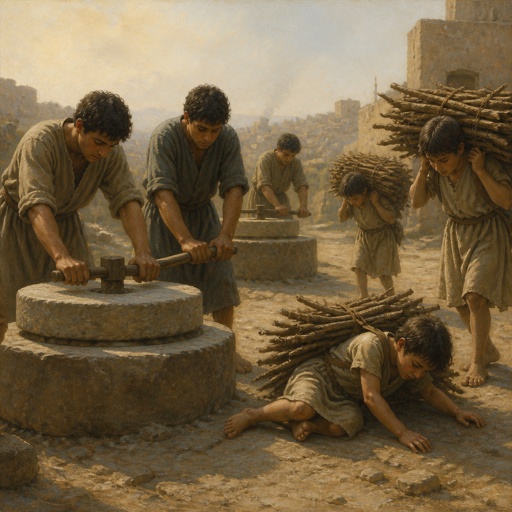
"They took the young men to grind, and the children fell under the wood." - Lamentations 5:13

Lamentations 4:6 - "For the punishment of the iniquity of the daughter of my people is greater than the punishment of the sin of Sodom, that was overthrown as in a moment, and no hands stayed on her."

Lamentations 4:12 - "The kings of the earth, and all the inhabitants of the world, would not have believed that the adversary and the enemy should have entered into the gates of Jerusalem."

Lamentations 4:1 - "How is the gold become dim! how is the most fine gold changed! the stones of the sanctuary are poured out in the top of every street."

"He hath caused the arrows of his quiver to enter into my reins." - Lamentations 3:13

Lamentations 4:17 - "As for us, our eyes as yet failed for our vain help: in our watching we have watched for a nation that could not save us."

Lamentations 4:18 - "They hunt our steps, that we cannot go in our streets: our end is near, our days are fulfilled; for our end is come."

Lamentations 1:4 The roads to Zion mourn, for no one comes to her appointed festivals.

Lamentations 1:4 The roads to Zion mourn, for no one comes to her appointed festivals.

Lamentations 1:4 The roads to Zion mourn, for no one comes to her appointed festivals.

Lamentations 4:7 - "Her Nazarites were purer than snow, they were whiter than milk, they were more ruddy in body than rubies, their polishing was of sapphire:"

Lamentations 4:3 - "Even the sea monsters draw out the breast, they give suck to their young ones: the daughter of my people is become cruel, like the ostriches in the wilderness."

Lamentations 4:20 - "The breath of our nostrils, the anointed of the LORD, was taken in their pits, of whom we said, Under his shadow we shall live among the heathen."

Lamentations 4:15 - "They cried unto them, Depart ye; it is unclean; depart, depart, touch not: when they fled away and wandered, they said among the heathen, They shall no more sojourn there."