Anointed for Healing: Recognizing the Sacred in Our Daily Acts
“And the priest shall take some of the log of oil, and pour it into the palm of his own left hand:” — Leviticus 14:15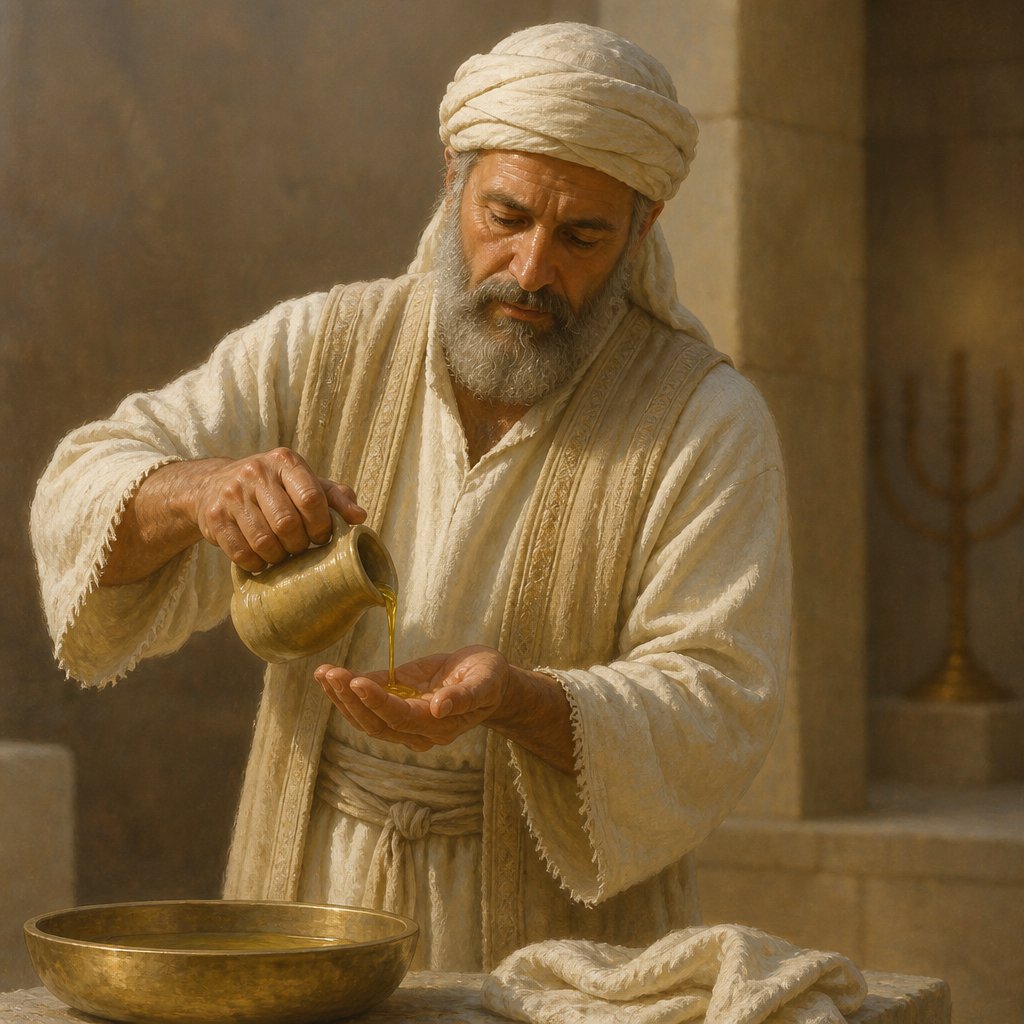
In Leviticus 14:15, we read, "And the priest shall take some of the log of oil, and pour it into the palm of his own left hand." This instruction, given in the context of the ceremonial cleansing of the leper, holds profound significance that extends beyond the historical and cultural confines of ancient Israel. It embodies a rich tapestry of themes that touch on healing, anointing, and the sacred rituals of life.
To grasp the depth of this verse, we must first understand the context. In Leviticus, the laws concerning cleanliness and purity are mandated for the people of Israel. The priest acts as a mediator between God and the people, and his role is to facilitate the restoration of those who have been marginalized by disease—in this case, leprosy. Leprosy, often misunderstood today, represented a deep spiritual and physical dislocation for individuals; it separated them not only from the community but also from participating in the sacred worship of God.
The act of the priest taking oil in his left hand symbolizes several key things. First, oil is often used in the Scriptures as a representation of the Holy Spirit. It denotes anointing, healing, and empowerment. In the life of a believer, we understand that the Holy Spirit is integral to our healing process—spiritually, emotionally, and physically. Just as the priest must engage with the oil, so too must we engage with our relationship with the Holy Spirit, inviting Him into our wounds and scars.
Secondly, the left hand, often associated with lesser honor in biblical texts, reminds us that God’s work is frequently accomplished through surprising and humble means. The priest, a person of high standing in Jewish culture, is instructed to use his less prominent hand, signifying that God can utilize our simple deeds for His profound purposes. Often, we may feel inadequate or ordinary in our abilities or service to God, yet He takes our weak offerings and transforms them into vehicles of grace and restoration.
Moreover, there is an invitation to reflect on the act of pouring. The act of pouring symbolizes abundance and generosity. When the priest pours oil, he does not just drizzle it; he liberally bestows it upon the person receiving healing. This challenges us to consider how we share the love, grace, and healing of God with those around us. Are we pouring liberally into the lives of people seeking healing? Are we generous with our time, love, and resources?
In our everyday lives, we may encounter leprous situations—places of brokenness, suffering, and despair. These may not be physical ailments but emotional, spiritual, or relational scars. God calls us to be conduits of healing, just like the priest mentioned in Leviticus. We can pour out kindness, patience, and compassion to those who suffer from grief, loneliness, or rejection. Each act of kindness becomes an anointing of oil, a sacred moment where God’s love is made manifest in our actions.
Finally, as we engage in these healing acts, it's essential to recognize the ownership of the oil. It is the priest's oil he pours. As believers, we are caretakers of God’s love and grace, and our capacity to heal others stems from our own experience of being healed. We cannot pour what we do not possess. This emphasizes the importance of our personal relationship with God, where we receive healing so that we may extend it.
Leviticus 14:15 invites us into an understanding of the sacredness of our ordinary actions. In the act of anointing and healing, both in the ancient context and today, we discover that these rituals are deeply intertwined with the nature of God. Thus, let us take time to engage with the Holy Spirit, allow Him to heal our own wounds, and lead us to a place where we can pour out His love into the lives of others, reminding us that every ounce of oil represents His grace at work in us and through us.
Get our apps


Artwork for Leviticus 14:15

Leviticus 14:15 - "And the priest shall take some of the log of oil, and pour it into the palm of his own left hand:"
"And the priest shall take some of the log of oil, and pour it into the palm of his own left hand:" - Leviticus 14:15

Leviticus 15:14 - "And on the eighth day he shall take to him two turtledoves, or two young pigeons, and come before the LORD unto the door of the tabernacle of the congregation, and give them unto the priest:"

Leviticus 14:51

Leviticus 14:55 - "And for the leprosy of a garment, and of a house,"

Leviticus 23:15-22

Leviticus 14:56 - "And for a rising, and for a scab, and for a bright spot:"

Leviticus 11:15 - "Every raven after his kind;"

Leviticus 14:1 - "And the LORD spake unto Moses, saying,"

Leviticus 11:14 - "And the vulture, and the kite after his kind;"

Leviticus 5:14 - "¶ And the LORD spake unto Moses, saying,"

Leviticus 15:1 - "And the LORD spake unto Moses and to Aaron, saying,"

Leviticus 14:54 - "This is the law for all manner of plague of leprosy, and scall,"

Leviticus 26:14 - "¶ But if ye will not hearken unto me, and will not do all these commandments;"

Leviticus 14:33 - "¶ And the LORD spake unto Moses and unto Aaron, saying,"

Leviticus 14:57 - "To teach when it is unclean, and when it is clean: this is the law of leprosy."

"And for the leprosy of a garment, and of a house," - Leviticus 14:55

Leviticus 15:15 - "And the priest shall offer them, the one for a sin offering, and the other for a burnt offering; and the priest shall make an atonement for him before the LORD for his issue."

Leviticus 13:14 - "But when raw flesh appeareth in him, he shall be unclean."

Leviticus 14:26 - "And the priest shall pour of the oil into the palm of his own left hand:"

Leviticus 14:30 - "And he shall offer the one of the turtledoves, or of the young pigeons, such as he can get;"

"And for a rising, and for a scab, and for a bright spot:" - Leviticus 14:56

Leviticus 15:9 - "And what saddle soever he rideth upon that hath the issue shall be unclean."

Leviticus 2:15 - "And thou shalt put oil upon it, and lay frankincense thereon: it is a meat offering."

Leviticus 22:15 - "And they shall not profane the holy things of the children of Israel, which they offer unto the LORD;"

Leviticus 14:50 - "And he shall kill the one of the birds in an earthen vessel over running water:"

Leviticus 9:14 - "And he did wash the inwards and the legs, and burnt them upon the burnt offering on the altar."

Leviticus 14:5 - "And the priest shall command that one of the birds be killed in an earthen vessel over running water:"

Leviticus 14:2 - "This shall be the law of the leper in the day of his cleansing: He shall be brought unto the priest:"

Leviticus 14:49 - "And he shall take to cleanse the house two birds, and cedar wood, and scarlet, and hyssop:"