The Weight of Justice: Chastisement and Release
“I will therefore chastise him, and release him.” — Luke 23:16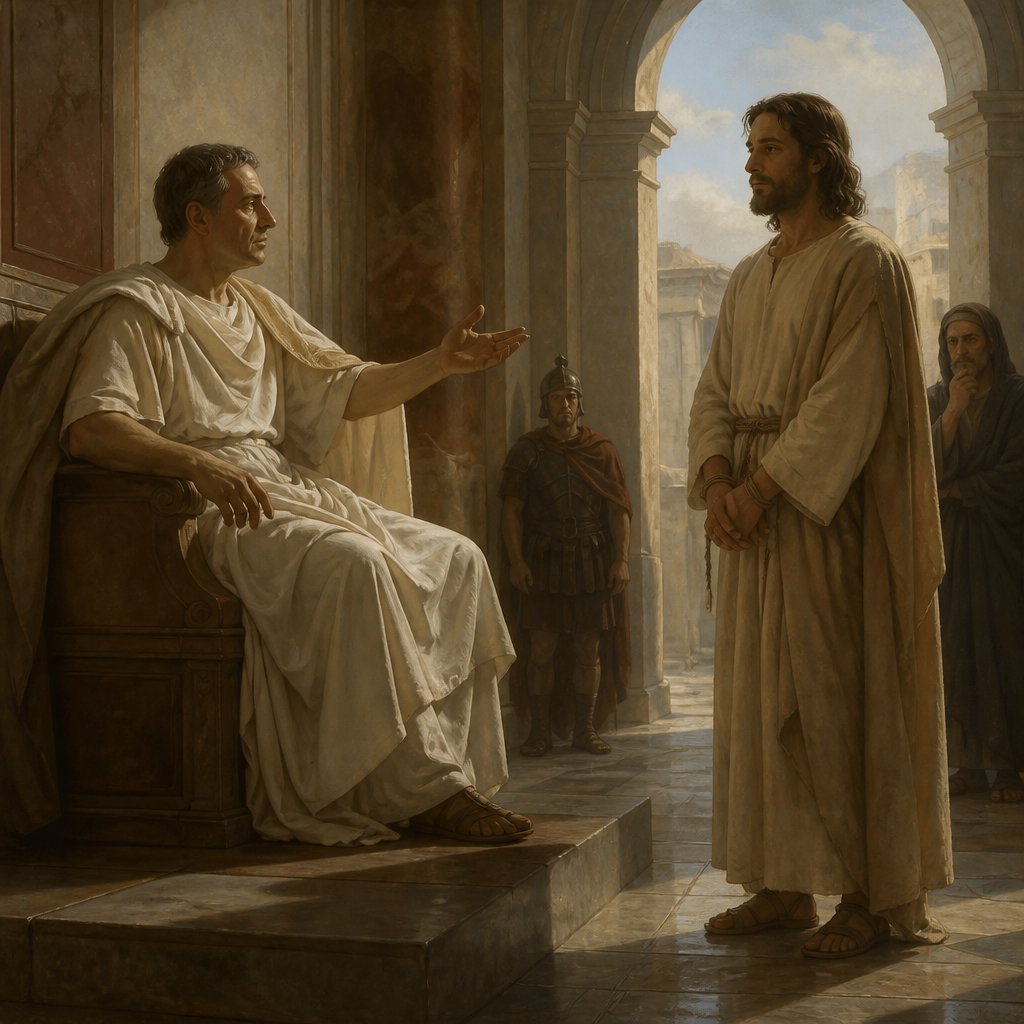
In the heart-wrenching scene depicted in Luke 23:16, the words spoken by Pilate resonate with a profound sense of irony and poignancy: "I will therefore chastise him, and release him." These words, uttered amidst a cacophony of chanting crowds and accusatory voices, embody the crux of Jesus’ earthly journey and the divine justice that unfolds through His suffering.
Consider the context of this moment. Jesus, the innocent Lamb of God, stands before a Roman governor who is tasked with maintaining order in a turbulent province. The Jewish leaders, envious and afraid of Jesus’ influence, bring forth false accusations against Him, claiming His guilt. Yet, Pilate, upon examining Jesus, finds no fault in Him (Luke 23:4). Faced with the pressure of public opinion, the complexity of Roman law, and the insatiable hunger of the mob for blood, he seeks to alleviate the situation by offering a compromise: chastisement followed by release.
At first glance, this proclamation may seem like a simplistic resolution to the tensions of that day. Yet, upon deeper reflection, it reveals layers of theological significance. The term "chastise" evokes images of punishment, discipline, and correction. It is a word that brings to mind the doctrine of suffering—how we are made stronger and more resilient through trials, much like silver refined in the fire. The chastisement of Jesus speaks to the necessity of suffering in God's redemptive plan, a reminder that He chose to bear our transgressions for the sake of our salvation.
In Isaiah 53:5, we read, "But he was wounded for our transgressions, he was bruised for our iniquities: the chastisement of our peace was upon him; and with his stripes we are healed." Here, the prophetic insight provides clarity to Pilate’s declaration. The chastisement that Jesus would endure was not for His own sins—He was without sin—but for ours. Pilate unknowingly articulates the reality that makes the gospel both beautiful and tragic. Jesus, the epitome of innocence, absorbs the justice that was meant for us, allowing us the chance to receive grace instead.
To consider the release part of Pilate’s statement is equally crucial. The release of Jesus for chastisement symbolizes the divine exchange that is at the heart of the Christian faith. Just as Barabbas, the convicted insurrectionist (Luke 23:18-25), was set free while Jesus was condemned, humanity finds its freedom from the bondage of sin through Christ’s sacrifice. The release of Barabbas was a prophetic foreshadowing of what later would be fulfilled through the blood of Christ.
This juxtaposition of chastisement and release invites each of us to reflect on our own journey. Have we embraced the grace offered through Christ’s suffering on our behalf? Have we understood the weight of His chastisement? God’s loving discipline is not punitive; it is restorative. In our lives, chastisement can serve as an opportunity for growth, leading us to a deeper reliance on God and a clearer understanding of His love.
Furthermore, we see that Pilate stands as a representation of every human heart faced with decisions of faith. He finds himself at a crucial juncture, one that could have changed the course of history. Yet, compelled by fear and the desire for appeasement, he prioritizes the public's demands over the calling of righteousness. This moment reminds us of the personal choices we all face: to uphold what is right, even when it is unpopular, or to bow to the pressures of the world.
In closing, Luke 23:16 serves not just as a moment in time, but as a timeless reminder: Christ’s chastisement leads to our release. Let us not take this freedom lightly. Instead, may we cherish the sacrifice that paved the way for our reconciliation with the Father. As we meditate on these truths, let us strive to live lives worthy of such a great calling, reflecting the love and grace we have received.
Get our apps


Artwork for Luke 23:16

Luke 23:16 - "I will therefore chastise him, and release him."
"I will therefore chastise him, and release him." - Luke 23:16

Luke 16:23 - "And in hell he lift up his eyes, being in torments, and seeth Abraham afar off, and Lazarus in his bosom."

Luke 23:53

Luke 19:23

luke 11:23

Luke 19:23

luke 11:23

Luke 15:23

luke 11:23

luke 11:23

"And in hell he lift up his eyes, being in torments, and seeth Abraham afar off, and Lazarus in his bosom." - Luke 16:23

Luke 23:54 - "And that day was the preparation, and the sabbath drew on."

Luke 23:23 - "And they were instant with loud voices, requiring that he might be crucified. And the voices of them and of the chief priests prevailed."

Luke 23:24 - "And Pilate gave sentence that it should be as they required."

Luke 8:16

luke 4:16

Genesis 23-16

Luke 23:45 - "And the sun was darkened, and the veil of the temple was rent in the midst."

Luke 7:23 - "And blessed is he, whosoever shall not be offended in me."

Luke 23:21 - "But they cried, saying, Crucify him, crucify him."

Luke 23:37 - "And saying, If thou be the king of the Jews, save thyself."

Luke 16:1-13

Luke 23:10 - "And the chief priests and scribes stood and vehemently accused him."

Luke 16:1-1313

Luke 16:22-26

Luke 16:1-13

Luke 16:1-13

Luke 2:16 - 21

Luke 23:52 - "This man went unto Pilate, and begged the body of Jesus."