The Depths of Forgiveness: Exploring Luke 7:41
“There was a certain creditor which had two debtors: the one owed five hundred pence, and the other fifty.” — Luke 7:41
In the Gospel of Luke, chapter 7, a profound parable is told by our Lord concerning debtors and a creditor, encapsulated in the simple yet powerful verse: "There was a certain creditor which had two debtors: the one owed five hundred pence, and the other fifty" (Luke 7:41 KJV). This verse serves as an introduction to a larger teaching about grace, forgiveness, and the measure of our love in relation to God’s mercy.
First, let’s unpack the context of this parable. Jesus is dining at the house of Simon the Pharisee when a sinful woman enters, uninvited. She approaches Jesus weeping, washing His feet with her tears, and drying them with her hair, an act of deep love and repentance. Simon, who had invited Jesus, judged both the woman and the actions of Christ, questioning the nature of Jesus’ prophetic abilities if He were truly the Messiah. In response, Jesus tells a story that reveals not only the condition of Simon's heart but also the profound nature of forgiveness.
The two debtors in the parable represent two types of sinners. The first debtor owes five hundred pence—an astronomical amount, while the second owes fifty pence, a much smaller debt. The staggering difference between the amounts reflects the varying degrees of sinfulness perceived by society. Yet, what is striking is not the amounts of the debts but the creditor’s action: he graciously forgives both debts.
This is critical to understanding the essence of God's grace. The debtors' actions do not earn their forgiveness; rather, it is the creditor’s decision to forgive that frees them from their obligations. In this, Jesus illustrates the radical nature of God’s mercy. Just as sin does not go unnoticed by the Lord, neither does He weigh sins on a scale of human judgment. Instead, His forgiveness is offered freely and abundantly to those who come to Him in sincere repentance.
Scripture reminds us, "For all have sinned, and come short of the glory of God" (Romans 3:23 KJV), confirming that we are all debtors to sin. Regardless of the extent or nature of our sins—some may feel like the woman with her overwhelming guilt, others may be like Simon, blind to their own faults—we share the same desperate need for grace. The beauty of this parable lies in its stark reminder that all of us are equally dependent on the mercy of God. Our debt, regardless of size, is insurmountable without divine intervention.
The parable continues, highlighting the response of each debtor after their debts are forgiven. Jesus poses the question, who would love the creditor more? Simon, slow to comprehend, answers that it would be the one forgiven more, the one burdened with greater debt. Here, Jesus reveals the heart of the matter: love for God is magnified by an understanding of the depth of His forgiveness. The woman recognizes the gravity of her sin and therefore exhibits a profound love in her worship of Jesus.
What can we learn from this poignant exchange? It compels us to reflect on our own perception of sin and forgiveness. Are we more like Simon, blind to our own shortcomings, allowing pride to shield us from the reality of God’s grace? Or are we like the woman, fully aware of our faults and deeply appreciative of the forgiveness we receive?
Let us internalize the lesson of Luke 7:41. The measure of our love for Christ directly correlates with how we perceive His forgiveness in our lives. The deeper our understanding of our condition as sinners, the more we are moved to love Him. I invite you to meditate on this while considering your own life. How have you received God's grace? How does that influence your worship and service?
Ultimately, this parable transcends mere words; it beckons us into a relationship characterized by gratitude, love, and an unwavering acknowledgment that despite our significant debts, we are met with overwhelming forgiveness. May we all strive to love much because we understand just how much we have been forgiven.
Get our apps


Artwork for Luke 7:41

Luke 7:41-47

Luke 7:41 - "There was a certain creditor which had two debtors: the one owed five hundred pence, and the other fifty."

"There was a certain creditor which had two debtors: the one owed five hundred pence, and the other fifty." - Luke 7:41

Luke 7:41-43 - "There was a certain creditor who had two debtors. One owed five hundred denarii, and the other fifty. And when they had nothing with which to repay, he freely forgave them both. Tell Me, therefore, which of them will love him more? Simon answered and said, “I suppose the one whom he forgave more.” And He said to him, “You have rightly judged.”"
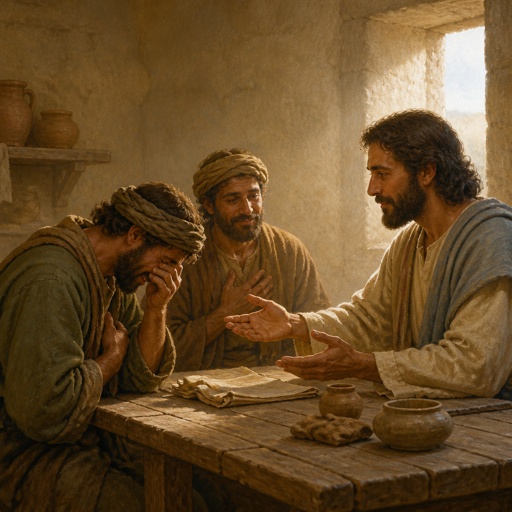
"There was a certain creditor who had two debtors. One owed five hundred denarii, and the other fifty. And when they had nothing with which to repay, he freely forgave them both. Tell Me, therefore, which of them will love him more? Simon answered and said, “I suppose the one whom he forgave more.” And He said to him, “You have rightly judged.”" - Luke 7:41-43

LUKE 24:41-43

Luke 2:41-52

Luke 19:41 - "¶ And when he was come near, he beheld the city, and wept over it,"

Luke 20:41 - "And he said unto them, How say they that Christ is David's son?"

Luke 22:41 - "And he was withdrawn from them about a stone's cast, and kneeled down, and prayed,"

Luke 2:41 - "Now his parents went to Jerusalem every year at the feast of the passover."

Luke 6:41 - "And why beholdest thou the mote that is in thy brother's eye, but perceivest not the beam that is in thine own eye?"

Nehemiah 7:41 - "The children of Pashur, a thousand two hundred forty and seven."

Luke 12:41 - "¶ Then Peter said unto him, Lord, speakest thou this parable unto us, or even to all?"

Luke 11:41 - "But rather give alms of such things as ye have; and, behold, all things are clean unto you."

Luke 23:41 - "And we indeed justly; for we receive the due reward of our deeds: but this man hath done nothing amiss."

Luke 1:41 - "And it came to pass, that, when Elisabeth heard the salutation of Mary, the babe leaped in her womb; and Elisabeth was filled with the Holy Ghost:"

Luke 24:41 - "And while they yet believed not for joy, and wondered, he said unto them, Have ye here any meat?"

Luke 10:41 - "And Jesus answered and said unto her, Martha, Martha, thou art careful and troubled about many things:"

Luke 4:40-41 KJVA (41) And devils also came out of many, crying out, and saying, Thou art Christ the Son of God. And he rebuking them suffered them not to speak: for they knew that he was Christ.

John 7:41 - "Others said, This is the Christ. But some said, Shall Christ come out of Galilee?"

Luke 18:41 - "Saying, What wilt thou that I shall do unto thee? And he said, Lord, that I may receive my sight."

Job 41:7 - "Canst thou fill his skin with barbed irons? or his head with fish spears?"

Luke 9:41 - "And Jesus answering said, O faithless and perverse generation, how long shall I be with you, and suffer you? Bring thy son hither."

Psalms 41:7 - "All that hate me whisper together against me: against me do they devise my hurt."

Acts 7:41 - "And they made a calf in those days, and offered sacrifice unto the idol, and rejoiced in the works of their own hands."

Genesis 41:7 - "And the seven thin ears devoured the seven rank and full ears. And Pharaoh awoke, and, behold, it was a dream."

"And he said unto them, How say they that Christ is David's son?" - Luke 20:41

"¶ And when he was come near, he beheld the city, and wept over it," - Luke 19:41

LUKE 24:41-43 41 And while they still did not believe it because of joy and amazement, he asked them, “Do you have anything here to eat?” 42 They gave him a piece of broiled fish, 43 and he took it and ate it in their presence.