The Overflow of Blessings: Lessons from the Feeding of the Four Thousand
“So they did eat, and were filled: and they took up of the broken meat that was left seven baskets.” — Mark 8:8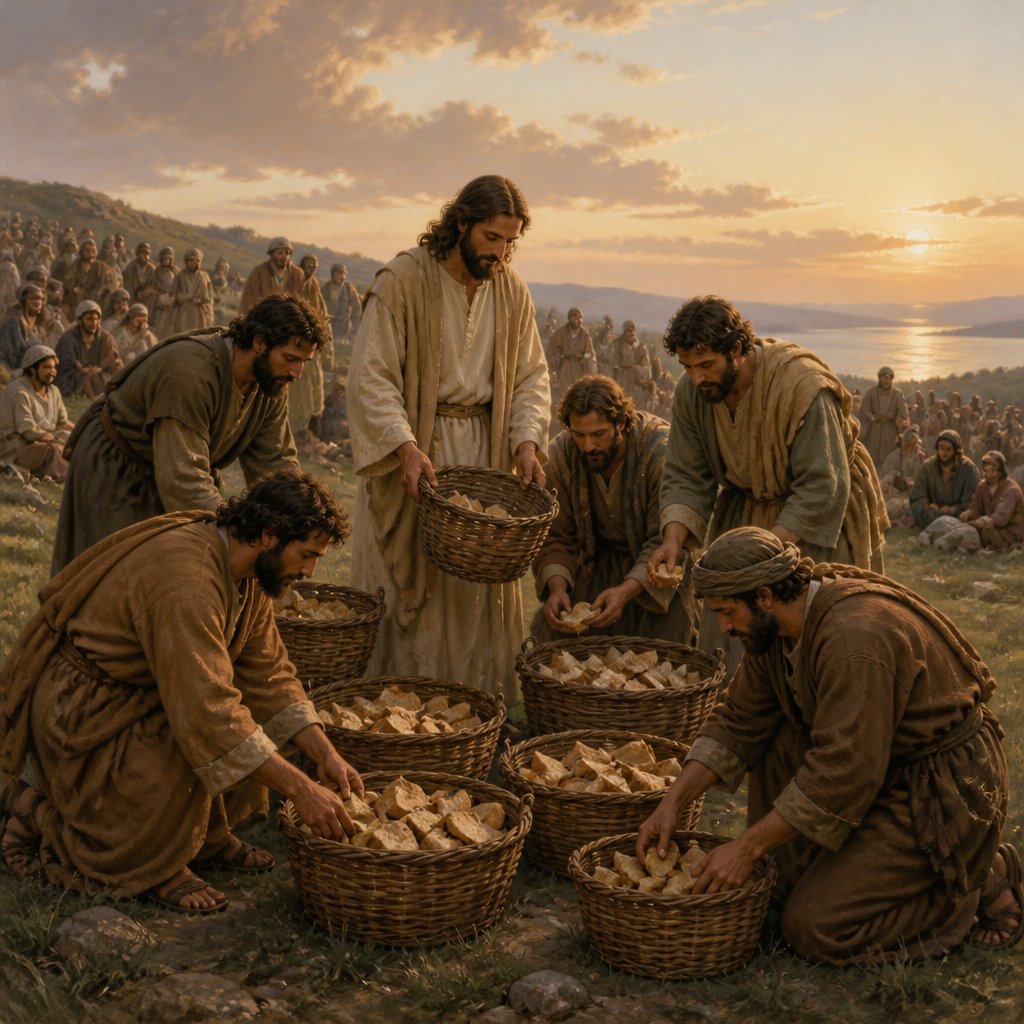
The passage in Mark 8:8 states, "So they did eat, and were filled: and they took up of the broken meat that was left seven baskets." This verse recounts a miracle performed by Jesus, where He fed four thousand men, not counting women and children, with just seven loaves of bread and a few small fish. At first glance, this miracle might seem simple enough—a demonstration of Christ’s power over nature and His compassion for the hungry. However, upon deeper reflection, it unveils profound lessons about provision, abundance, and God’s character toward humanity.
To fully grasp the significance of this miracle, we need to understand the context in which it occurred. The people had been with Jesus for three days, drawn by His teaching and the miraculous healings He performed. As they lingered, it became evident that they were hungry. Jesus, seeing their plight, was moved with compassion.
What stands out in this narrative is not just the miracle itself, but the heart of Christ—the compassionate provider. Here, we see that Jesus was attentive to the physical needs of the people, showing that God cares deeply for us in both spiritual and physical realms. It’s easy to overlook the details of our daily lives, yet Christ provides for us in ways we often do not see or acknowledge. When we are faced with needs—whether they be emotional, spiritual, or physical—Jesus invites us to come to Him, trusting that He will meet those needs.
In this instance, Jesus instructs His disciples to gather the loaves and fish, and through a series of blessings and breaks, they are multiplied to feed the multitude. This act illustrates a powerful truth: God can take what seems insufficient and transform it into abundance. Each of us has areas in our lives where we feel we lack—the resources, the strength, or even the wisdom to navigate a situation. But the feeding of the four thousand teaches us that when we bring our inadequate offerings to Christ, He has a way of multiplying them to bless not only us but also those around us.
The leftovers—seven baskets of broken meat—are equally significant. They symbolize the idea of abundance that follows God’s provision. In a world often characterized by scarcity, we are reminded that God does not merely meet our needs; He exceeds them. The seven baskets represent completeness and perfection in biblical numerology, reminding us that God’s grace and provision are sufficient and overflowing. It shatters the barriers of limitation we impose upon ourselves and brings us to a place of trust and expectancy in His provision.
Moreover, this miracle invites us to reflect on our own lives in the context of giving. The disciples actively participated in distributing the food, demonstrating that God often chooses to use us as vessels of His provision. We may not always have abundance to share, but the act of giving—even when it seems small or inadequate—can lead to a significant impact. God can take our small acts of faith and multiply them in ways we cannot imagine, reaching the lives of many.
As we ponder this story, let us not forget that Jesus, the Bread of Life (John 6:35), is ultimately our greatest sustenance. He invites us to come to Him, to be filled, and to feast on His abundant grace. Remember, just as the crowd was filled, so too are we filled with His love, grace, and peace. And like the seven baskets left over, may we take this overflow and share it with a world that desperately needs to encounter His goodness.
In conclusion, let us approach each day with the confidence that our God not only sees our needs but is fully capable of exceeding our expectations. We are invited to partake in His banquet of blessings, trusting that as we bring our own brokenness and limitations to Him, He will produce a harvest of abundance and grace that spills over into the lives of others. Amen.
Get our apps


Artwork for Mark 8:8

Mark 8:8 - "So they did eat, and were filled: and they took up of the broken meat that was left seven baskets."
"So they did eat, and were filled: and they took up of the broken meat that was left seven baskets." - Mark 8:8

Mark 8:35

Mark 8:35

Mark 12:8

Mark 13:8
Mark 13:8

Mark 8:35

Mark 13:8

Mark 8:7

Mark 8:35

Mark 12:8

Mark 2:8

Mark 8:27 - 35

Mark 8:27 - 35

Mark 16:6-8

Mark 8:27 - 35

Mark 8:27 - 35

Mark 16:6-8

Mark 16:6-8

Mark 8:27 - 35

Mark 8:30 - "And he charged them that they should tell no man of him."

Mark 8:37 - "Or what shall a man give in exchange for his soul?"

Mark 8:16 - "And they reasoned among themselves, saying, It is because we have no bread."

Mark 8:21 - "And he said unto them, How is it that ye do not understand?"

Mark 12:8 - "And they took him, and killed him, and cast him out of the vineyard."

Mark 10:8 - "And they twain shall be one flesh: so then they are no more twain, but one flesh."

Mark 8:24 - "And he looked up, and said, I see men as trees, walking."

Mark 8:13 - "And he left them, and entering into the ship again departed to the other side."

Mark 8:28 - "And they answered, John the Baptist: but some say, Elias; and others, One of the prophets."