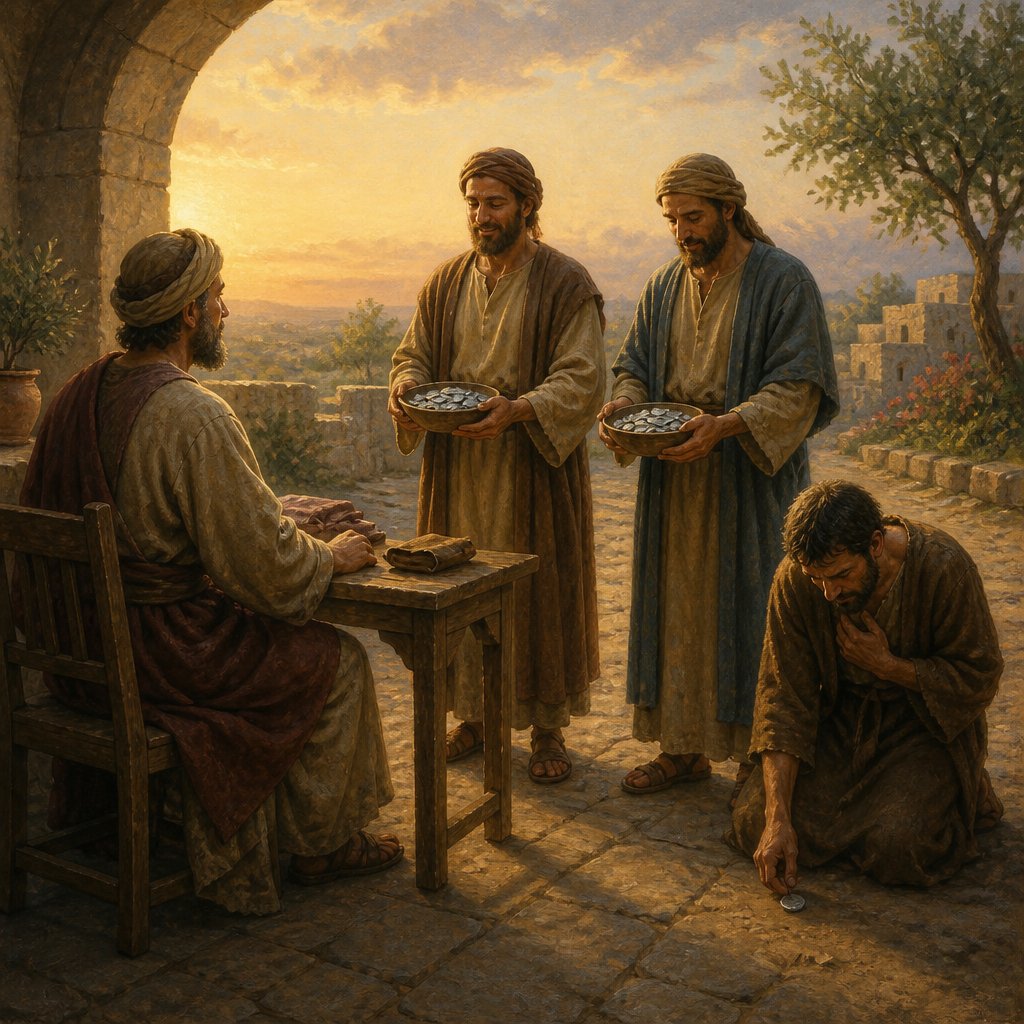
In Matthew 25:14-30, we are presented with a parable often referred to as the Parable of the Talents. This passage carries a profound message concerning the principle of stewardship, accountability, and the very nature of our relationship with God.
The parable begins with a master who is preparing to leave for a far country. Before he departs, he entrusts his slaves with his possessions, distributing to each according to their ability: five talents to one, two to another, and one to the last. This act alone sets the stage for an exploration of how the faithful handling of our God-given resources determines our role in His Kingdom.
What is a talent? In biblical terms, a talent was a significant measure of money – perhaps weighing as much as 75 pounds in silver. Beyond the monetary implication, a talent can also symbolize the unique gifts, abilities, opportunities, and responsibilities that God bestows upon us. Each servant receives a different amount and this emphasizes that God knows our strengths and weaknesses. He assigns tasks based on our capabilities, which offers us crucial insight: God does not judge us by the quantity of what we are given, but by the quality of our faithfulness with what we have.
As we continue with the parable, we see how two servants responded to their master’s trust. The first servant, who received five talents, immediately went out and traded, doubling his investment. The second, receiving two talents, followed suit, gaining another two. Both showed initiative, diligence, and a willingness to take risks because they understood their master’s character. When the master returns, he commends them with, "Well done, thou good and faithful servant.” This is the reward of faithfulness — to be entrusted with responsibilities in a greater capacity and invited into the joy of the Lord.
However, the third servant chose a very different path. Out of fear and the perception that his master was a hard man, he buried his talent in the ground. When called to account, he defends his inaction with excuses, revealing a fundamental misunderstanding of his master. The master responds to him not only with disappointment but with a strong rebuke, characterizing his choice as wicked and slothful. This servant’s fear paralyzed him from doing any good with what he had been given, leading to a tragic loss.
This parable invites us to consider our own responses to the talents we possess. Are we using our abilities to glorify God and advance His Kingdom? Or, like the third servant, are we hiding away our gifts due to fear, insecurity, or complacency? It is vital that we understand that God’s heart is not about perfection, but about participation. He desires our faithfulness more than our results. Each of us is called to actively participate in God’s mission, whether our contribution seems large or small. It’s not the scale of our investment that matters, but the genuineness of our faithfulness in acting upon what He has entrusted to us.
We must also reflect on the implications of the ending of this parable. The unprofitable servant faced dire consequences, illustrating the seriousness of neglecting our responsibilities. As believers, we are called to witness, serve, and bear fruit for the Kingdom. In the economy of God, the principle is clear: to those who are faithful with little, more will be given. Conversely, to those who bury their talents out of fear, even what they have will be taken away.
In conclusion, Matthew 25:14-30 is a compelling call to faithful stewardship. Let us examine what talents we have received from our Master. Are we trading wisely with them, drawing closer to Him and expanding His kingdom? May we not bury our gifts but embrace them, fully trusting in the character of our benevolent Master, who gives us the opportunity to partner with Him in the joy of creation and redemption. Let this parable challenge and inspire us to live as faithful servants, ready and equipped to make the most of every opportunity He places before us.
Get our apps


Artwork for Matthew 25:14-30

Matthew 25:14-30 - "“For it will be like a man going on a journey, who called his servants and entrusted to them his property. To one he gave five talents, to another two, to another one, to each according to his ability. Then he went away. He who had received the five talents went at once and traded with them, and he made five talents more. So also he who had the two talents made two talents more. But he who had received the one talent went and dug in the ground and hid his master's money. Now after a long time the master of those servants came and settled accounts with them. And he who had received the five talents came forward, bringing five talents more, saying, ‘Master, you delivered to me five talents; here, I have made five talents more.’ His master said to him, ‘Well done, good and faithful servant. You have been faithful over a little; I will set you over much. Enter into the joy of your master.’ And he also who had the two talents came forward, saying, ‘Master, you delivered to me two talents; here, I have made two talents more.’ His master said to him, ‘Well done, good and faithful servant. You have been faithful over a little; I will set you over much. Enter into the joy of your master.’ He also who had received the one talent came forward, saying, ‘Master, I knew you to be a hard man, reaping where you did not sow, and gathering where you scattered no seed, so I was afraid, and I went and hid your talent in the ground. Here, you have what is yours.’ But his master answered him, ‘You wicked and slothful servant! You knew that I reap where I have not sown and gather where I scattered no seed? Then you ought to have invested my money with the bankers, and at my coming I should have received what was my own with interest. So take the talent from him and give it to him who has the ten talents. For to everyone who has will more be given, and he will have an abundance. But from the one who has not, even what he has will be taken away. And cast the worthless servant into the outer darkness. In that place there will be weeping and gnashing of teeth.’"
"“For it will be like a man going on a journey, who called his servants and entrusted to them his property. To one he gave five talents, to another two, to another one, to each according to his ability. Then he went away. He who had received the five talents went at once and traded with them, and he made five talents more. So also he who had the two talents made two talents more. But he who had received the one talent went and dug in the ground and hid his master's money. Now after a long time the master of those servants came and settled accounts with them. And he who had received the five talents came forward, bringing five talents more, saying, ‘Master, you delivered to me five talents; here, I have made five talents more.’ His master said to him, ‘Well done, good and faithful servant. You have been faithful over a little; I will set you over much. Enter into the joy of your master.’ And he also who had the two talents came forward, saying, ‘Master, you delivered to me two talents; here, I have made two talents more.’ His master said to him, ‘Well done, good and faithful servant. You have been faithful over a little; I will set you over much. Enter into the joy of your master.’ He also who had received the one talent came forward, saying, ‘Master, I knew you to be a hard man, reaping where you did not sow, and gathering where you scattered no seed, so I was afraid, and I went and hid your talent in the ground. Here, you have what is yours.’ But his master answered him, ‘You wicked and slothful servant! You knew that I reap where I have not sown and gather where I scattered no seed? Then you ought to have invested my money with the bankers, and at my coming I should have received what was my own with interest. So take the talent from him and give it to him who has the ten talents. For to everyone who has will more be given, and he will have an abundance. But from the one who has not, even what he has will be taken away. And cast the worthless servant into the outer darkness. In that place there will be weeping and gnashing of teeth.’" - Matthew 25:14-30
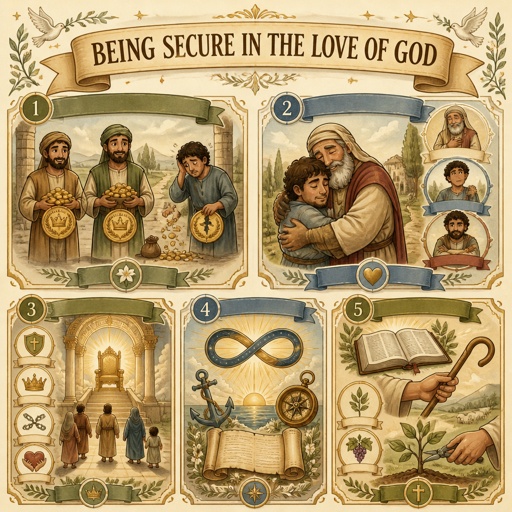
Create a faith-based educational infographic in a warm, hand-drawn illustrated style. Style details: - Soft cream parchment background with subtle texture - Hand-drawn line art with gentle outlines, no harsh edges - Watercolor wash coloring, muted tones: beige, sage green, dusty blue, gold accents - Decorative elements: floral vines, stars, doves, banners, ribbons, ornate frames - Friendly cartoon-style biblical characters with simple robes, expressive faces - Clean, readable serif and script typography inside banners and labels - Organized into 5 numbered sections with rounded frames and ribbon headers - Warm, inspiring, gentle, and reverent mood. Not photorealistic. Content layout: Title at top in large banner: "BEING SECURE IN THE LOVE OF GOD" Section 1: "The Parable of the Talents - Matthew 25:14-30" Show 2 obedient servants holding coins labeled "SECURE" and 1 fearful servant dropping coins labeled "INSECURE". Add note "Gentleness - Matthew 12:18-21" Section 2: "The Prodigal Son Parable - Luke 15:11-32" Show father hugging younger son. Small inset of older son with arms crossed. Labels: "Heart of Father - unconditional love", "Heart of Younger Son - Self Discovery", "Heart of Older Son - anger". Add tag "Heart of GOD - Luke 15:1-2" Section 3: "Throne of Grace" Golden glowing throne under an arch. People walking toward it. Text: "Boldness", "Confidence", "overcome SIN", "Sympathize with our weaknesses" Section 4: "His Love Never Ends - Lamentations 3:22-23" Infinity symbol in blue/gold, anchor, compass, sunrise, scroll that says "Mercies are new every morning". Big text: "GOD'S Love Never Ends" Section 5: "The Discipline of Love" Open Bible, a caring hand with a shepherd's staff, and hand pruning a small plant. Verses: "Romans 11:22 Kindness and Severity", "Hebrews 12:6-7 discipline" Overall: Wholesome, educational, church-friendly, high detail, vector illustration feel.

Matthew 25: 14-25

Matthew 25:30 - "And cast ye the unprofitable servant into outer darkness: there shall be weeping and gnashing of teeth."

Matthew 14:25 - "And in the fourth watch of the night Jesus went unto them, walking on the sea."

Matthew 14:30 - "But when he saw the wind boisterous, he was afraid; and beginning to sink, he cried, saying, Lord, save me."
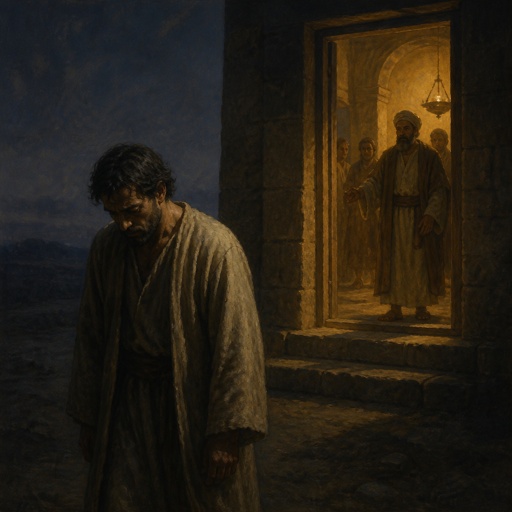
"And cast ye the unprofitable servant into outer darkness: there shall be weeping and gnashing of teeth." - Matthew 25:30

Matthew 25:14 - "¶ For the kingdom of heaven is as a man travelling into a far country, who called his own servants, and delivered unto them his goods."

"And in the fourth watch of the night Jesus went unto them, walking on the sea." - Matthew 14:25

Matthew 25:25

Matthew 6:30

Matthew 5:30

Matthew 5:30

John 14:30

Matthew 24:30-31

Matthew 24:30-31

Matthew 24:30-31

Matthew 24:30-31

Matthew 24:30-31

Matthew 24:30-31

Matthew 24:30-31

Matthew 24:30-31

Matthew 24:30-31

Matthew 24:30-31

Matthew 26:25

Matthew 16:25

Matthew 25:21

Matthew 25:23

matthew 25:31