Harmony in Community: Lessons from Nehemiah 12:36
“And his brethren, Shemaiah, and Azarael, Milalai, Gilalai, Maai, Nethaneel, and Judah, Hanani, with the musical instruments of David the man of God, and Ezra the scribe before them.” — Nehemiah 12:36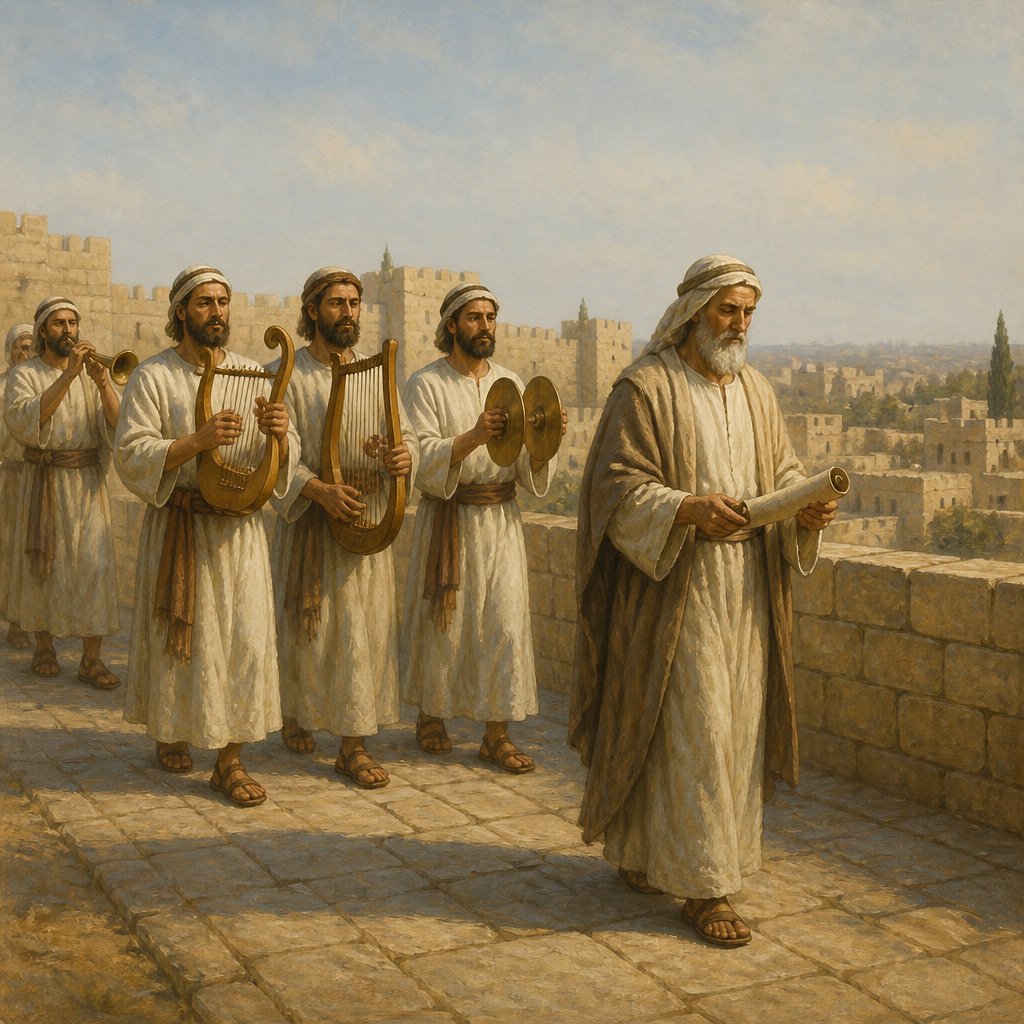
As we reflect on Nehemiah 12:36, we bear witness to a scene rich with communal joy and purposeful worship: “And his brethren, Shemaiah, and Azarael, Milalai, Gilalai, Maai, Nethaneel, and Judah, Hanani, with the musical instruments of David the man of God, and Ezra the scribe before them.” The imagery conjured up in this verse signifies the return to Jerusalem after a long period of desolation and the people’s eagerness to restore not only the city but their connection to God through worship.
To understand this scripture completely, we need to delve into its context. Nehemiah led the effort to rebuild the walls of Jerusalem, and as the physical restoration took place, a spiritual revival was essential. As the walls were being constructed, so too was their community, with each individual taking up their role in this sacred restoration. This scripture highlights the importance of coming together as a community united in purpose, driven by the desire to honor God.
The mention of specific names — Shemaiah, Azarael, Milalai, Gilalai, Maai, Nethaneel, Judah, Hanani — is not merely an enumeration of duties; it illustrates that every person matters. Each name represents a contribution to the larger narrative of redemption. In God’s kingdom, every believer has a pivotal role to play, and this is a glorious reminder that no one is insignificant. Just as Nehemiah had guys like Ezra the scribe leading the way, God uses each one of us in different capacities to fulfill His divine plan.
Additionally, the musical instruments of David signify the legacy of worship that has been handed down through generations. David, a man after God’s own heart, laid the foundation for worship in Israel. The return to these musical instruments embodies not just a restoration of tradition but also an invitation to fully engage in praise and worship. Music has an extraordinary ability to usher in the presence of God, creating an atmosphere of reverence and gratitude. In our worship today, we are invited to pick up the instruments of our time — our voices, our talents, and our hearts — and join in the grand symphony of praise toward our Creator.
What does it mean to come together with our brethren in our modern context? There is great strength in unity. In the New Testament, we are reminded in 1 Corinthians 12 about the body of Christ — that each part is necessary for the overall health of the church. In this high-paced, distracted world, it is increasingly crucial that we gather intentionally, whether in worship services, small groups, or community outreach. God calls us to bring our unique gifts together to build one another up and glorify Him.
Furthermore, Ezra the scribe represents the importance of the Word of God in our gathering. The Scribe, tasked with teaching and interpreting the Law, serves as a reminder that our worship should be anchored in Scripture. It’s through the Word that we understand God’s character and His directives for us. In everything we do, including worship, our focus should be on God and the truth of His Word. It’s essential that as we come together in worship and service, we also immerse ourselves in Scripture to ensure that our actions and songs align with God's will.
As we reflect on Nehemiah 12:36 today, let us be inspired to engage actively in our communities of faith. This involves acknowledging each other's contributions, praising God with our voices and instruments, and rooting our worship in the truth of His Word. Together, we can create a beautiful tapestry that glorifies God and exemplifies the Kingdom’s purpose, reminding ourselves that our unity in Christ is a powerful force. Thus, let us march forward, hand in hand, with our hearts tuned to His melody, ready to restore and rebuild for His glory.
Get our apps


Artwork for Nehemiah 12:36

Nehemiah 12:36 - "And his brethren, Shemaiah, and Azarael, Milalai, Gilalai, Maai, Nethaneel, and Judah, Hanani, with the musical instruments of David the man of God, and Ezra the scribe before them."
"And his brethren, Shemaiah, and Azarael, Milalai, Gilalai, Maai, Nethaneel, and Judah, Hanani, with the musical instruments of David the man of God, and Ezra the scribe before them." - Nehemiah 12:36

Nehemiah 11:36 - "And of the Levites were divisions in Judah, and in Benjamin."

Nehemiah 7:36 - "The children of Jericho, three hundred forty and five."
"And of the Levites were divisions in Judah, and in Benjamin." - Nehemiah 11:36
"The children of Jericho, three hundred forty and five." - Nehemiah 7:36

Nehemiah 12:26 - "These were in the days of Joiakim the son of Jeshua, the son of Jozadak, and in the days of Nehemiah the governor, and of Ezra the priest, the scribe."

Nehemiah 12:5 - "Miamin, Maadiah, Bilgah,"

Nehemiah 12:33 - "And Azariah, Ezra, and Meshullam,"

Nehemiah 12:4 - "Iddo, Ginnetho, Abijah,"

Nehemiah 12:2 - "Amariah, Malluch, Hattush,"

Nehemiah 12:3 - "Shechaniah, Rehum, Meremoth,"

Nehemiah 10:12 - "Zaccur, Sherebiah, Shebaniah,"

Nehemiah 12:6 - "Shemaiah, and Joiarib, Jedaiah,"

Nehemiah 9:36 - "Behold, we are servants this day, and for the land that thou gavest unto our fathers to eat the fruit thereof and the good thereof, behold, we are servants in it:"

Nehemiah 12:12 - "And in the days of Joiakim were priests, the chief of the fathers: of Seraiah, Meraiah; of Jeremiah, Hananiah;"

Nehemiah 12:13 - "Of Ezra, Meshullam; of Amariah, Jehohanan;"

Nehemiah 12:16 - "Of Iddo, Zechariah; of Ginnethon, Meshullam;"

Nehemiah 12:20 - "Of Sallai, Kallai; of Amok, Eber;"

Nehemiah 12:19 - "And of Joiarib, Mattenai; of Jedaiah, Uzzi;"

Nehemiah 12:34 - "Judah, and Benjamin, and Shemaiah, and Jeremiah,"

Nehemiah 12:15 - "Of Harim, Adna; of Meraioth, Helkai;"

Nehemiah 12:18 - "Of Bilgah, Shammua; of Shemaiah, Jehonathan;"

Nehemiah 12:21 - "Of Hilkiah, Hashabiah; of Jedaiah, Nethaneel."

Nehemiah 12:14 - "Of Melicu, Jonathan; of Shebaniah, Joseph;"

Nehemiah 12:17 - "Of Abijah, Zichri; of Miniamin, of Moadiah, Piltai;"

Matthew 12:36-37

Matthew 12:36-37

matthew 12:36-37

Nehemiah 12:11 - "And Joiada begat Jonathan, and Jonathan begat Jaddua."