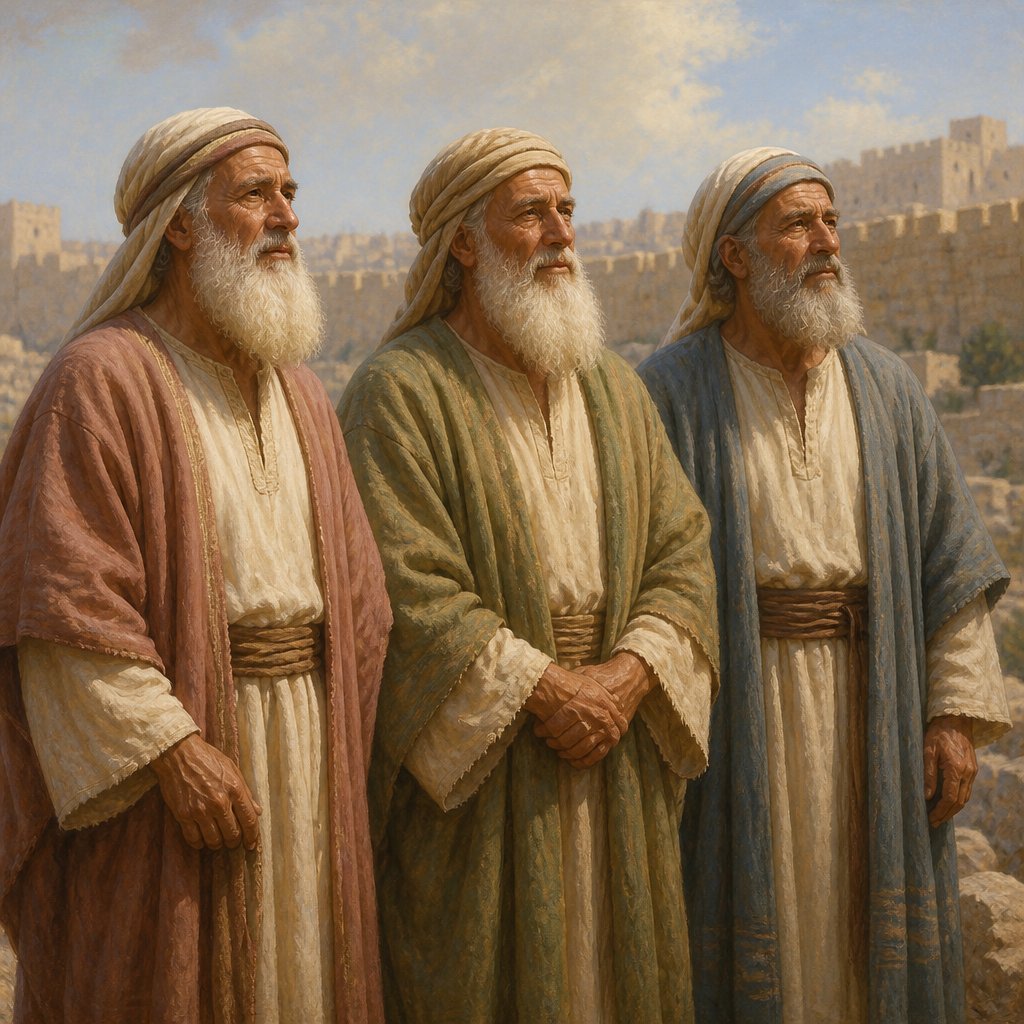
The verse Nehemiah 12:4, which reads, "Iddo, Ginnetho, Abijah," may seem at first glance to be a mere mention of names in a long genealogical list, but within its simplicity lies profound truths about legacy, identity, and God’s faithful restoration of His people.
As we delve into the context of this passage, we find ourselves in the midst of a rebuilding narrative, both physically and spiritually. Nehemiah has returned to Jerusalem to oversee the rebuilding of the walls after years of devastation. The people are reestablishing their community, their worship, and their identity as God’s chosen ones. Nehemiah's leadership encapsulates a journey of renewal, calling the Israelites to rejoice in God’s grace and remember the covenant He established with their forebears.
Looking specifically at the names mentioned – Iddo, Ginnetho, and Abijah – we must appreciate that each represents not just individuals, but the lineage and collective history of God’s people. In ancient Israel, genealogy was not merely about family trees; it was a declaration of one’s identity, heritage, and position in the community of faith. These names symbolize the continuity of God's promises and the faithfulness of generations that preceded the current returnees.
**Faithfulness of Generations**
In a world that often prioritizes the fleeting and the new, we are reminded of the importance of our roots. Each of us has a spiritual ancestry that has contributed to our faith journey. The men named in this verse were not just bystanders in history; they were faithful servants of God who made choices that paved the way for those who followed. In the same spirit, we reflect on how our own actions and faith can deeply impact future generations. Are we nurturing faithfulness in our families? Are we planting seeds of hope and trust in God’s plans, just as those before us did?
**The Importance of Legacy**
Iddo, for example, was a prominent priest, and his lineage was tied directly to the temple worship, which was central to the Israelites’ identity. This brings forth the key principle of legacy – our faith is meant to be preserved and passed down, nurtured through the generations. Just as the Israelites were called to remember their ancestral roots, we too are called to remember our own spiritual heritage. In this context, this verse encourages us to consider how we uphold and pass on our faith, unwinding the thread of spiritual history woven by those who came before us.
**Hope in Restoration**
Moreover, this verse reflects God's commitment to restoration and His enduring relationship with His people. The return of these names in the context of rebuilding signifies hope and renewal after periods of desolation. For the Israelites, this was an opportunity to reaffirm their commitment to God, a chance to rebuild what had been lost. In our own lives, we can experience seasons of rebuilding, whether they be emotional, spiritual, relational, or physical. The mention of these ancestors reminds us that God's restorative power transcends generations.
**Conclusion: Responding to the Call**
As we meditate on Nehemiah 12:4, let us ask ourselves how we can embody the traits of Iddo, Ginnetho, and Abijah today. Are we rooted deeply in our prayer lives, worship, and community involvement? Are we building a legacy of faithfulness that future generations can look upon? As we encounter challenges and desolation, may we also recognize opportunities for restoration and renewal. Let us commit to honor our spiritual lineage and the God who restores. By doing so, we affirm that the path of faith is not a solitary journey, but one directed by the faithful lives of those who have gone before us and those who will come after us.
Get our apps


Artwork for Nehemiah 12:4

Nehemiah 12:4 - "Iddo, Ginnetho, Abijah,"

"Iddo, Ginnetho, Abijah," - Nehemiah 12:4

Nehemiah 4:12 - "And it came to pass, that when the Jews which dwelt by them came, they said unto us ten times, From all places whence ye shall return unto us they will be upon you."

Nehemiah 12:26 - "These were in the days of Joiakim the son of Jeshua, the son of Jozadak, and in the days of Nehemiah the governor, and of Ezra the priest, the scribe."

Nehemiah 12:5 - "Miamin, Maadiah, Bilgah,"

Nehemiah 12:33 - "And Azariah, Ezra, and Meshullam,"

Nehemiah 12:2 - "Amariah, Malluch, Hattush,"

Nehemiah 12:3 - "Shechaniah, Rehum, Meremoth,"

Nehemiah 10:12 - "Zaccur, Sherebiah, Shebaniah,"

Nehemiah 12:6 - "Shemaiah, and Joiarib, Jedaiah,"

Nehemiah 12:12 - "And in the days of Joiakim were priests, the chief of the fathers: of Seraiah, Meraiah; of Jeremiah, Hananiah;"

Nehemiah 4:6

Nehemiah 4:6

Nehemiah 12:13 - "Of Ezra, Meshullam; of Amariah, Jehohanan;"

Nehemiah 12:16 - "Of Iddo, Zechariah; of Ginnethon, Meshullam;"

Nehemiah 12:20 - "Of Sallai, Kallai; of Amok, Eber;"

Nehemiah 4:6

Nehemiah 12:19 - "And of Joiarib, Mattenai; of Jedaiah, Uzzi;"

Nehemiah 12:34 - "Judah, and Benjamin, and Shemaiah, and Jeremiah,"

Nehemiah 12:15 - "Of Harim, Adna; of Meraioth, Helkai;"

Nehemiah 12:18 - "Of Bilgah, Shammua; of Shemaiah, Jehonathan;"

Nehemiah 12:21 - "Of Hilkiah, Hashabiah; of Jedaiah, Nethaneel."

Nehemiah 12:14 - "Of Melicu, Jonathan; of Shebaniah, Joseph;"

Nehemiah 12:17 - "Of Abijah, Zichri; of Miniamin, of Moadiah, Piltai;"

Nehemiah 12:11 - "And Joiada begat Jonathan, and Jonathan begat Jaddua."

Nehemiah 10:4 - "Hattush, Shebaniah, Malluch,"

Nehemiah 7:12 - "The children of Elam, a thousand two hundred fifty and four."

Nehemiah 12:32 - "And after them went Hoshaiah, and half of the princes of Judah,"

"Miamin, Maadiah, Bilgah," - Nehemiah 12:5

"Shemaiah, and Joiarib, Jedaiah," - Nehemiah 12:6