Viewing the Ruins: A Call to Restoration
“And I went out by night by the gate of the valley, even before the dragon well, and to the dung port, and viewed the walls of Jerusalem, which were broken down, and the gates thereof were consumed with fire.” — Nehemiah 2:13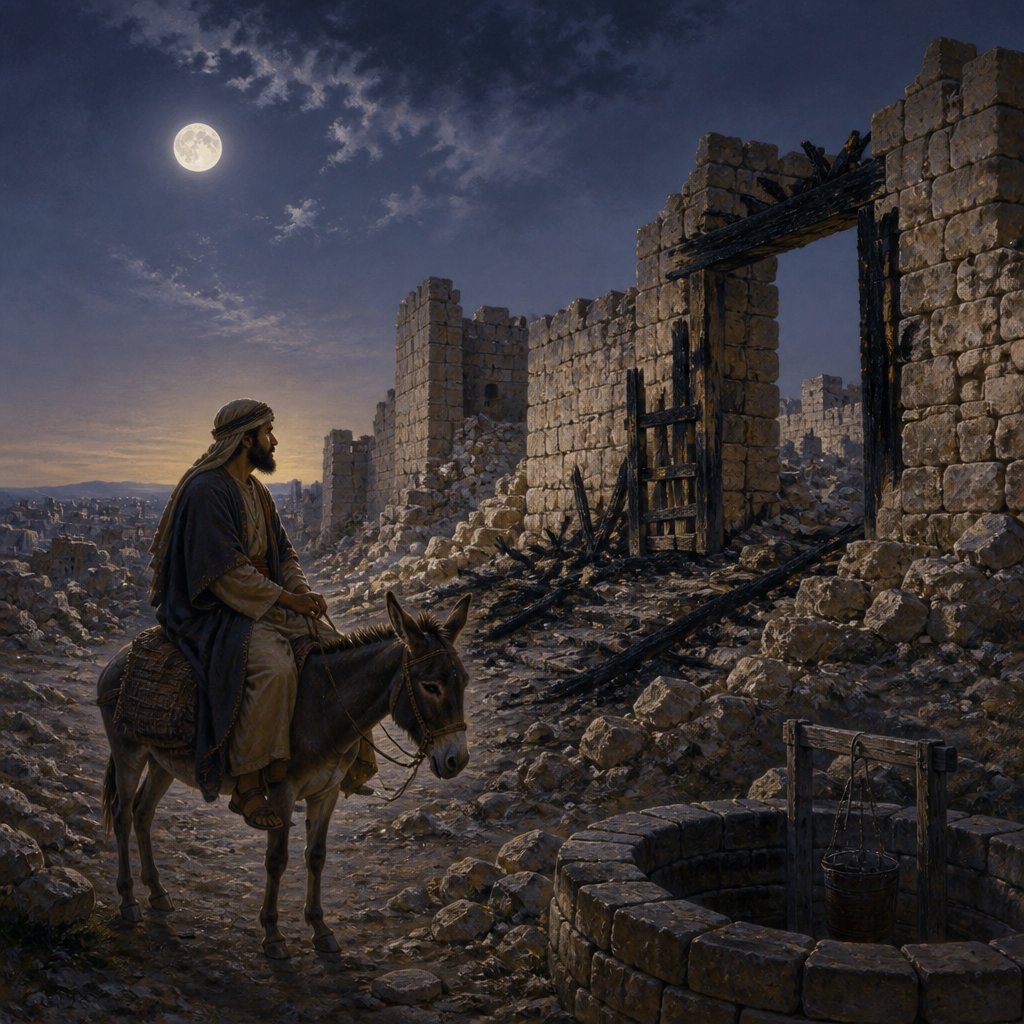
Nehemiah 2:13 states, "And I went out by night by the gate of the valley, even before the dragon well, and to the dung port, and viewed the walls of Jerusalem, which were broken down, and the gates thereof were consumed with fire." This verse is both a historical account and a profound illustration of the spiritual journey of restoration that God undertakes in our lives.
Nehemiah, serving as the cupbearer to the king of Persia, felt a deep burden for his homeland, Jerusalem, which lay in ruins. When he heard of the desolation of the city and its walls, his heart broke. He knew the walls represented not just physical protection but the identity and honor of his people. With this burden heavy upon him, he prayed fervently and sought an opportunity to act.
In this verse, Nehemiah stealthily inspects the walls of Jerusalem at night. There is significance in his choice to go out by night. The darkness can symbolize the secrecy and the vulnerability of the situation; Nehemiah needed clarity before he acted publicly. He wanted to assess the destruction firsthand without drawing attention to himself or provoking opposition too soon. Nehemiah understood that great works often start in the quiet of personal reflection and prayer.
As Nehemiah surveys the broken walls and consumed gates, he is not merely looking at physical ruins but contemplating the hearts and lives that have been devastated by sin, negligence, and apathy. When we encounter situations of brokenness—whether in our own lives or in the world around us—how often do we take the time to truly view and understand the extent of the damage? Nehemiah’s example teaches us that before we can effectively rebuild, we must first recognize and mourn the depth of the destruction.
The broken walls symbolize the safety and security that has been lost. In our spiritual lives, walls often represent the boundaries God has set for our protection. When these boundaries are broken, it leaves us vulnerable to attacks from the enemy, just as Jerusalem was exposed to its foes. Nehemiah’s process of viewing the ruins can be seen as an invitation for us to examine our own lives. Are there walls that have fallen due to disobedience, negligence, or perhaps a lack of vigilance in our spiritual walk?
In reflecting upon Nehemiah's actions, we can learn the importance of assessing the current state of our lives. Do we take the time to examine our own hearts, to view the areas in our lives that are consumed by fire—figuratively destroyed by the flames of worldly desires, broken relationships, or unmet spiritual goals? It is often uncomfortable to face these realities; yet, just as Nehemiah faced the ruins, we must confront our brokenness if we’re to see restoration.
This investigation leads us not to despair, but to hope. Nehemiah's next actions—rallying the people to rebuild—demonstrates that restoration is possible, and it works best when done in community. We are not called to rebuild our lives in isolation but together with other believers. As we engage with one another in prayer, support, and action, we encourage each other toward healing and growth.
Furthermore, we must recognize that true restoration comes from recognizing our own inadequacies and invoking God’s strength. When Nehemiah encountered the ruins, he knew that he could not rebuild alone; he needed God’s guidance and provision. Similarly, we are reminded in Philippians 4:13, "I can do all things through Christ which strengtheneth me."
As we think on Nehemiah 2:13, let us commit to a heart of examination and willingness to engage in restoration work. May we allow God to reveal the broken walls in our lives, empower us with His Spirit, and use us to rebuild not only our own lives but also our families, communities, and churches. Let us say yes to the call to repair, knowing that the God of restoration walks with us through every step.
Get our apps


Artwork for Nehemiah 2:13

Nehemiah 2:13 - "And I went out by night by the gate of the valley, even before the dragon well, and to the dung port, and viewed the walls of Jerusalem, which were broken down, and the gates thereof were consumed with fire."
"And I went out by night by the gate of the valley, even before the dragon well, and to the dung port, and viewed the walls of Jerusalem, which were broken down, and the gates thereof were consumed with fire." - Nehemiah 2:13

Nehemiah 11:13

Nehemiah 13:2 - "Because they met not the children of Israel with bread and with water, but hired Balaam against them, that he should curse them: howbeit our God turned the curse into a blessing."

Nehemiah 10:13 - "Hodijah, Bani, Beninu."

Nehemiah 12:13 - "Of Ezra, Meshullam; of Amariah, Jehohanan;"

Nehemiah 7:13 - "The children of Zattu, eight hundred forty and five."

"Hodijah, Bani, Beninu." - Nehemiah 10:13

"Of Ezra, Meshullam; of Amariah, Jehohanan;" - Nehemiah 12:13

Nehemiah 13:12 - "Then brought all Judah the tithe of the corn and the new wine and the oil unto the treasuries."

Nehemiah 13:31 - "And for the wood offering, at times appointed, and for the firstfruits. Remember me, O my God, for good."

Nehemiah 13:20 - "So the merchants and sellers of all kind of ware lodged without Jerusalem once or twice."

Nehemiah 13:4 - "¶ And before this, Eliashib the priest, having the oversight of the chamber of the house of our God, was allied unto Tobiah:"

Nehemiah 13:23 - "¶ In those days also saw I Jews that had married wives of Ashdod, of Ammon, and of Moab:"

Nehemiah 13:29 - "Remember them, O my God, because they have defiled the priesthood, and the covenant of the priesthood, and of the Levites."

Nehemiah 12:2 - "Amariah, Malluch, Hattush,"

Nehemiah 13:24 - "And their children spake half in the speech of Ashdod, and could not speak in the Jews' language, but according to the language of each people."

Nehemiah 13:8 - "And it grieved me sore: therefore I cast forth all the household stuff of Tobiah out of the chamber."

Nehemiah 10:2 - "Seraiah, Azariah, Jeremiah,"

Nehemiah 13:3 - "Now it came to pass, when they had heard the law, that they separated from Israel all the mixed multitude."

Nehemiah 13:9 - "Then I commanded, and they cleansed the chambers: and thither brought I again the vessels of the house of God, with the meat offering and the frankincense."

Nehemiah 13:7 - "And I came to Jerusalem, and understood of the evil that Eliashib did for Tobiah, in preparing him a chamber in the courts of the house of God."

"The children of Zattu, eight hundred forty and five." - Nehemiah 7:13

Nehemiah 13:13 - "And I made treasurers over the treasuries, Shelemiah the priest, and Zadok the scribe, and of the Levites, Pedaiah: and next to them was Hanan the son of Zaccur, the son of Mattaniah: for they were counted faithful, and their office was to distribute unto their brethren."

Nehemiah 13:30 - "Thus cleansed I them from all strangers, and appointed the wards of the priests and the Levites, every one in his business;"

Nehemiah 13:17 - "Then I contended with the nobles of Judah, and said unto them, What evil thing is this that ye do, and profane the sabbath day?"

Nehemiah 13:11 - "Then contended I with the rulers, and said, Why is the house of God forsaken? And I gathered them together, and set them in their place."

Nehemiah 13:1 - "On that day they read in the book of Moses in the audience of the people; and therein was found written, that the Ammonite and the Moabite should not come into the congregation of God for ever;"

Nehemiah 13:27 - "Shall we then hearken unto you to do all this great evil, to transgress against our God in marrying strange wives?"

Nehemiah 2:11 - "So I came to Jerusalem, and was there three days."