Living in the Reality of Resurrection
“Likewise reckon ye also yourselves to be dead indeed unto sin, but alive unto God through Jesus Christ our Lord.” — Romans 6:11
The journey of faith often leads us into profound truths that challenge our understanding and compel us to rethink the narratives we embrace. Romans 6:11 presents one such truth: "Likewise reckon ye also yourselves to be dead indeed unto sin, but alive unto God through Jesus Christ our Lord." This succinct verse encapsulates a life-altering revelation—the acknowledgment of our identity in Christ. It calls for a deep reckoning that shapes how we interact with sin and perceive our relationship with God.
To "reckon" in this context means to consider something to be true, to take it into account, and to draw conclusions based on that reality. Paul, writing to the Romans, implores believers to view themselves through the lens of Christ’s resurrection. This reckoning calls for us to understand and internalize that we are spiritually dead to sin and alive to God. This transformation points to the crux of Christ’s redemptive work: His death and resurrection enable us to move from a life defined by sin to one characterized by the vibrant life of God.
We live in a world that constantly pulls us into cycles of sin and temptation—adversities that beckon us to embrace our past identities. But here lies the heart of Paul's message. By faith, we must reckon ourselves dead to those former ways; we are not merely improved versions of our old selves. In Christ, we possess a new identity, created to reflect His glory, and empowered by His Spirit.
The reality of being "dead indeed unto sin" is of paramount importance. Many believers grapple with guilt, shame, and the cycle of sinfulness, failing to realize that the old self has been crucified with Christ (Romans 6:6). The implications of this truth are staggering; we are no longer under sin’s dominion. We have been given the holy privilege of walking in the newness of life. Being dead to sin does not imply that sin will not tempt us or that we will not struggle. Instead, it emphasizes that sin no longer possesses the authority over our lives that it once did.
What does it mean to be "alive unto God through Jesus Christ our Lord"? This vital aspect of our identity cannot be understated. Being alive unto God means experiencing His presence, engaging in His purposes, and knowing His love in profound and transformative ways. We are invited into a relationship filled with intimacy, purpose, and sinless communion. Our identity as those alive to God impacts our daily decision-making, interactions, and inner motivations. It fosters an atmosphere of worship where our lives become a testament to His grace and glory.
When we fully embrace this truth, we begin to see life through the lens of resurrection power. We can approach challenges with confidence, knowing we are equipped to overcome. No longer do we have to succumb to despair or hopelessness; instead, we can reach out in faith, embodying the power of Christ to enact change in our hearts and lives.
The daily challenge is to live in this reckoning. It requires an active and ongoing engagement with God's Word and a heart open to the Holy Spirit’s guidance. We must renew our minds, anchoring our thoughts in the truth of who we are in Christ and how that fundamentally changes our approach to sin. A practical step could be starting each day with a declaration of this truth: "I am dead to sin and alive to God through Jesus Christ my Lord." Let this affirmation shape our thoughts and actions.
In summary, Romans 6:11 invites us into a profound mystery—our death to sin and life in God through Jesus Christ. It is an invitation to rethink our identity, embrace our reality, and actively engage in a life that brings glory to God. May we continue to reckon with this divine truth and live out its implications, reflecting the transformative power of the gospel to a world in desperate need of hope.
Get our apps


Artwork for Romans 6:11
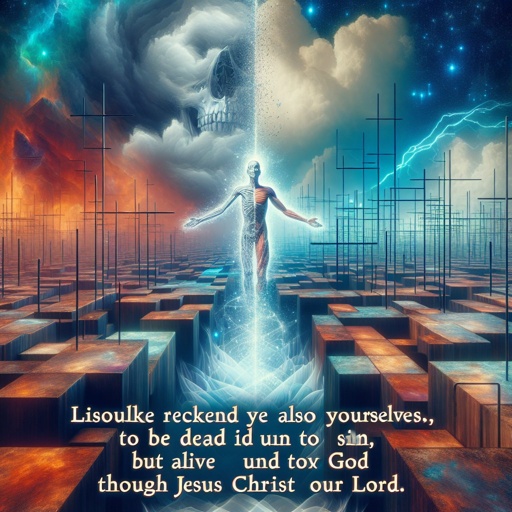
Romans 6:11 - "Likewise reckon ye also yourselves to be dead indeed unto sin, but alive unto God through Jesus Christ our Lord."

"Likewise reckon ye also yourselves to be dead indeed unto sin, but alive unto God through Jesus Christ our Lord." - Romans 6:11

Romans 11:6 - "And if by grace, then is it no more of works: otherwise grace is no more grace. But if it be of works, then is it no more grace: otherwise work is no more work."

Romans 6:23

Romans 6:23

Romans 11:11
Romans 11:6 And if by grace, then it is no longer of works; otherwise grace is no longer grace. But if it is of works, it is no longer grace; otherwise work is no longer work.

Romans 11:6 And if by grace, then it is no longer of works; otherwise grace is no longer grace. But if it is of works, it is no longer grace; otherwise work is no longer work.

Romans 11:18
Romans 11:18

Romans 11:18

Romans 11:18

Romans 11:18

Romans 11:18

Romans 11:18

Romans 8:11

Romans 8:6

Romans 5: 1-11

Romans 11:25-32

Romans 2:11 - "For there is no respect of persons with God."

Romans 5: 1-11

"And if by grace, then is it no more of works: otherwise grace is no more grace. But if it be of works, then is it no more grace: otherwise work is no more work." - Romans 11:6
"And if by grace, then is it no more of works: otherwise grace is no more grace. But if it be of works, then is it no more grace: otherwise work is no more work." - Romans 11:6

Romans 15:4-6

Romans 11:29 - "For the gifts and calling of God are without repentance."

Romans 6:7 - "For he that is dead is freed from sin."

Romans 3:11 - "There is none that understandeth, there is none that seeketh after God."

Romans 12:11 - "Not slothful in business; fervent in spirit; serving the Lord;"

Romans 10:11 - "For the scripture saith, Whosoever believeth on him shall not be ashamed."

"For there is no respect of persons with God." - Romans 2:11