What does 1 Chronicles 10:10 mean?
“And they put his armour in the house of their gods, and fastened his head in the temple of Dagon.” — 1 Chronicles 10:10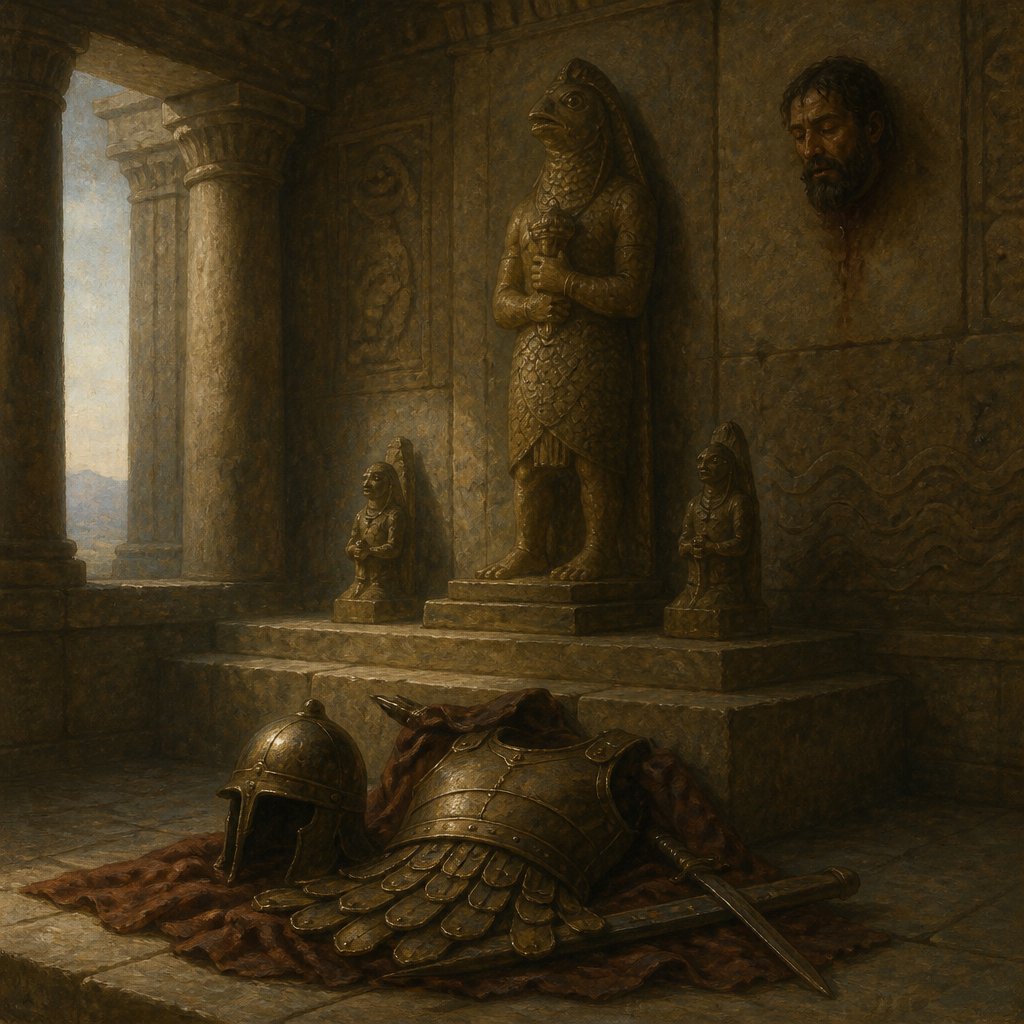
1 Chronicles 10:10 (KJV) states: "And they put his armour in the house of their gods, and fastened his head in the temple of Dagon."
This verse comes from the first book of Chronicles in the Old Testament, which is a historical account of the lineage of the Israelites and the reign of King David. The verse is part of a larger passage describing the death of King Saul, the first king of Israel.
The context of 1 Chronicles 10:10 is a pivotal moment in the history of Israel. King Saul, who was chosen by God to rule over the Israelites, has just been killed in battle against the Philistines. This tragic event marked the end of Saul's reign and the beginning of the reign of King David. The verse describes how the Philistines treated the body of Saul after his death, which was a dishonorable act according to Israelite customs.
The themes present in this verse include the consequences of disobedience and the sovereignty of God. Throughout the Bible, there are numerous examples of individuals experiencing the negative consequences of their disobedience to God's commands. In the case of King Saul, his disobedience to God's instructions ultimately led to his downfall and death in battle. This serves as a sobering reminder of the importance of obedience and the severe consequences of rebellion.
Additionally, the verse highlights the sovereignty of God, even in times of defeat and humiliation. Despite the dishonorable treatment of Saul's body by the Philistines, God's ultimate authority and control over the events of history are reaffirmed. This theme of God's sovereignty is a recurring motif throughout the Bible, emphasizing the power and control of God over all things, including the actions of individuals and nations.
Symbolism is also present in 1 Chronicles 10:10. The placement of Saul's armor in the house of the Philistine gods and his head in the temple of Dagon holds symbolic significance. The act of placing Saul's armor in the house of their gods could be seen as a defiant statement of victory and a display of power by the Philistines over the God of Israel. Likewise, the placement of Saul's head in the temple of Dagon, the Philistine god, serves as a symbol of the Philistines' triumph and the humiliation of Israel's king.
Overall, 1 Chronicles 10:10 is a verse that conveys profound themes of the consequences of disobedience, the sovereignty of God, and the symbolism of defeat and victory. It serves as a powerful reminder of the importance of obedience to God's commands and the implications of rebellion, as well as the assurance of God's ultimate authority and control over all things. In the broader context of the Old Testament, this verse contributes to the larger narrative of the Israelites' relationship with God and the unfolding of God's plan for His chosen people.
Get our apps


Artwork for 1 Chronicles 10:10

1 Chronicles 10:10 - "And they put his armour in the house of their gods, and fastened his head in the temple of Dagon."
"And they put his armour in the house of their gods, and fastened his head in the temple of Dagon." - 1 Chronicles 10:10

1 Chronicles 4 : 10

1 Chronicles 9:10 - "¶ And of the priests; Jedaiah, and Jehoiarib, and Jachin,"

1 Chronicles 12:10 - "Mishmannah the fourth, Jeremiah the fifth,"

1 Chronicles 24:10 - "The seventh to Hakkoz, the eighth to Abijah,"

1 Chronicles 1:10 - "And Cush begat Nimrod: he began to be mighty upon the earth."

1 Chronicles 15:10 - "Of the sons of Uzziel; Amminadab the chief, and his brethren an hundred and twelve."

1 Chronicles 8:10 - "And Jeuz, and Shachia, and Mirma. These were his sons, heads of the fathers."

1 Chronicles 2:10 - "And Ram begat Amminadab; and Amminadab begat Nahshon, prince of the children of Judah;"

1 Chronicles 25:10 - "The third to Zaccur, he, his sons, and his brethren, were twelve:"

1 Chronicles 10:11 - "¶ And when all Jabesh-gilead heard all that the Philistines had done to Saul,"

2 Chronicles 10:1 - "And Rehoboam went to Shechem: for to Shechem were all Israel come to make him king."

1 Chronicles 6:10 - "And Johanan begat Azariah, (he it is that executed the priest's office in the temple that Solomon built in Jerusalem:)"
"¶ And of the priests; Jedaiah, and Jehoiarib, and Jachin," - 1 Chronicles 9:10

1 Chronicles 23:10 - "And the sons of Shimei were, Jahath, Zina, and Jeush, and Beriah. These four were the sons of Shimei."

1 Chronicles 10:6 - "So Saul died, and his three sons, and all his house died together."

1 Chronicles 10:5 - "And when his armourbearer saw that Saul was dead, he fell likewise on the sword, and died."

1 Chronicles 16:10 - "Glory ye in his holy name: let the heart of them rejoice that seek the LORD."

1 Chronicles 10:3 - "And the battle went sore against Saul, and the archers hit him, and he was wounded of the archers."

"Mishmannah the fourth, Jeremiah the fifth," - 1 Chronicles 12:10

"The seventh to Hakkoz, the eighth to Abijah," - 1 Chronicles 24:10

1 Chronicles 3:10 - "¶ And Solomon's son was Rehoboam, Abia his son, Asa his son, Jehoshaphat his son,"

1 Chronicles 10:14 - "And enquired not of the LORD: therefore he slew him, and turned the kingdom unto David the son of Jesse."

1 Chronicles 28:10 - "Take heed now; for the LORD hath chosen thee to build an house for the sanctuary: be strong, and do it."

1 Chronicles 10:1 - "Now the Philistines fought against Israel; and the men of Israel fled from before the Philistines, and fell down slain in mount Gilboa."

1 Chronicles 7:10 - "The sons also of Jediael; Bilhan: and the sons of Bilhan; Jeush, and Benjamin, and Ehud, and Chenaanah, and Zethan, and Tharshish, and Ahishahar."

1 Chronicles 27:10 - "The seventh captain for the seventh month was Helez the Pelonite, of the children of Ephraim: and in his course were twenty and four thousand."

1 Chronicles 5:10 - "And in the days of Saul they made war with the Hagarites, who fell by their hand: and they dwelt in their tents throughout all the east land of Gilead."

1 Chronicles 10:8 - "¶ And it came to pass on the morrow, when the Philistines came to strip the slain, that they found Saul and his sons fallen in mount Gilboa."